
ISO 13485 manufacturing is the operational baseline, not a guarantee of FDA readiness. While the FDA’s QMSR (effective Feb 2, 2026) adopts ISO 13485:2016, our audits frequently reveal critical gaps in labeling and complaint records where US inspectors remain rigid.
A valid certificate is only the starting point; true compliance requires granular Device Master Records and validated process traceability. In sectors like medical apparel, adherence to Medical Clothing Standards further strengthens quality assurance, ensuring that manufacturing processes align with both ISO 13485 and product-specific regulatory expectations.
Key Takeaways
- Feb 2, 2026 QMSR Deadline: We treat ISO 13485 as the mandatory baseline. A certificate alone fails FDA audits without objective evidence of labeling controls.
- The Medical Device File (MDF): Maintain this as the single source of truth. It must contain every specification for the device type to satisfy US inspectors.
- Validate "Special Processes": You cannot destructively test every seam. We validate sewing parameters (Clause 7.5.2) to guarantee barrier protection on finished lots.
- Track Material to Lot: We require evidence linking the raw fabric coating batch to the specific sewing line and sterilization record.
- Risk-Based Sampling: We reject arbitrary sample sizes. Use risk analysis to determine if 5 or 50 units require testing to ensure seam integrity.
If you’re evaluating a partner, use the inspection-ready checklist below.

The Operational Mechanics of ISO 13485 and FDA QMSR
In our experience auditing textile factories for medical compliance, we often encounter a dangerous disconnect. Management believes a certificate on the wall equals compliance. In reality, a certificate is just paper. A Quality Management System (QMS) is the operational engine that prevents a non-sterile surgical gown from reaching a surgeon.
We analyze the specific mechanics of ISO 13485:2016 below. We also explain how the FDA’s new Quality Management System Regulation (QMSR) alters the landscape effective February 2026.
1. Defining “ISO 13485 Manufacturing” in Operations

When we step onto a factory floor to assess medical textile capabilities, we do not look for perfection. We look for control. ISO 13485 is not a standard of product luxury; it is a standard of process consistency.
In plain operational terms, we translate the standard into these factory realities:
- Controlled Documents: Operators on the sewing line must use the current version of the stitch diagram (Work Instruction). We check to ensure the old version (Rev A) was physically removed and destroyed when Rev B was issued. If an operator uses an old cheat sheet, the system has failed.
- Controlled Materials: We must prove the blue SMS (Spunbond-Meltblown-Spunbond) fabric roll used today matches the exact specifications of the roll validated six months ago. We do not accept "similar" substitutes.
- Validated Processes: We know the seam sealing machine works because we tested the parameters (heat, speed, pressure) during setup, not just the final jacket. We trust the physics of the machine settings.
- Controlled Nonconformance: If a needle breaks, production stops. The affected garments are quarantined. We document exactly what happened before restarting.
- Controlled Release: The product does not leave the loading dock until a Quality Manager signs the release. This signature confirms all testing data is complete.
🧠 Auditor's Note: In general apparel, a "fix" is often informal. A supervisor might shout, "Adjust the tension!" In ISO 13485 manufacturing, that adjustment is a change to a critical process parameter. It must be documented, or the entire batch is technically invalid.
2. The 2026 Regulatory Landscape (FDA QMSR)

The FDA has finalized its transition from the old Quality System Regulation (QSR) to the new Quality Management System Regulation (QMSR). This rule becomes effective February 2, 2026.
This shift "incorporates ISO 13485:2016 by reference." This means the FDA now accepts the international standard as the foundational backbone of compliance. However, for manufacturers and buyers, this is not a free pass.
The Supervisor Note: The FDA "Plus" Factors The FDA retains specific requirements that go beyond ISO 13485. In our gap analyses for 2026 readiness, we focus on these FDA-specific additions:
- Labeling and Packaging Controls: The FDA is stricter here than ISO. We verify that labeling operations prevent mix-ups (e.g., putting a Size L label on a Size M gown).
- Records and Device Tracking: US-specific Unique Device Identification (UDI) rules still apply. We ensure the factory system can generate UDI-compliant barcodes.
- Signature Requirements: Electronic signatures must meet 21 CFR Part 11 standards. A simple "Click to Approve" is often insufficient without password re-authentication.
The Buyer’s Interpretation. FDA inspectors will change how they inspect, but not what they expect. They will look for objective evidence. If you import medical textiles into the US, you cannot simply show an ISO certificate. You must show that your factory understands the specific FDA additions regarding complaint files and servicing records.
3. ISO 13485:2016 Certification: What It Proves
A common pitfall we see in procurement is trusting a certificate without understanding its lifecycle. Accreditation bodies issue certificates on a 3-year cycle.
- Year 1 (Certification Audit): A deep dive into every clause. This is the most rigorous check.
- Year 2 & 3 (Surveillance Audits): Lighter checks. These often miss creeping issues in documentation or new equipment that was not validated.
- Recertification: The cycle resets.
Scope is Critical. We have rejected suppliers who presented a valid ISO 13485 certificate for "Plastic Injection Molding" when we were sourcing "Sterile Surgical Gowns." The certificate was real, but the scope did not cover textile conversion, sewing, or sterilization management. The factory had no proven competence in the specific risks of soft goods.
Evidence to Request Do not just ask for the PDF. Request this validation package:
- Current Certificate: Check the expiry date and the specific "Scope Statement."
- Most Recent Audit Summary: Ask to see the Non-Conformances (NCs). A factory with zero NCs is suspicious; no system is perfect. A factory with closed NCs shows a healthy, reactive system.
- Org Chart: We look for proof that the Quality Manager reports to top management, not the Production Manager. Quality must have the power to stop the line.
4. Medical Device QMS Requirements Buyers Should Audit

When we audit a sewing floor for medical compliance, we ignore the sales pitch. We look for these specific control points that impact product safety.
Document and Record Control
We walk to a random sewing station. We check the Work Instruction taped to the machine.
- The Test: Is the operator using "Rev A" instructions while the central system lists "Rev B"?
- The Risk: If documents are uncontrolled, the product is uncontrolled. The operator might be using an old seam allowance that compromises barrier protection.
Supplier Controls
For medical textiles, the supply chain is the primary risk vector.
- Fabric Mills: Has the factory physically audited their fabric source? Or did they just buy from a distributor?
- Dye Lots: Are there controls to ensure dye chemicals do not alter the fabric's biocompatibility?
- Accessories: We verify certificates for elastic and thread to ensure they are latex-free if the label claims "Latex Free."
Incoming Inspection
We examine the warehouse receiving area. Medical fabric should not just be counted.
- The Test: Our Medical Uniform Manufacturer look for test reports for incoming rolls. Are they testing weight (GSM), tensile strength, and hydrostatic pressure before the fabric enters the cutting room?
- The Risk: Cutting defective fabric wastes money and risks producing non-compliant PPE.
Equipment Calibration
In a medical garment, a seam is a barrier. We check the seam sealing tape machines.
- The Test: Are the temperature and pressure gauges calibrated? Is there a sticker showing the next calibration date?
- The Risk: If a gauge reads 180°C but the actual temp is 170°C, the tape may look adhered but will fail under fluid pressure.
5. The Medical Device File (MDF): Your 2026 Survival Kit
Under the new QMSR, the Medical Device File (MDF) becomes your primary evidence during an inspection. This replaces the old "Device Master Record" (DMR) terminology but serves the same purpose. It is the DNA of your device.
We advise buyers to maintain a mirror of this file. It must contain the following documents:
| Document Type | Owner (Who creates it) | FDA Expectation |
|---|---|---|
| Product Description | Buyer / OEM | Defines Intended Use clearly (e.g., "Surgical Gown, AAMI Level 3"). |
| Product Specifications | Buyer / Factory | Detailed drawings, dimensions, tolerances, and material callouts. |
| Mfg Procedures | Factory | Step-by-step Work Instructions (cutting, sewing, sealing, folding). |
| QA Procedures | Factory | Acceptance criteria (e.g., AQL 2.5 for visual defects). |
| Packaging Specs | Buyer / Factory | Sterile barrier system specs (Tyvek grade, pouch size, seal width). |
| Labeling | Buyer | Must comply with 21 CFR Part 801 (US) including symbols and warnings. |
| Traceability Records | Factory | Link finished lots to raw material batches (Device History Record). |
6. Clause 7.5.2: Validation of Processes (The Textile Case Study)
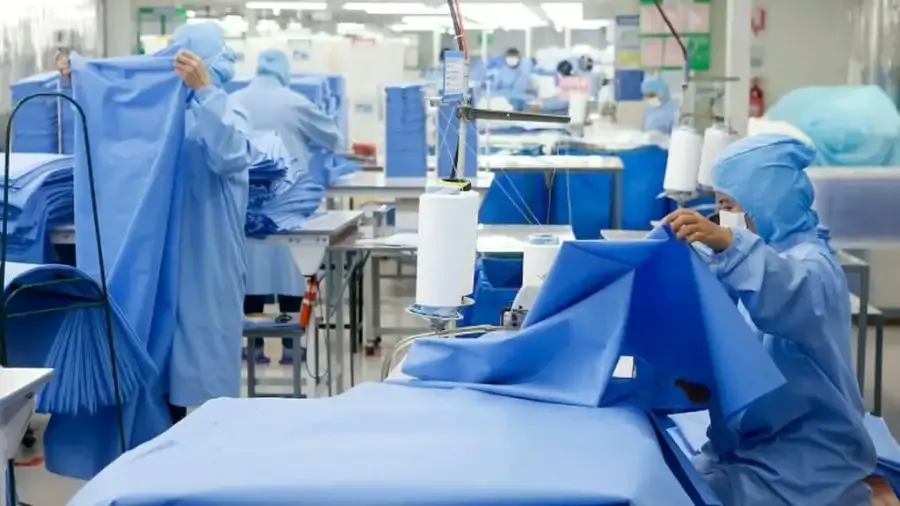
This is the most critical technical concept in medical manufacturing. ISO 13485 Clause 7.5.2 states: If you cannot verify the output without destroying the product, you must validate the process.
The Problem: We produce fluid-resistant surgical gowns. To prove the seams are waterproof (AAMI PB70 Level 3), we must subject them to hydrostatic pressure testing. This test pushes water against the seam until it bursts. The test destroys the gown. We cannot test 100% of the production run, or we would have nothing left to sell.
The Solution: Process Validation Instead of testing every gown, we validate the seam sealing process. We prove that specific machine settings guarantee a waterproof seam.
Step 1: Installation Qualification (IQ) We prove the seam sealing machine is installed correctly. We check the air supply stability, voltage consistency, and pneumatic pressure. We ensure the machine is calibrated.
Step 2: Operational Qualification (OQ) We run tests to find the Process Window. We intentionally fail the product to find the limits.
- Test A (Too Cold): We run at 160°C. Result: Tape peels off. Fail.
- Test B (Too Hot): We run at 200°C. Result: Fabric burns/melts. Fail.
- Test C (Optimal): We run at 180°C ± 5°C with a speed of 3m/min and pressure of 2 bar. Result: Pass.
- Result: We define the Operational Window as 175°C–185°C.
Step 3: Performance Qualification (PQ) We run three full production lots at the optimal settings (180°C). We destructively test samples using strict AQL (Acceptable Quality Limit) sampling. If all samples pass, the process is deemed Validated.
Ongoing Control: During daily production, operators monitor the machine settings. If the machine stays within the validated window (175°C–185°C), we consider the seams good without destroying them. This is the only way to manufacture medical textiles at scale safely.
🔬 The Science: Validation relies on Parameter Correlation. We correlate machine inputs (Heat/Pressure) to clinical outputs (Fluid Resistance). If the input is stable, the output is guaranteed.
Sources:
7. Medical Textile Traceability
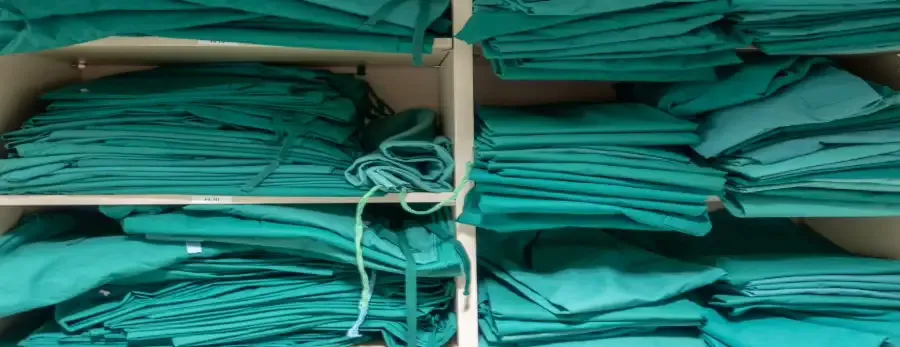
Traceability in medical textiles closes the gap between a minor internal issue and a total public recall.
- Competitor Approach: "We bought polyester from the market."
- Compliant Approach: "We used Polyester Roll #554 from Mill A, Lot #992."
The Traceability Chain:
- Receiving: Fabric Lot #A123 arrives from the mill. The factory assigns an Internal Batch #RAW-001.
- Cutting: Batch #RAW-001 is cut into 500 panels. These become WIP Lot #SEW-500.
- Sewing: WIP Lot #SEW-500 is sewn on Line 4 (validated line).
- Finished Goods: The batch is packed and labeled as Finished Lot #FG-2024-09.
The Recall Scenario: If a hospital reports a skin reaction to the gown, we check the lot number. We trace it back to Fabric Lot #A123. We investigate and find the mill used the wrong dye. We recall only the units made from that specific fabric roll (Lot #FG-2024-09), rather than recalling a year's worth of product. This precision saves millions of dollars and protects the brand reputation.
8. Sterile Standards: ISO 13485 vs. Performance

ISO 13485 manages the system, but performance standards manage the risk. It is vital to understand the difference.
- ISO 13485: Proves you documented the sterilization process and managed the logistics.
- AAMI PB70 / EN 13795: Proves the gown actually stops blood and viruses.
For sterile goods, we treat the Sterile Barrier System (the pouch) as a component. It must be validated. If the pouch seal fails during shipping due to poor vibration testing, the gown is non-sterile, regardless of how clean the factory is. We verify that the factory has performed transit testing (ASTM D4169) to prove the packaging survives the journey.
9. ISO 13485 vs. ISO 9001 (The Procurement Trap)
Many fashion factories hold ISO 9001. This is insufficient for medical devices.
- ISO 9001: Focuses on "Customer Satisfaction" and continuous improvement.
- ISO 13485: Focuses on Safety, Efficacy, and maintaining the effectiveness of the system.
The Risk: An ISO 9001 factory might substitute a "better" zipper to please a customer because it looks nicer. An ISO 13485 factory knows that changing a component without validation is a violation of the Medical Device File. Do not fall into the trap of using general apparel manufacturers for regulated medical devices. The mindset is fundamentally different.
10. Commercial Review: Evaluating a Partner

At LeelineWork, we position ourselves as a technical manufacturing partner, not just a sewing house. We use the following scorecard to evaluate our own readiness and that of our supply chain. We recommend buyers use this to assess any potential vendor.
Partner Scorecard:
- Documentation Maturity: Can they produce a Device History Record (DHR) for a previous lot in under 24 hours?
- Validation Capability: Do they have IQ/OQ/PQ records for critical equipment (sealers, sterilizers)?
- Traceability Depth: Can they trace a finished garment back to the thread spool and fabric roll?
- Change Control: Do they ask for written permission before changing raw materials or sub-suppliers?
- Audit Transparency: Do they allow you to speak directly to the Quality Manager without a salesperson present?
Learn More:
- Medical Uniform Manufacturers Hub
- Medical Clothing Standards & QC
If you require a comprehensive documentation pack or a factory capability review for your next medical textile project, contact our engineering team here. We speak the language of compliance.
Real-World Scenarios: When Standard Advice Fails
General rules work for general buyers. But in the medical textile trade, you are likely dealing with specific constraints, strict auditors, or tight budgets. Below, we break down how ISO 13485 mandates change based on who you are and what you buy.
Scenario A — You’re a Hospital Supply Chain Director Buying Sterile Gowns

The Trap: Relying on the "Master Certificate." In my experience with hospital procurement, a PDF certificate satisfies the legal team but fails the floor audit. I once watched a supply director scramble for sterilization load records during a surprise Joint Commission visit. The supplier took 48 hours to reply because they had to email the factory in China. That delay caused a finding of non-conformance.
The Reality Check: A certificate proves the factory can do it. It does not prove they did it for your specific batch.
The Adjustment: Do not wait for an audit to ask for data. Make "Lot-Specific Documentation" (the Shadow File) a condition of payment.
- Demand Distribution Records: Ensure the factory tracks exactly which lot went to your specific distribution center.
- Link Seam Performance: Request a Certificate of Analysis (COA) that ties hydrostatic pressure tests (AATCC 127) to the specific production week.
- Verify the Load: Require the sterilization cycle number on the packing list. If the box says "Lot A123," the sterilization report must match "Load A123."
Scenario B — You’re a Medical Device Brand Owner Importing from China

The Trap: Assuming the factory is the "Manufacturer." Under the FDA’s Quality Management System Regulation (QMSR), the entity initiating specifications and labeling is often the "Legal Manufacturer." We frequently see US brands treat the factory as the responsible party. This is dangerous. If a patient claims a gown caused an infection, the FDA knocks on your door, not the factory’s door in Hubei.
⚠️ Warning: The "Compliance Landed Cost" Risk Sea freight is cheap, but ocean transport is brutal. Keeping a sterile barrier intact during 30 days of high-humidity ocean transit requires validated shipper cartons.
Our experience: We have seen brands save $0.50 per carton on cardboard, only to have the entire container rejected at the port because humidity crushed the boxes, compromising the sterile barrier.
The Adjustment:
- Define Roles: Clarify in your Quality Agreement who holds the FDA Establishment Registration.
- Lock the supply chain: Your contract must forbid substitutions. We have seen factories swap thread suppliers to save $0.01 per garment, causing seam failures in the US market.
- Buffer Your Lead Time: Add 14 days for third-party pre-shipment inspections. Do not ship until the lab report clears.
Scenario C — You’re a QA Manager Qualifying Non-Sterile Scrubs

The Trap: Over-validating the wrong things. You do not need a 50-page validation protocol for a standard nurse uniform. However, you must validate specific fabric claims. We once audited a factory making "antimicrobial" scrubs. They had excellent sewing quality, but zero test reports proving the chemical coating survived industrial laundering.
The Reality Check: If you claim "Fluid Resistant," that is a medical claim. Even for a simple lab coat, you must trace the fabric batch to verify it meets standards like AATCC 42 (Water Resistance).
The Adjustment:
- Simplify: Skip the sterile barrier validation (ISO 11607).
- Verify CTQs: Focus your audit on the "Critical to Quality" factors. Verify the chemical batch for the fabric.
- Control Documents: Ensure the "Document Control" system prevents operators from using old patterns. A 2cm sizing error is a returnable defect in this industry.
Scenario D — Sterile vs. Non-Sterile Validation
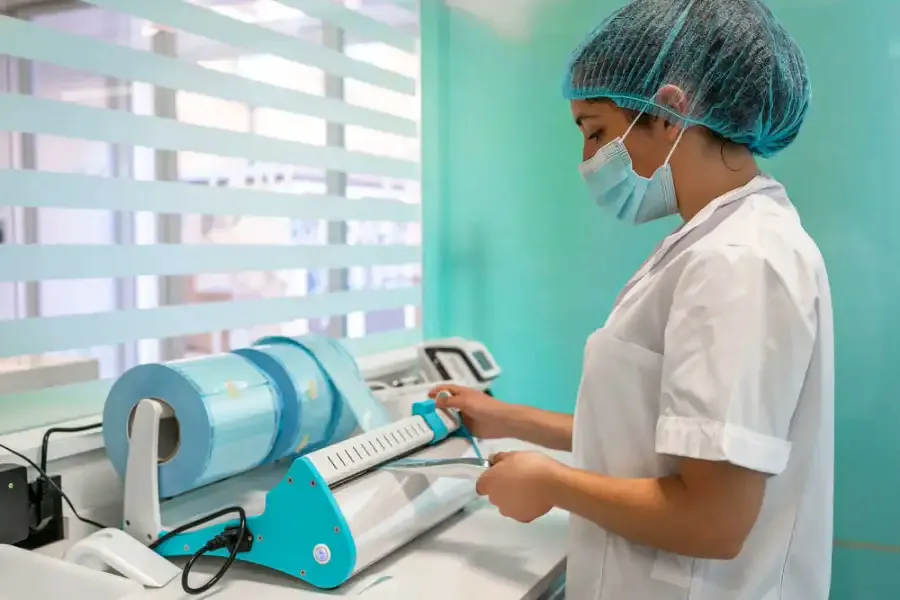
The Trap: Treating the packaging as "just a box." For sterile goods, the pouch is as important as the gown. I have seen perfect surgical gowns fail because the pouch seal peeled open during transit testing. For non-sterile goods, the risk is lower, but moisture is still the enemy.
The Adjustment:
- Sterile Products: You must validate the sealing process (Heat/Dwell Time) and the shipping carton (via ASTM D4169 distribution testing).
- Non-Sterile Products: Rely on incoming material verification. If the fabric passes inspection and the in-process checks are good, the output is likely safe.
Scenario E — ISO 13485 Certified Supplier, but Non-Medical Product
The Trap: Thinking certifications don't matter for "basic" uniforms. You may not need a Medical Device File for a chef coat. But buying from an ISO 13485 factory guarantees consistency. In our testing, we found that general apparel factories vary sizing by up to 2cm between batches. Medical factories hold tolerance to 0.5cm because they follow strict process controls.
The Adjustment: Use this leverage. Tell the factory: "I don't need a CE mark, but I expect the same 'Change Control' discipline you give your medical clients." This ensures they don't swap fabrics without asking you first—a common headache in general textile sourcing.
Scenario F — Low MOQ Development vs. High-Volume Production
The Trap: The "Golden Sample" Illusion. A "Golden Sample" is often sewn by a master technician on a dedicated machine. This does not prove the factory can replicate it 10,000 times on a line with 20 different operators. We often see perfect samples followed by a flawed first batch because the production line used different tension settings.
🛡️ Our Verdict: Pilot runs are mandatory. For orders under 500 units, we treat the first 50 units as a "Pilot Run." We inspect these 50 units against the Golden Sample before authorizing the remaining 450.
The Adjustment:
- Prototype Stage: Ask for material data sheets. Prove the raw material works.
- Scale-Up: Ask for "Process Capability" data. Prove the line can hold the spec at speed.
People Also Ask About ISO 13485 Manufacturing
1. Is ISO 13485 certification mandatory in the U.S. now that QMSR is effective (Feb 2, 2026)?
Technically voluntary, but practically essential. While the FDA does not explicitly demand the certificate, the QMSR harmonizes US requirements with ISO 13485:2016. In our experience, if a factory lacks this certification, their Quality Management System rarely meets the structural baseline required to pass a modern FDA inspection.2. What documents must be in a Medical Device File for medical garments?
A mirror of the Device Master Record (DMR). You must maintain a strict index containing current Product Specifications, Manufacturing Work Instructions (sewing/sealing), Labeling proofs (per 21 CFR 801), Packaging specifications (sterile barrier), and a traceability log linking every raw material batch to the finished production lot.3. What is “validated manufacturing” for sewing or seam sealing?
Proof that the process works without destroying the product. Since we cannot destructively pressure-test every surgical gown, we validate the machine parameters (Installation/Operational Qualification). If the sealer runs within the validated temperature and pressure window, we statistically guarantee the seam integrity of the entire batch.4. ISO 13485 vs ISO 9001: which one should I require from a garment manufacturer?
ISO 13485 is non-negotiable for clinical products. ISO 9001 focuses on general customer satisfaction. ISO 13485 focuses specifically on product safety and risk management. We often see ISO 9001 factories swap fabric suppliers to save money without notifying the buyer—a violation that renders medical devices non-compliant.5. How does risk-based manufacturing change my audit checklist?
It shifts focus to "Critical to Quality" (CTQ) zones. Rather than inspecting every cosmetic stitch, we spend 80% of our audit time verifying barrier seams, sterilization seals, and labeling accuracy. We prioritize the processes that, if failed, could cause patient harm or infection (Class II risks).6. What level of traceability should I require for scrubs vs surgical gowns?
Traceability scales with risk. For non-sterile scrubs, we require tracking the fabric dye lot to the finished garment to manage chemical safety. For sterile surgical gowns, traceability must extend deeper—linking the specific sterilization cycle load number to the individual shipping carton for precise recall management.7. What’s the fastest way to screen a potential ISO 13485 manufacturer?
Request three specific documents immediately. Ask for their current Scope Certificate (ensure it covers "textiles"), a blinded index of a Medical Device File they maintain for another client, and a redacted summary of their last Corrective and Preventive Action (CAPA). If they cannot produce a CAPA log, they are not truly managing quality.8. What should a quality agreement include for an overseas manufacturer?
Strict Change Control and Notification terms. The agreement must explicitly forbid the factory from changing raw material sub-suppliers without your written approval. It must also define who acts as the "Legal Manufacturer" for FDA registration and mandate notification of any regulatory inspections within 24 hours.Need to audit your medical textile supply chain? Don't rely on a PDF certificate alone. At LeelineWork, we bridge the gap between regulatory theory and factory floor reality.
- Request a Factory Capability Review: Let us validate your supplier’s Medical Device File.
- Contact Our Team: Get a consultation on QMSR readiness.
Read Next:
- Best 10 Medical Uniform Manufacturers In Qatar
- 10 Top Medical Uniform Brands Reviewed
- Guide to Custom Surgical Gown Manufacturing

Senior Apparel Production & Compliance Specialist