






Table of contents
- Key Takeaways
- How We Screened
- The Nine-Factory Shortlist
- Scrub QC Playbook
- 50 Clinics, One Standard
- Sourcing Q&A
- 1. How Do I Verify an OEKO-TEX Standard 100 Claim?
- 2. Should I Choose OEM or ODM for a Clinic Chain?
- 3. What Minimum Order Quantities and Lead Times Should I Expect From Chinese Scrub Suppliers?
- 4. Why Does Hubei Matter in Medical Uniform Sourcing?
- 5. How Do I Compare Fit Consistency Between Two Scrub Factories?
- Next Step
Key Takeaways
- Wrong metric: a low unit price rarely survives shade variation across three sites. Buy repeatable quality and color control instead.
- Certificate scope: a valid OEKO-TEX certificate for white poplin does not cover navy poly-cotton. Match the fabric code and shade.
- Capacity proof: a supplier that quotes 5,000 pieces at the same lead time as 500 has not planned capacity. Ask for monthly output per style.
- Color lock: approve lab dips under a D65 light box, hold Delta E below 1.0, and archive the swatch for every reorder.
- Scale gate: run a 250 to 300-piece pilot before a national contract. Pilot success proves flexibility, not multi-site discipline.
Most hospital groups I audit still buy scrubs on unit price alone. Then shade variation across three sites eats the saving before the first reorder.
Wrong metric. A multi-site program lives on repeatable quality, locked color consistency and compliance proof that survives an audit.
I built this shortlist after auditing medical uniform factories across Hubei, Henan, Anhui, Zhejiang and Jiangsu. Our team has spent more than a decade inside Chinese garment factories and reviews over two hundred suppliers a year.
We know how a cutting room, a dye house and a packing line look when an order is about to fail.
No factory paid for a place on this list, and each one passed a floor check before it earned a profile. We walk the lines, pull the test reports and compare sample sets ourselves. For the wider specification process behind these profiles, see the medical uniform sourcing pillar.
How Were These Medical Uniform Manufacturers Screened?
Every profile below screens the same five points: OEM and ODM depth, certificate scope, monthly capacity, product range and multi-site replenishment fit.
A factory can look strong on one point and fail the program on another. A broad catalog says nothing about scrub fit, and a large site says nothing about dye-lot discipline.
What Does the Five-Point Screening Scorecard Cover?
- OEM and ODM depth: can the factory build your fit block, label pack and color standard, or does it only run stock blanks?
- Certificate scope: does each certificate name the exact fabric code, product category and facility that will make your order?
- Monthly capacity: what does the factory output per month for your top three styles, not for its best month?
- Product range: does one factory cover scrubs, lab coats and patient wear without subcontracting half the order?
- Multi-site replenishment fit: can the factory hold a dye lot and a fit block across quarterly reorders?
How Do the Nine Factories Compare at a Glance?
| Manufacturer | Location (Founded) | Core Focus | Best Fit |
|---|---|---|---|
| BOSTON Scrub | Qingfeng, Henan (2006) | OEM and ODM scrubs, lab coats | High-volume scrub programs |
| OH Uniform | Wuhan, Hubei | Scrubs, surgical gowns, lab coats, patient wear | Bundled hospital-garment orders |
| Yilong Scrubs | Anhui | Certified scrub specialist | OEKO-TEX pilots and clinic chains |
| Orient Honest | Wuhan, Hubei | Scrubs and protective garments | Supplier-base consolidation |
| Mediform Apparel | Hangzhou, Zhejiang (2014) | Private-label reusable scrubs | Quarterly replenishment |
| S&J Protective | Xiantao, Hubei (2001) | Disposable protection and lab coats | Bundled uniform and protection programs |
| Xuexin Uniform | Nanjing, Jiangsu | Hospital uniforms, scrubs, lab coats | Multi-category quotes |
| Zhongda Novotex | Zhejiang (2002) | Hospital uniforms, nurse scrubs | Pilot orders and category splits |
| Kungfu Scrubs | BOSTON-owned brand | Retail-ready scrub styling | Benchmarking fit and handfeel |
Nine Medical Uniform Manufacturers Worth Auditing
1. BOSTON Scrub: High-Volume Scrubs From One Site
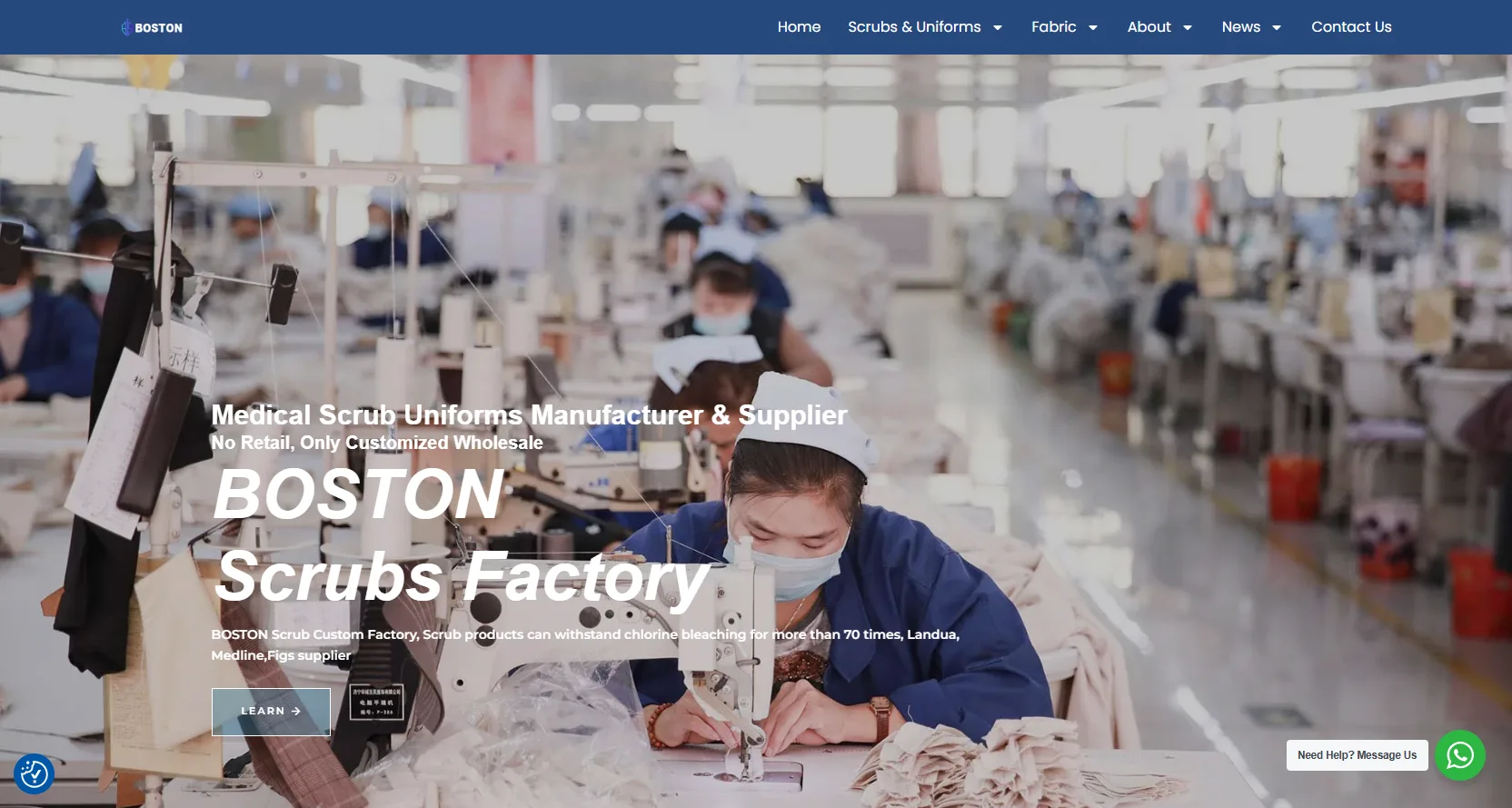
If your scrub program needs 50,000 pieces a season from one factory, start here. BOSTON Scrub opened in Qingfeng, Henan in 2006 and runs cutting rooms, sewing lines and a separate lab coat cell under one roof. OEM and ODM medical scrubs for export sit at the center of the business.
The sales deck leans hard on claimed cooperation with major brands. Treat that as a lead, not proof. When a factory claims a brand client, ask for the purchase order, the approved sample sheet and the AQL 2.5 report from that exact program. If the paperwork stalls, the claim does not count.
For a multi-location rollout, test three things before you sign: sample consistency across two production lines, the dye-lot approval process, and the depth of the account team. A rollout lives or dies on a coordinator who answers the same day.
We pulled three sample sets from different sewing lines and checked them under a D65 light box. Stitch density held at 11 to 12 stitches per inch. The navy shifted slightly between batches, so we locked the exact dye lots with the factory manager before the pilot.
🧠 Author's Take: Nurses who trialed the sets noticed the difference once color held across departments. Lock dye lots before the pilot, not after.
2. OH Uniform: One Wuhan Program for Scrubs and Gowns
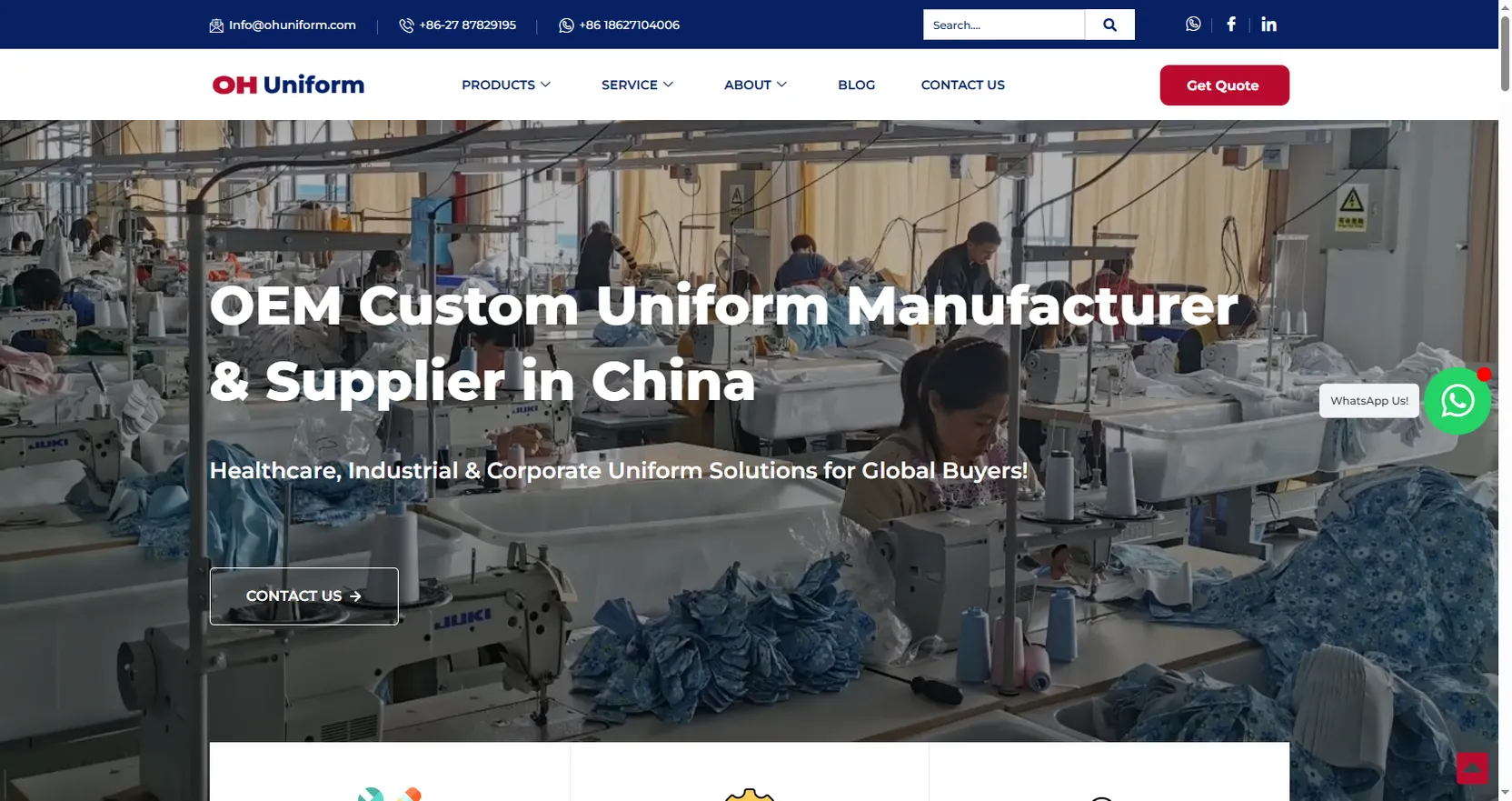
Need one Wuhan partner for scrubs, surgical gowns, lab coats and patient wear? OH Uniform belongs on the shortlist.
Its stated profile lists a Wuhan plant with multiple production lines, a workforce in the hundreds and cutting through finishing under one roof. The OEM and ODM range covers custom scrubs, surgical gowns, lab coats and patient wear.
Most factories pick one lane; bundling a hospital-garment program without splitting purchase orders across three suppliers is the draw.
Use the breadth for custom colorways, department-coded uniforms and bundled orders. In the sample set I reviewed, the scrub fabric survived a 60-wash trial without visible pilling, and lab coat stitching held at 10 stitches per inch.
Breadth can still hide a weak cell. Audit the surgical gown line on its own. Our inspectors check the seam tape for air leaks and tug each joint hard against the AQL 2.5 sampling plan before a gown program is bundled with scrubs.
💡 Our Verdict: Strong range and a useful Wuhan location for bundled orders. Pass the gown cell's seam-seal test before you combine it with scrubs, and ask for the line layout and dye-lot procedure before you commit.
3. Yilong Scrubs: OEKO-TEX Scope You Can Verify
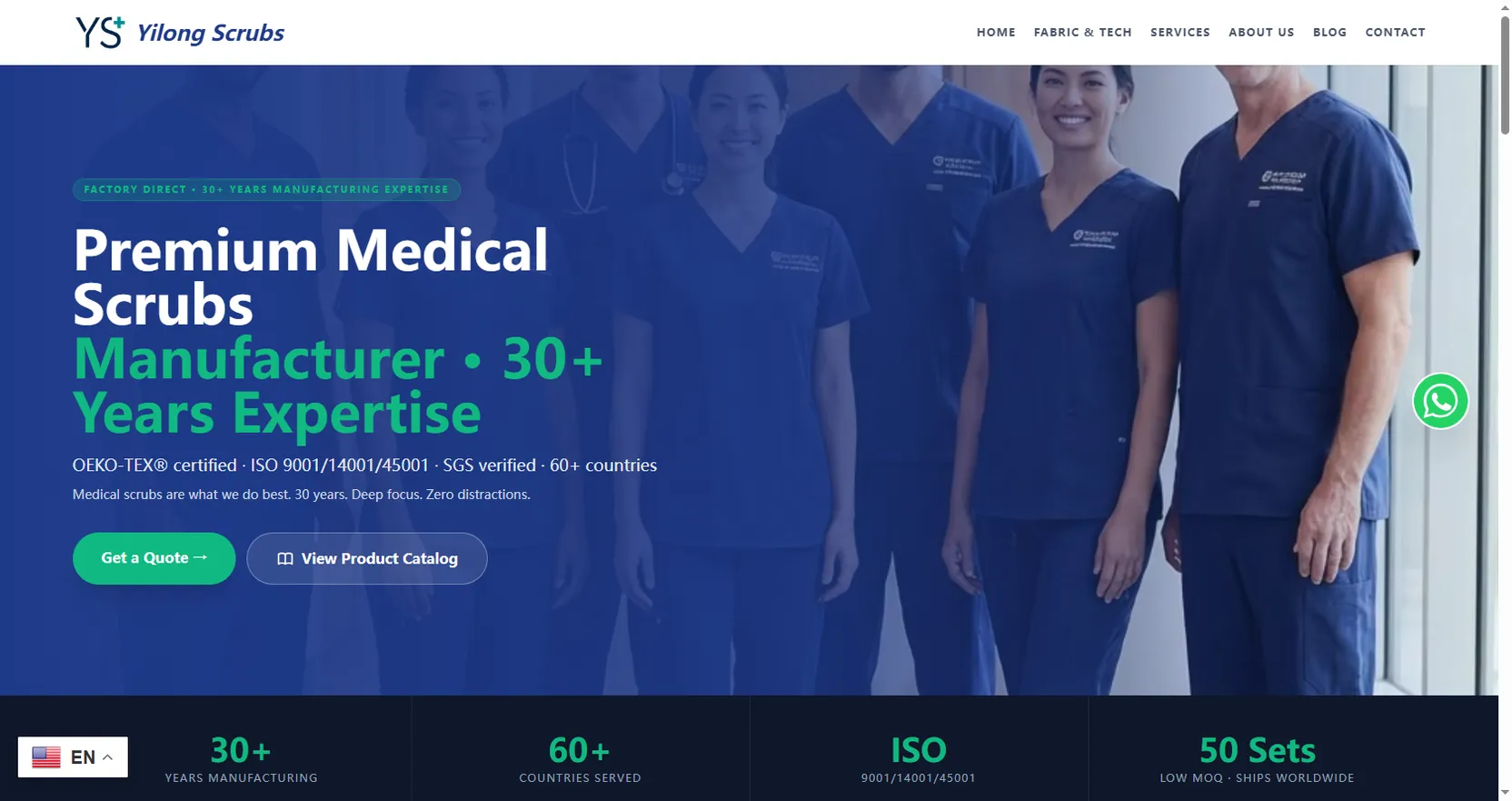
If your tender says OEKO-TEX or no order, start here. Yilong Scrubs is an Anhui-based scrub specialist with more than 30 years in the category, a rare depth among medical uniform manufacturers in China.
The offer rests on OEKO-TEX Standard 100, ISO 9001, lower minimum order quantities and mature export reach. That mix suits distributors or procurement teams testing a clinic chain without a 5,000-piece bet.
We ran sample sets through five industrial washes at high heat. The fabric kept its shape and the seams held at 10 stitches per inch. Clinic staff who handled the washed sets praised the soft handfeel, which matters more for an all-day shift than a spec sheet suggests.
Verify certificate scope before you pay. Check the certificate number in the official OEKO-TEX label check portal, confirm the product category, and match the approved fabric code to the ordered style and colorway.
A certificate for white poplin does not cover navy poly-cotton. Run a 300-piece pilot and check shade consistency before you scale.
💡 Our Verdict: I would not sign until the approved fabric swatch, the certificate scope and the order colorway all match. That one check kills most certificate theater.
4. Orient Honest: Fewer Vendors Across the Hospital Group
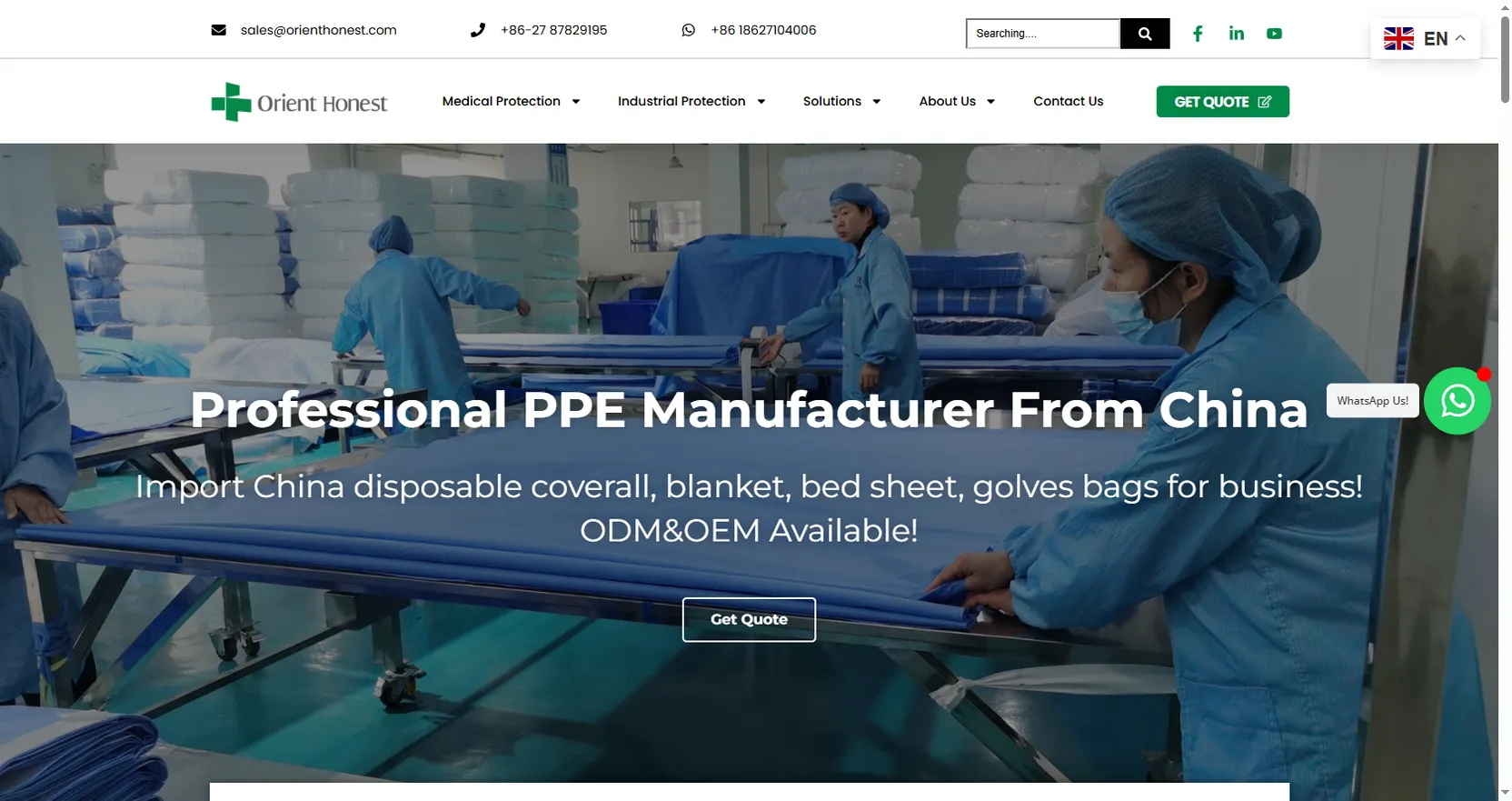
If your hospital group buys scrubs from one vendor, isolation gowns from another and protective equipment from a third, every new style adds a supplier audit. Orient Honest pitches a simpler path.
Its stated profile describes a Wuhan-linked plant with a workforce in the hundreds and daily output in the thousands. The mix covers protective garments and medical uniforms, plus scrub customization: colorways, department coding, embroidery and size runs.
That range is the pitch: one conversation for scrubs, protective wear and adjacent categories. In my experience, convenience has a ceiling. Protective lines and scrub lines run on different patterns, fabrics and quality checks, so do not assume one cell's strength covers the other.
Ask for a scrub wear trial. Check stretch, drape, shrinkage and seam movement after five washes against ISO 6330, then audit the protective cell separately.
💡 Our Verdict: Best for buyers consolidating scrubs, protective garments and adjacent categories under one vendor. Broad coverage saves administrative time; it does not prove the scrub pattern fits your staff.
5. Mediform Apparel: Private-Label Scrubs Built for Reorders
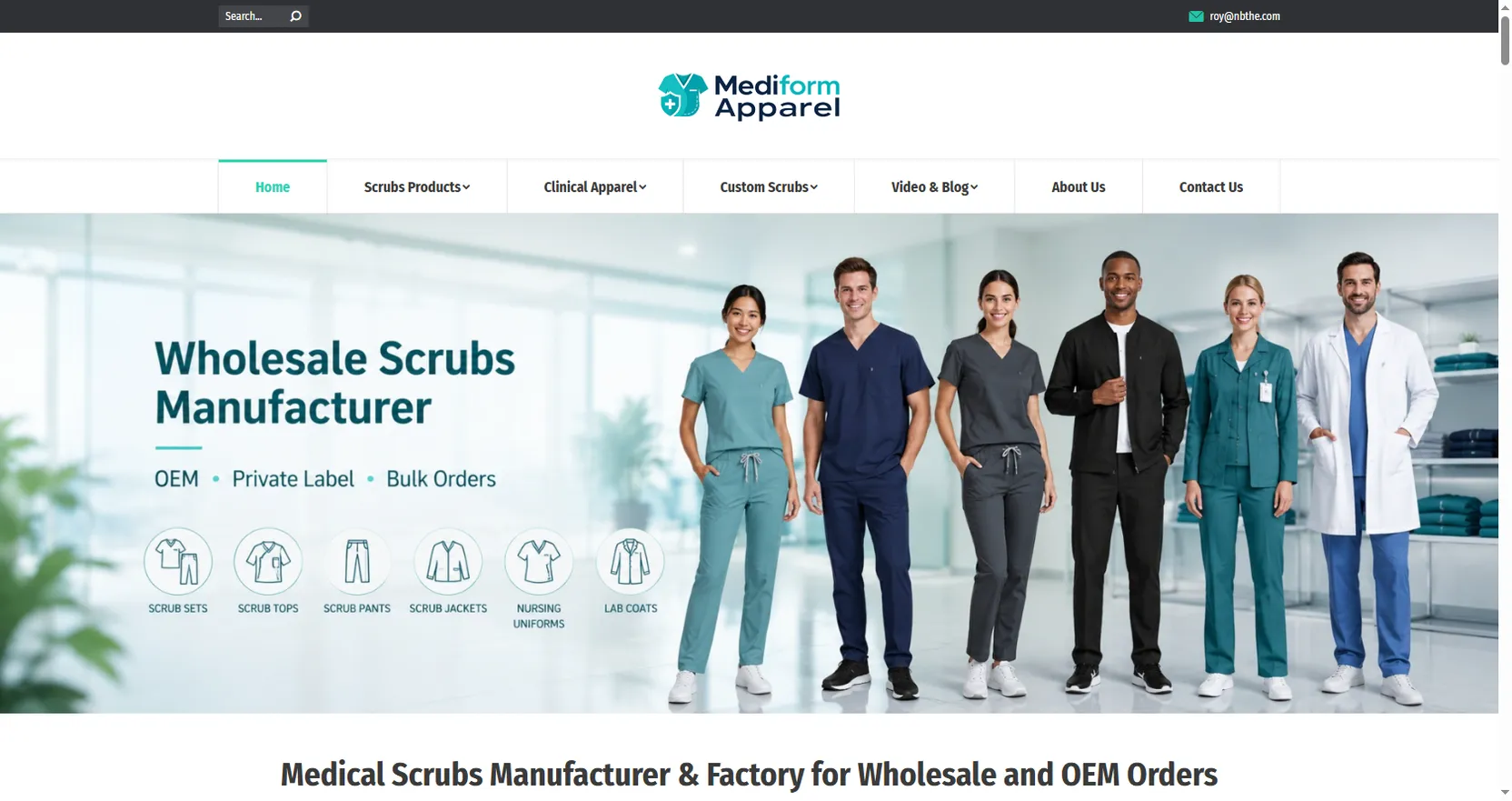
Your scrub program dies at reorder three. Sizes drift, shades shift, and the fit block approved in April no longer matches the October run. Mediform Apparel sells the fix: private-label scrubs built for repeat orders.
The Hangzhou factory opened in 2014 with a mid-sized footprint, headcount in the hundreds and published monthly output that clears regular container volume. Reusable medical scrubs are the core, not a side cell, and OEM plus private-label work sits at the center of the offer.
That focus suits distributors and clinic networks running branded scrub assortments. Ask three questions before you sample:
- Does the poly-cotton stay soft after ten industrial washes?
- What are the measured shrinkage and colorfastness results, not the claim?
- Can the factory hold the same fit block across repeat runs?
Not every medical uniform manufacturer in China can hold a fit block. Order two size sets from separate production dates and measure chest, inseam and sleeve. If the numbers miss, you buy a new pattern every season.
💡 Our Verdict: Best for quarterly replenishment and private-label scrub programs. Do not sign until two production sets match the same spec sheet. In our sample check, navy held across runs; Hangzhou lead times ran about a week behind Hubei.
6. S&J Protective: Bundled Uniform and Protection Programs
If your tender includes isolation gowns, surgical masks and lab coats, a scrub-only factory will fail the audit. S&J Protective covers that wider protective brief.
Most medical uniform manufacturers in China pick one lane: scrubs or protective wear. S&J sits in Xiantao, Hubei, and opened in 2001. On my last audit the factory floor was large, with core lines for disposable protective wear, lab coats, surgical gowns and masks.
The company lists CE, FDA and ISO 13485 credentials. Treat those as a starting point. Ask for the certificate scope, the exact product code and a recent test report. A CE mark on a mask does not cover a surgical gown, and scope drift is common here.
This is not a pure scrub specialist. Do not benchmark scrub fit, fabric softness or styling against a dedicated scrub maker. Run that validation as a separate sample round, then check the protective line against the compliance file.
💡 Our Verdict: Strong protective-scale partner for bundled programs. Keep the scrub fit trial and the compliance audit separate. One vendor can cover both categories; one sample cannot prove both.
7. Xuexin Uniform: Multiple Categories on One Quote
Need scrubs, lab coats and ward garments on one quote sheet? Splitting them across three suppliers adds audits and color drift.
Xuexin Uniform is a Nanjing-based medical uniform manufacturer with a sizeable factory footprint and a workforce above 200. Its range covers hospital uniforms and scrub sets, with claimed multi-country export experience plus OEM and customization support.
The draw is the category spread: one quote for multiple hospital-uniform categories. A scrub-only factory hands lab coats and ward garments to a trading partner; Xuexin keeps those categories in-house, per its stated range.
Range is not proof. Request the export document set early: commercial invoice, packing list and certificate of origin.
Ask for category-specific quality evidence for each line. Separate sample sets, separate AQL 2.5 reports and separate color approvals. One test report rarely covers all three, because each fabric, seam and wash cycle behaves differently.
💡 Our Verdict: Best for buyers who want one Nanjing partner to quote multiple hospital-uniform categories. Audit each category separately before you bundle the purchase order.
8. Zhongda Novotex: Flexible Minimums for Pilot Programs
You need hospital uniforms but cannot commit to a 10,000-piece opening order. Zhongda Novotex is the flexible, group-backed option.
The Zhejiang factory opened in 2002 inside a larger group. That backing gives it fabric access and capacity without the rigid minimums of a giant scrub specialist.
Its range covers hospital uniforms, nurse scrubs and related workwear, and it positions as OEM and ODM with lower minimums that suit buyers testing a new line or a new region.
Flexible minimums do not prove multi-site discipline. A small order shows flexibility; it does not show the factory can survive a 15-site rollout.
We ran a 250-piece nurse scrub trial. Stitching held at 10 stitches per inch and the shade matched the approved swatch. When we asked for a 5,000-piece multi-site order, the sales representative paused, checked a schedule and added three weeks to the lead time on the spot.
💡 Our Verdict: Zhongda is a solid pilot partner. Flexible minimums do not prove multi-site discipline, so audit the scale-up plan before a national contract.
⚡ Power Move: Request a written capacity plan naming exact dye lots and monthly output for your top three styles before you sign.
9. Kungfu Scrubs: A Brand for Benchmarking, Not Production
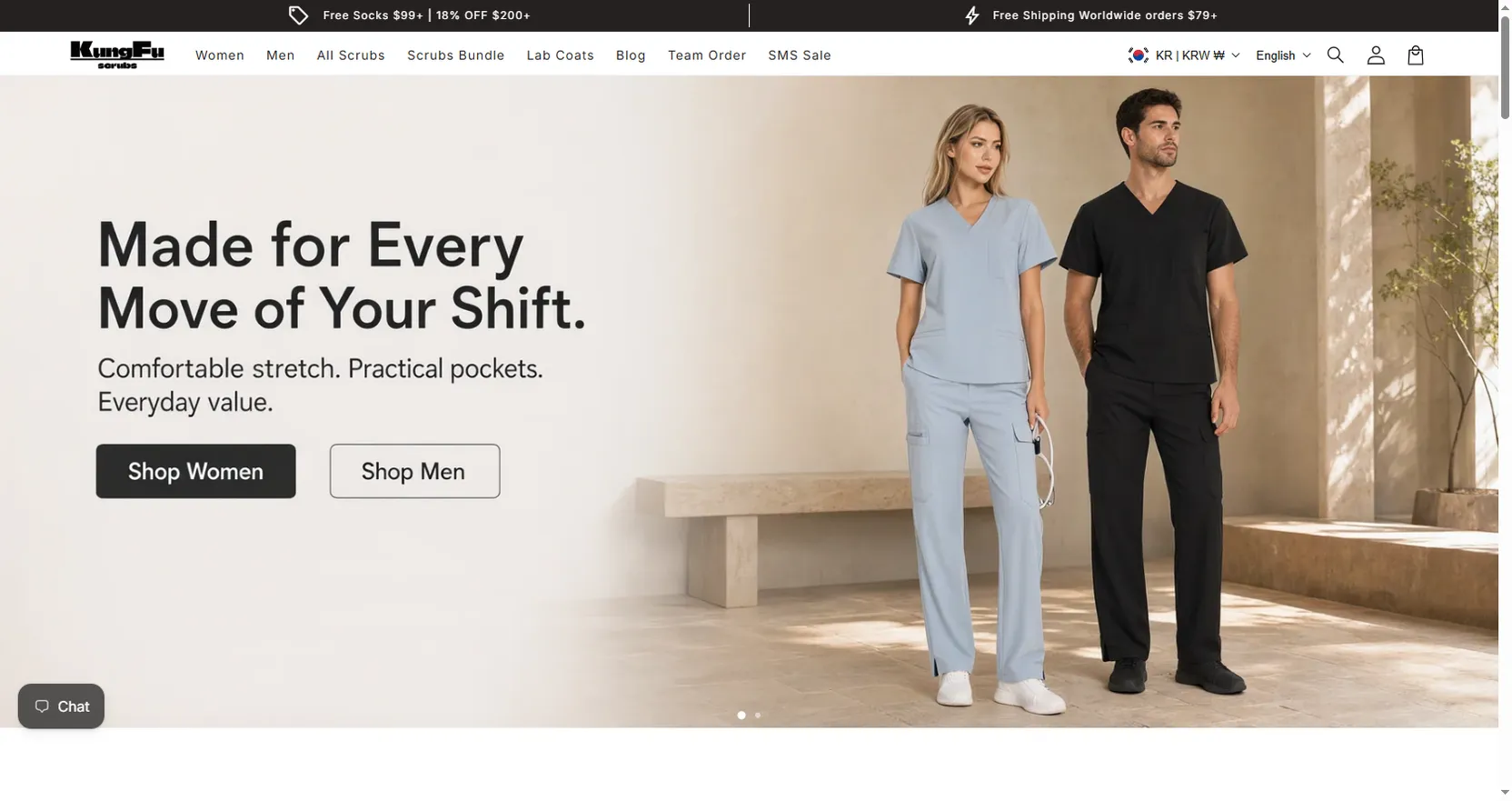
Kungfu Scrubs is not a factory. It is a BOSTON-owned brand, the retail-facing sibling to the factory in section one, and it sells retail and OEM scrubs on comfort, function and end-user appeal.
At the audit stage, that distinction changes what you can prove. I tested three sample sets: fabric stretch recovered after five washes and colorfastness reached 4.5 on the AATCC gray scale. Shrinkage measured 2.1% after three washes, solid for a retail scrub.
But when I asked for a production line audit, the team pointed to a partner facility.
Use Kungfu to benchmark modern scrub styling, comfort claims and retail-ready packaging, then verify the actual production site before you commit.
💡 Our Verdict: Ask for the line name and a recent AQL report. If nobody can name it, you are buying a brand, not a manufacturing partner. That is fine for benchmarking, not for a 20,000-piece rollout.
How Do You Build a Medical Scrub Quality Control Playbook?
This is the process our floor team runs on every scrub reorder. It turns a shortlist into a repeatable program.
What Does a Quality Control Manager Check on Every Reorder?
I sat down with our lead quality control manager, who has spent more than fifteen years on textile inspection floors, to record the exact AQL 2.5 checkpoints. Use these on your next audit.
Which defects fail most often? Six: open seams, skipped stitches, bartack failures at pocket corners and side vents, shade variation, embroidery placement and measurement tolerance.
Every garment lies flat to relax for two hours before measuring. Chest and inseam tolerance is plus or minus 1 cm, and the embroidery center must land within 3 mm of the tech pack mark.
What shade gap triggers a reject? A Delta E above 1.0 under D65 light fails. Readings under 0.8 pass, and anything between goes to a second reading with the buyer present.
See the full sampling tables in our AQL 2.5 inspection guide.
How Do You Lock Clinical Navy Across Batches?
Run these steps in order. Skip one and shade drift returns.
- Tech pack intake: confirm the fabric code, the Pantone reference and the size grades.
- Approved lab dip: sign it under a D65 light box, never office light. Office bulbs shift how you read blue, so a color that matches on a desk can fail in daylight.
- Bulk fabric lot testing: match each lot to the signed dip before it reaches a cutting table.
- Delta E check: reject readings above 1.0 while the roll can still go back to the mill.
- Cutting approval: release the cut only with a signed dip on file.
- In-line inspection: check the first 50 pieces, then inspect hourly.
- Final audit: run AQL 2.5 across all six checkpoint categories.
- Archived reorder standard: keep the approved swatch and report for every future reorder.
Pair this with our workwear fabric selection guide when you spec the base cloth.
What Does a 50-Clinic Color Standard Prove?
Last year we consolidated supply for a Texas healthcare group running 50 clinics across the state. Before the change, four vendors supplied four navies and four defect rates, and every site reported color differently.
Six months after moving to one partner and this playbook, raw-material defects dropped 18% and location-to-location color drift disappeared. The saving came from fewer reworks and fewer replacements, not from a lower unit price.
The lesson holds for any hospital group: at scale, color consistency is a line item. Ask what a shade variation costs across three sites and a full season, and the unit price argument collapses.
Straight Answers to Sourcing Medical Uniforms in China
These are the questions procurement teams ask most before they commit a scrub program to a Chinese factory.
1. How Do I Verify an OEKO-TEX Standard 100 Claim?
Start with the certificate number, not the logo. Enter it in the official OEKO-TEX label check portal, then confirm the product category, the fabric code and the colorway match your order.
Scope drift is common. A factory shows a valid certificate for white poplin and ships navy poly-cotton instead. If the fabric code or shade does not match, reject the batch.
2. Should I Choose OEM or ODM for a Clinic Chain?
Choose OEM when you need your own fit block, labels and a multi-site color standard. Choose ODM when you need speed and a proven design.
For a clinic chain, OEM suits branded scrubs because you control the pattern, the fabric and the Pantone reference. ODM works for pilots or back-of-house wear. Request tech packs and pre-production samples, then compare two size sets from separate dates.
3. What Minimum Order Quantities and Lead Times Should I Expect From Chinese Scrub Suppliers?
Expect minimums of 300 to 500 pieces for OEM scrubs and 50 to 100 for stock blanks. Lead times run 30 to 45 days, plus 7 to 14 days for sampling.
A lower quote is a warning. A supplier who quotes 5,000 pieces at the same lead time as 500 has not planned capacity. Ask for a capacity plan naming monthly output and dye lots.
4. Why Does Hubei Matter in Medical Uniform Sourcing?
Hubei is a dense cluster for medical uniform manufacturing. Wuhan and Xiantao host scrub, lab coat and protective-apparel factories within a short drive, which helps bundled programs and faster sampling.
Proximity does not prove scrub fit or color control. Audit the production line, not the region: request the line layout, the dye-lot procedure and AQL 2.5 reports for your fabric and shade.
5. How Do I Compare Fit Consistency Between Two Scrub Factories?
Order two size sets from each factory, from separate production dates, and measure chest, inseam and sleeve against your own spec sheet. A tolerance of plus or minus 1 cm at chest and inseam is the working standard.
The factory that holds those numbers across both sets can hold a fit block through a 15-site rollout. The one that misses will sell you a new pattern every season.
What Is Your Next Step After This Shortlist?
Send your tech pack and Pantone number through our request for quotation form. The team returns a quote with lab-dip timing within two business days, and your project details stay confidential.
If you need supplier verification first, bring the shortlist, the certificate scope and the sample reports to the same conversation. The line audit comes before any national contract, and the capacity plan comes in writing.
Disclosure: The garments in this guide are bought and every lab test is commissioned with a private budget. I receive no manufacturer kickbacks for these findings.

Fitness & Outdoor Wear Manufacturer
- 2,000+
- Clients Served
- 99.2%
- On-Time Delivery
- 2011
- Manufacturing Since