




Multi-Campus School Uniform Programs

Multi-Campus School Uniform Programs, one sealed spec, every campus.

A factory-direct program for districts, education groups, and university campuses — one archived spec carrying a Pantone-locked palette, graded sizing, and wash-tested durability. Sampling clears in 5 business days, a new campus onboards in 6–8 weeks, so next year's site still matches the first.

MOQ 50 units per SKU · 5-day sampling · 15+ years on one factory floor.

Schoolchildren in white shirts and blazers at a school campus stairwell
One spec, every campus
ΔE ≤ 1.5
Batch colour control
XS–6XL
Graded size charts
50+
Wash-cycle tested
99.2%
On-time delivery
Where It Breaks

Six ways a school uniform program drifts apart.

Colour, sizing, replenishment, durability, spend, and paperwork — at one school each is a nuisance. Across fourteen campuses each one compounds until the district no longer reads as one institution.

Schoolboys in matching maroon blazer uniforms with an embroidered crest
Same uniform, same grade — the fit, shade, and crest parents compare between students.
What holds it together instead

One dye-house reference

Your house colour is read by spectrophotometer and locked at the dye house — not matched to the last delivery. Every lot is read against that fixed reference before it is cut.

One grade rule, on file

A graded size archive per campus, by grade and gender, so a size that fits this year fits the same way next year.

Same-lot reserve fabric

Reserve woven from the original dye lot so a mid-year top-up never opens a new colour batch.

One archived spec, one dye-house reference, one grade rule, and one reserve of same-lot fabric is what stops the drift.

01

Colour drifts campus to campus

The newest campus lands a shade off the first — burgundy at one site, oxblood at another. Because each reorder is matched to the previous delivery, the error compounds instead of resetting.

What it costs One off-shade run is a full re-cut, repeated at every campus it shipped to.

02

Sizing falls apart across grades and genders

A “Size 10” that fits the sample but not the reorder, and a boys cut scaled straight from a girls block. Growth across the year turns small mismatches into a spring exchange queue.

What it costs A re-grade means new patterns before any campus is re-supplied.

03

Mid-year enrollees and transfers wait

A student arrives in October with no uniform, and the top-up has to clear a fresh quote and sample before it ships. Days of the child in street clothes become a complaint to the board.

What it costs Every ad-hoc top-up re-opens the negotiation the program was meant to close.

04

Wear dies in the laundry

Home or commercial washing fades the house colour and pills the knits within a term. Shirts get retired long before they wear out, so parents and bursars buy again mid-year.

What it costs Lower cost-per-wear is the whole point — and colour loss retires garments first.

05

Spend is invisible

Each campus negotiates its own price against its own baseline, so no two sites pay the same and the district has no single cost-per-student figure to defend to the board.

What it costs Fragmented buying adds a margin to every unit — and hides where it goes.

06

Compliance scatters

An audit lands and the CPSIA certificate, OEKO-TEX report, and wash-test data trace to nothing, or live in a folder no one can find.

What it costs One untraceable certificate puts the whole supply line under review.

Who It Is For

Built for whoever runs the whole school network.

The program is the same factory and the same compliance discipline; what changes is the governance layer, because a district board, a franchise group, and a university estates team buy against different constraints.

Buyer typeWho they areTheir painWhat the program fixes
Education groupsMulti-brand groups running primary through secondary schools, often across regions or borders.Each school keeps its own crest, colours, and supplier — so the group has no consolidated buying power or cost per student.One supplier and one fabric library for the group, with each school’s crest and colours held as line items on one program record.
K-12 districtsPublic and charter districts standardising dress code across many campuses under one board policy and budget.Board accountability with no central price baseline — identical garments cost different amounts per campus, and the audit trail is thin.One price schedule, one Pantone-locked palette, and compliance documents filed by PO — evidence a board audit or parent complaint both need.
School chains & franchisesFast-growing private chains and franchise networks opening campuses on a fixed calendar, each needed identical from day one.A campus opens before its uniform lands, and the new batch arrives a shade off the flagship — a miss the brand cannot afford on opening day.A sealed sample and archived spec so a campus added later is made to the same reading, packed per campus for direct distribution.
University campus servicesUniversity estates, facilities, catering, and campus-services teams dressing grounds, security, sports, and hospitality staff.Departments buy independently across a sprawling estate — no single identity, no consolidated spend.A department-to-colour map on one locked palette, with role-graded sizing and laundry-durability proven to the cycle each contract runs.
Pantone-Locked Palette

One house colour, the same reading campus to campus.

A campus-to-colour map sets what each site wears; one dye-house reading sets how it looks. Every lot is verified against that reading before cutting, so next year’s campus matches the flagship.

Campus-to-colour map

Campus A — Primary

Navy polo · grey skirt

#0F1B33

Campus A — Secondary

Navy blazer · house tie

#23345C

Campus B — Primary

Burgundy polo · grey skirt

#6E1F2A

Campus B — Secondary

Burgundy blazer · gold trim

#84293A

House sport — all campuses

Forest tracksuit · white tee

#294A38

Staff — all campuses

Charcoal knit · white shirt

#3A3E45

Each campus, grade band, or department wears a defined colour from one locked palette — held on file so the map keeps working as the network grows.

Graded size system

A size curve for every grade — not one adult block scaled down.

Most sizing complaints come from stretching a single pattern across every age. This program runs a graded curve band by band, with separate boys and girls blocks from primary up, and a per-campus size archive so a size that fits this year fits the same way next year.

A row of kindergarten children in uniform polo shirts, skirts, and shorts standing against a brick wall

3–5 yrs

Kindergarten

Size range2–6
Fit blockUnisex, easy-on
  • Pull-on waists with soft, full-elastic bands let a child dress unaided.
  • Tagless necklines and generous armholes with drop shoulders clear a layer without a struggle.
  • Hook-and-loop or large buttons a small hand can work; flat-locked seams lie smooth against skin.
Five primary-school children in uniform shirts, ties, burgundy cardigans, and grey skirts standing in front of a school wall display

6–11 yrs

Primary / elementary

Size range6–12
Fit blockBoys & girls cuts
  • Separate boys and girls blocks start at size 6, so the cut follows each child, not one unisex pattern.
  • Sleeve and hem lengths carry a planned growth allowance.
  • The waist is adjustable where the chart allows — a September fit still closes comfortably by spring.
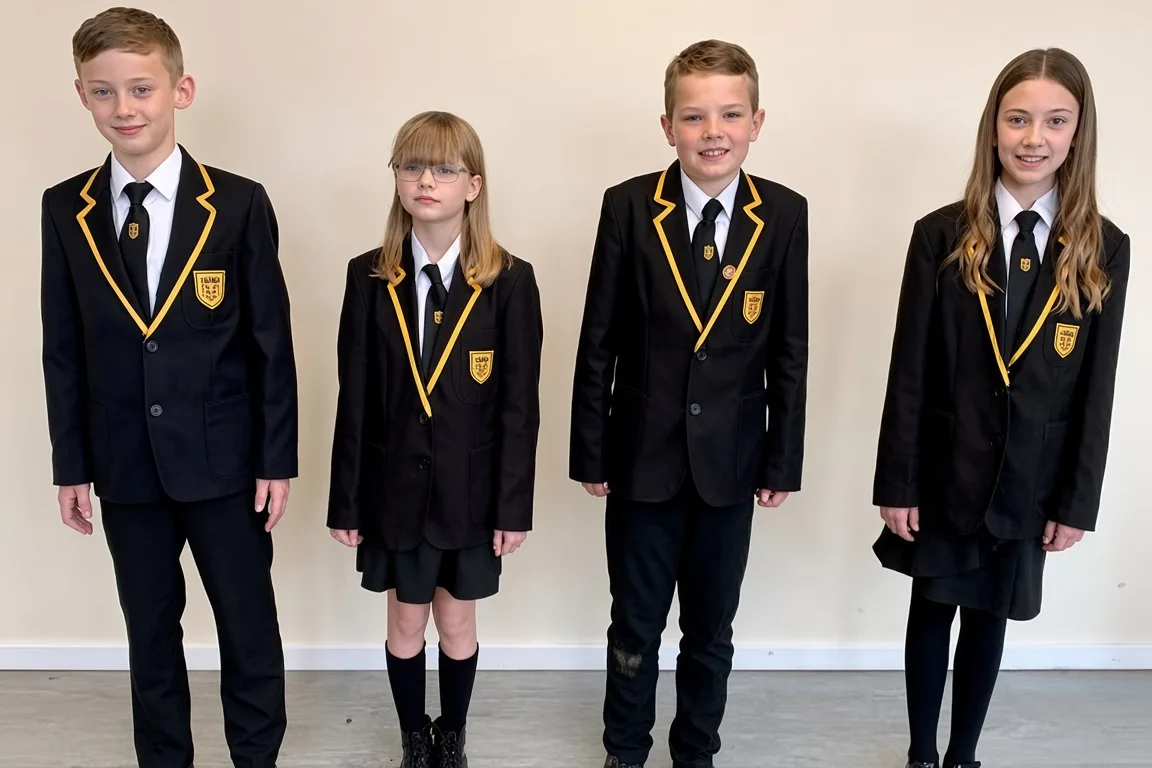
Four secondary-school students in black blazer uniforms with gold-trimmed lapels and a school crest, standing in a row

11–14 yrs

Secondary / middle

Size range12–16
Fit blockBoys & girls cuts
  • The adolescent growth spurt gets its own shoulder and chest grade — not a scaled-up primary block.
  • Boys and girls blocks run separately through the torso and hip.
  • The fit stays clean as frames change shape between sizes.
Four senior students in navy blazer uniforms with a school crest, skirts and shorts, standing outside a school building

14–18 yrs

High / senior

Size range16–20 · S–XL
Fit blockGraded adult
  • An adult-grade silhouette with a fitted and a relaxed fit held on the same chart.
  • A school can mix tailored blazers with easier daily pieces without two size systems.
  • Grading follows adult proportions, keeping shoulder, chest, and sleeve lengths true to full-grown frames.
A group of university students in blazer and plaid-skirt uniforms walking together along a campus path between brick buildings

16+ yrs

University & staff

Size rangeXS–6XL
Fit blockGraded adult
  • Full adult grading to 6XL carries every campus-services role — estates, security, catering, reception — on one size chart.
  • A facilities crew and a front desk read as the same institution.
  • Extended sizes hold the same grade rule rather than stretching a smaller block, keeping shoulder and sleeve lengths correct at the top of the range.

A per-campus size archive

Every campus keeps its own graded size chart on file, built from its actual size breakdown — so reorders draw the same grade rule and fit complaints stop recurring across terms.

Growth allowance, planned in

Junior sizes carry a deliberate room-to-grow in hems and sleeves, so a garment bought in September is not obsolete by spring — measurements held to your tech-pack tolerance, ±0.5" (1.3 cm) unless you specify tighter.

Built to Survive the Wash

Durability graded on cost per wear, not sticker price.

A cheap shirt that fades in a term costs more than a dear one that lasts three. Colour loss is the most common reason a school uniform is retired — ahead of actual wear — so wash life is the number that decides the real budget.

Typical commercial wash life by fibre

Cotton~20–30 washes

Soft, but colour fades and seams fray first in a hot commercial cycle.

Poly-cotton (TC 65/35)~60–80+ washes

The common uniform blend — holds shape and colour through a full academic year of washing.

Poly-viscose (TR) + anti-pill~80–100 washes

Built for central or industrial laundry; anti-pill finish keeps the surface from fuzzing.

Industry-typical ranges; actual life depends on cycle temperature, detergent, and load. We test to the cycle your program actually runs, not a typical one.

The maths that settles the budget argument

Sticker price ÷ wears delivered, not sticker price alone. A garment that lasts three academic years at a slightly higher unit cost beats one replaced every term — and the reinforced construction that buys the extra life typically adds a low single-digit percentage to the unit price.

Read the full cost-per-wear breakdown

Tested before a yard is cut

AATCC 61 / ISO 105-C06Colourfastness to washingASTM D3512Pilling resistanceMartindale ≥ 15,000Abrasion resistanceISO 6330 / 15797Dimensional & wash-cycle change
How fabric durability is tested
Sampling

What "sample approved" actually means.

A sample is a decision, not a gesture. These are the success criteria we agree before cutting — so neither side is negotiating the standard after the sample lands. Copy this into your approval doc.

CriterionPass rule
Dimensions & fitEvery measurement within your tech-pack tolerance — we confirm the tolerance band before cutting, ±0.5" (1.3 cm) unless you specify tighter
ColourSpectrophotometer ΔE ≤ 1.5 against your approved Pantone, checked on the finished garment, not the greige roll
After-washConstruction, colour, and reflectivity tested through your required wash cycles — ISO 6330 at 60 °C default, or your standard
Reflective / hi-vis areaTape and reflective area measured against the required class layout — ANSI/ISEA 107 or EN ISO 20471
Batch inspectionBulk lots sampled to ISO 2859-1 General Inspection Level II — Critical 0 / Major 2.5 / Minor 4.0, the same AQL plan the lot is judged against before it ships
DocumentationFabric mill cert, per-batch lab report, and 4-point fabric inspection record filed by PO with the sample

What you need to give us.

A sample lands approved in one round when these arrive with the brief. Hand them over late and the first sample is guessing — this is the checklist that stops that.

Wash conditions

How the garment is laundered on site — commercial or industrial, wash temperature, detergent, and dryer or iron finish. Our default test is ISO 6330 at 60 °C.

Role list

Every role on site, the colour and standard each one needs, and headcount per role per location — the map the whole program is built against.

Size distribution

The size breakdown to order, and human measurements where the program is made-to-measure rather than graded from a chart.

Reference colour

A Pantone number, physical swatch, or existing garment we can read by spectrophotometer, so the colour formula is locked to your reference, not matched by eye.

Standards by market

Which product standards apply and where the goods ship — so we confirm ANSI/ISEA 107, NFPA 2112, EN ISO 20471, or a local equivalent is genuinely required before you pay for over-spec.

First delivery window

The date the first site needs stock, so sampling and production are scheduled against a real deadline instead of a placeholder.

Back-to-School Rollout

Work back from day one — not toward it.

Peak-season congestion is buffered into the plan instead of billed as a rush. A first order lands in about 5–7 weeks from enquiry; this is how that maps onto a school calendar once the spec is agreed.

A student and teacher in school uniforms talking at a classroom desk
Stock lands before the first bell — sized, campus-coded, and checked to the sealed sample.

Spring

Brief & size freeze

Campus list, grade bands, house colours, and the size breakdown are set against the archived spec.

Campus listSize freeze

Week 1 · 5 days

Sample sealed

House colours are read at the dye house and a pre-production sample is approved and sealed as the golden standard.

Golden samplePantone lock

+15–20 days

Bulk production

AQL 2.5 gates at each stage; every garment measured against its grade rule and the sealed sample.

AQL 2.5Grade check

+14–20 days

Campus-coded delivery

Cartons labelled per campus with per-campus packing lists; the batch compliance pack ships filed by PO.

Per-campus packCompliance file

Term start

In term, on day one

Stock lands before the first bell, and any late joiner draws from reserve on the reorder window.

Reserve stockReorder 10–14 days

A campus added later in the year runs its own sample before it can be supplied — budget a separate onboarding window and the standard cycle applies once it is inside the program.

Lock in your delivery date
Testimonials

From procurement and operations leads who put a whole network on one spec.

"

Fourteen campuses used to mean fourteen buying decisions, and not one of them matched. One house burgundy came back three different shades. A transfer student in October waited weeks for a top-up held up by a fresh quote.

House colours were read once at the dye house and locked, so the lot for our newest campus was drawn from the same reading as the first. Sizing now runs on one grade rule to a ±0.5" tolerance, not a guess per school.

Mid-year became the quiet win: a late enrollee gets the nearest size off reserve inside the 10–14 day reorder window — no re-sampling, no negotiation. Colour complaints went to zero.

"
Danielle Okafor

Danielle Okafor

Director of Procurement — Regional K-12 School District

"

Grounds, security, catering, and reception — four service lines across a university estate — each ran its own supplier and its own shade of navy. No one could tell me what the campus actually spent.

One department-to-colour map now covers all four, and a graded size chart runs to 6XL for the estates crew. Every fabric clears the laundry's real wash cycle before bulk is cut.

First audit, the CPSIA and OEKO-TEX files were already in the box, filed by PO, with lead inside the 100 ppm CPSIA limit. My team stopped chasing paperwork, and the campus finally reads as one institution.

"
Marcus Fielding

Marcus Fielding

Head of Campus Services — University Estates

FAQ

The questions a school board,
and a parent, both ask.

If your question isn't here, our RFQ desk responds within 24 hours — no sales pitch, just specs.

That is the core of what we do. Each program's spec — fabric, colour formula, grade-based size charts, crest placement — is archived once, and every campus order draws from that same record.

A campus added eighteen months later is cut against the sealed sample and stored Pantone reading, so it matches the first rollout, and each campus ships labelled and packed per site so distribution routes cartons without re-sorting.

Colour is locked at the dye house, not eyeballed at the cutting table. Your reference swatch or garment is read by spectrophotometer and the formula locked, and every new dye lot is verified against that reading to ΔE ≤ 1.5 before a yard is cut.

The reading is archived by style, so the campus added next year still matches the flagship — colour never compounds the way a match-to-last-delivery chain does.

Yes. Each level runs a graded curve — separate boys and girls blocks from primary up, a new adolescent grade for secondary, and adult grading to 6XL for senior and staff — held to your tech-pack tolerance (±0.5" / 1.3 cm unless you specify tighter).

Junior sizes carry a planned growth allowance in hems and sleeves, and each campus keeps its own size archive so reorders draw the same grade rule.

Because the spec is on file, a mid-year top-up is a one-line PO against the archived spec — no re-quote and no re-sampling. The garment is cut from same-lot reserve fabric so it matches the student's class exactly, and reorders run in 10–14 days once the spec is locked.

Reserve is concentrated in the high-turnover sizes, sized to your intake and attrition rather than a flat figure.

That is the first thing a uniform budget is judged on. Fabric is tested to the wash cycle the school actually runs — colourfastness (AATCC 61 / ISO 105-C06), pilling (ASTM D3512), abrasion (Martindale), and dimensional change — and the per-batch report ships in the box filed by PO.

Getting wash life right is what moves the number that matters: cost per wear, not sticker price.

US-bound schoolwear ships with a CPSIA Children’s Product Certificate (lead ≤ 100 ppm, phthalates ≤ 0.1%) and the third-party test report behind it. Skin-contact fabric is OEKO-TEX 100 Class I — the class applied to children’s wear — and garments for ages 0–7 follow EN 14682 cord-safety rules.

Everything is filed by PO, so a new campus inherits the same pack.

Send your campuses — we'll return a program spec

Send your campus count, grade bands, house colours, and size breakdown — or just a brief. A named engineer replies within 24 hours with a spec and a quote. No sales pitch, no rate-card guesswork.

Read the 14-campus case study

Scoping a single garment line instead? See ourcustom school uniform manufacturingrange — kindergarten through high school, athletic, and staff wear.Comparing program patterns?See all uniform programs. Browse theverified case studies.Last updated: November 2026.