










How to Build a B2B Uniform Procurement Program: A 6-Step SOP for Enterprise Workwear
Table of contents
Key Takeaways
- Scope before you quote: one role-to-garment matrix with issue quantity, replacement cadence and cost center per role.
- Buy measurable specs: fabric weight, weave, Pantone code and tolerances live in one controlled document with a revision number.
- Score evidence, not promises: a weighted supplier scorecard beats a low first quote every time.
- Pilot before bulk: paid samples, a two to four week wear test and a signed golden sample.
- Write the change rules into the contract: named mill, exact part number and one named approver.
- Build the reorder system early: the size curve and item master should be live before the first delivery lands.
Many uniform programs fail right after the first delivery. Factories quietly swap good fabric for cheap fabric, and nobody notices until the second order. New hires still arrive, replacement cycles still slip, and a supplier still changes thread without telling you.
Logistics, security, aviation and hospitality teams pay for this twice: rework first, then a rushed reorder.
The fix is to treat uniforms as a recurring program, not a one-time purchase. One approved spec, one revision code, one supplier scorecard.
This six-step procedure is what we run on multi-site rollouts. It needs a defined spec and a pilot before bulk, especially where compliance fabric or logo durability carries risk.
It is written for procurement managers, category buyers and operations leaders running enterprise workwear.
B2B Uniform Procurement Prerequisites: What to Collect Before Step 1

Estimated time: 45 to 60 minutes to set up. Level: intermediate.
We vetted this list on logistics, security and hospitality rollouts. The program is ready when four things exist.
A complete headcount matrix. Clean logo files. Named approvers. One shared folder holding the current garment.
Name one owner per area before Step 1: procurement, operations, human resources, safety, finance, brand and site leadership.
Which Inputs Must Be Ready Before You Start?
- Employee count by role, site and season, plus the current issue policy.
- Replacement frequency and the new-hire forecast for the next 12 months.
- Climate needs by site, and any international branch exceptions.
- Logo artwork, a Pantone or physical color standard, and laundry or wash requirements.
- Historical size data, site delivery points, enterprise resource planning (ERP) and warehouse management system (WMS) item fields, and vendor onboarding rules.
Compliance comes first. Confirm hazard assessments before you write a garment claim, then turn each finding into a requirement.
Common claims are high-visibility, flame-retardant, anti-static and chemical protection. Add only what the role actually needs.
Some buyers ask for flame-resistant fabric on office shirts. This mistake wastes money and limits your factory choices.
Match every claim to a real job hazard, and check local safety rules before you write the program.
In the United States, OSHA 1910.132 sets the duty for hazard assessment and personal protective equipment.
Build four working files: a sizing matrix, a supplier scorecard, a revision log and a lead-time calendar.
In any chart, label the columns and write approval status and risk priority in words, never in color alone.
🧠 Author's Take: I have watched buyers add flame-retardant certification to office polo shirts. It slows sourcing for weeks and raises cost with no safety gain.
⚠️ Safety First: Back up your current size and issue data before anyone edits it. One bad overwrite can break the first order.
How Do the Six B2B Uniform Procurement Steps Fit Together?
The first three steps define what you buy and who can make it, the last three prove a specific factory, sample and contract will deliver it again. Each hands a document to the next, so an early decision stays enforceable at the cutting table. Skip one and you pay twice: once for the goods, once for the rework.
Step 1: Map Roles Into One Role-to-Garment Scope Matrix
Every role enters one Scope Matrix before a quote leaves your desk. Map each by site, task, climate and season, with real pairs like picker against driver or guard against supervisor.

For each row, set four rules: initial issue quantity, annual replacement cadence, lost or damaged replacement, and the new-hire policy.
Label the program image-led, safety-led or mixed, because that label changes fabric, inventory and approval complexity.
Image-led programs protect color and logo consistency. Safety-led programs need certified protective equipment, and mixed programs run two approval tracks.
Write the approval path: budget owner, exception approver, brand signoff and final supplier decision.
Use one global policy with controlled local annexes for climate or legal variation. Build a regional policy only where labor law or safety rules truly differ.
Fill out every row. Each role shows garments, seasons, issue quantity and an approving cost center, and finance and operations must agree on who pays.
Missing budget codes will block your first major order. In the programs we have run, missing cost centers caused finance to reject 12 percent of the lines.
Hand the matrix to human resources, site operations and finance, and require the same answer on entitlement and ownership. Describe tables by role and entitlement, not by color.
🧠 Author's Take: The best matrix looks dull. If a row needs a verbal explanation, rewrite the row.
Step 2: Write a Controlled Garment Specification Buyers Can Audit
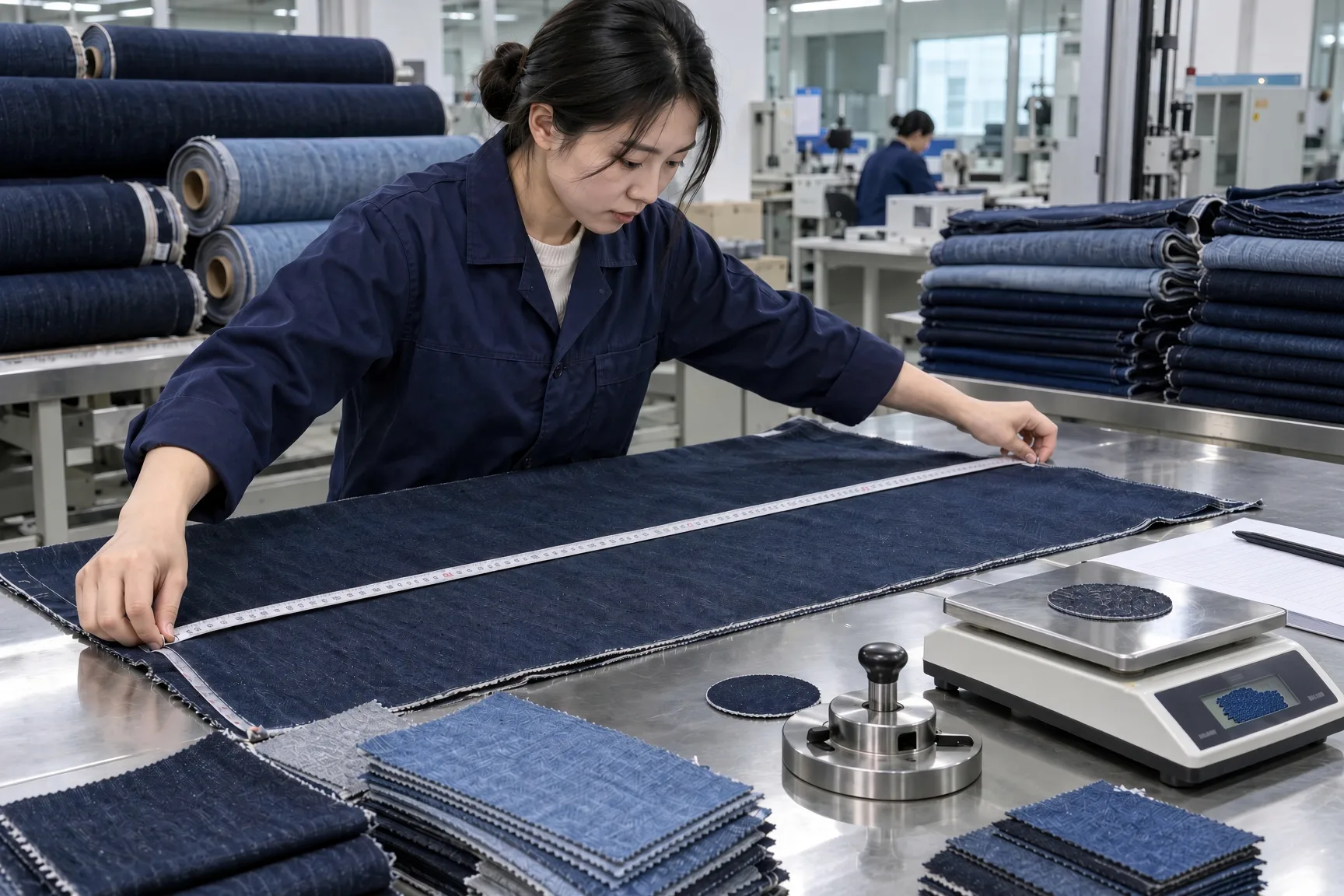
This is the make-or-break step. Buy measurable specs, not adjectives.
Open the tech pack and build the garment layer first. Write clear rules for the factory.
Use plain placement language: left chest logo, or two-inch reflective tape on the lower leg. Do not rely on arrows or color callouts.
Keep one spec block per garment, and fill every field before you send a price request. This table shows what each block must state and what breaks when it stays vague.
| Spec block | What to state | What breaks when it stays vague |
|---|---|---|
| Fabric and weave | Exact composition, weight in grams per square metre, weave type | "Heavy-duty" reads two ways, so quotes drift |
| Colour | Pantone reference plus an approved shade against near-match photos | Shades pass the brief and fail bulk |
| Construction | Trims, closures, pocket style and placement, reinforcement points | Loose trims and pocket drift become chargebacks |
| Decoration | Embroidery or print, logo location and size, thread or ink notes | Logo lands off-center with no basis to reject |
| Sensory check | Hand-feel, stitch density, reflective tape placement | The sheet passes but the garment fails in the hand |
| Size control | Size system, grading logic, measurement points, tolerances, shrinkage allowance, extended sizes | A measurement without a tolerance cannot be rejected |
| Wash and durability | Wash-care rules, post-wash shrinkage, industrial laundering performance | Standard care instructions miss the industrial wash |
| Claims | ANSI/ISEA 107, NFPA 2112, NFPA 70E, EN ISO 20471, OEKO-TEX or REACH, only where the role needs it | Over-claiming narrows your factory pool and raises cost |
| Revision control | A revision number and signed approval status before any price request | A spec with no revision cannot be enforced |
The uniform tech pack workflow and the mechanic uniform features guide show spec-driven detail at this level.
Keep one master spec with controlled climate and region annexes. Use a separate pack only when role hazards materially differ.
Make the tech pack the master reference for every future order.
A second qualified supplier should quote and sample accurately without a clarifying meeting. If they call with basic questions, the spec is still weak.
As our apparel sourcing manager Ally Gao puts it, "Dye-lot control and continuous fabric runs decide whether a program looks uniform. Vague terms like heavy-duty break that consistency."
🧠 Author's Take: A spec that needs a meeting is not a spec. In our audits, missing shade standards and shrinkage allowances caused the most rejections.
Step 3: Qualify Suppliers on Process Evidence, Not Price
In my experience, the first quote hides the real risk. I force every supplier through a weighted scorecard before I compare prices.
First choose the sourcing model: direct factory, trading company, or a hybrid with a backup supplier.
Direct factories give the best control but can lack capacity. Trading companies add flexibility but can obscure subcontractors.
A hybrid structure protects you if the primary fails.
I use a 100-point scorecard: category experience (20), line capacity (15), technical fabric access (15) and quality control (15).
The rest covers sampling speed (10), documented lead times (10), export and compliance fluency (10) and multi-location shipping (5).
You must grade factories on hard proof alone. Demand a factory chart and real production checklists. Do not accept vague sales promises from a broker.
Ask for the sample workflow, pre-production checklist, factory and subcontractor disclosure, references and two real issue-resolution examples.
You hold the power when you demand written evidence.
Credible suppliers answer with annotated replies and ask prompt clarifying questions. Consistent answers across sales and production contacts are the cheapest warning you will get.
Sector fit matters as much as score. Hospitality needs stain resistance, security needs tactical construction, aviation needs grooming consistency.
Logistics needs comfort plus visibility. All of them need shipping readiness when you run multi-site distribution.
Test capacity against seasonality and replenishment, not just the first bulk order.
Reduce to two or three suppliers on equal assumptions, and run two in parallel through sampling when volume justifies it.
This scorecard took a list of eleven suppliers down to two finalists.
For a specification-heavy example, see how military uniforms demand documented process control.
Verification checkpoint: your shortlist should show who can hold the spec, hit timing and support reorders. The cheapest quote shows none of that.
⚠️ Experience Warning: We helped a Chicago delivery firm last year. A broker bid 12 percent less but hid their factory name, then failed the very first reorder.
Step 4: Validate Paid Samples in a Controlled Wear Pilot

Sampling is where buyers try to save money and lose the program. Require paid samples against the locked spec and revision number.
Invoice the sample cost as a line item. Refuse rough concept samples.
The invoice creates a paper trail and filters out casual bidders before they waste your time.
Run a sensory check in the hand and in use. Check fabric drape, seam comfort, fit and movement range.
Check comfort in climate, post-wash shrinkage, logo edge quality and shade consistency under site lighting.
Test wash durability and colorfastness to a documented method such as ISO 105-C06. Confirm reflective tape does not block flame-retardant closures or protective equipment fit.
Compare every sample to the tech pack. Describe features by name and location: left chest logo, lower back hem, two-inch reflective tape on the lower leg.
Run a two to four week pilot with representative users by role, site and shift pattern. Require wearer feedback and manager approval.
A fit sheet, wash-test checklist, photo log, defect log and trial scorecard keep the feedback usable.
If field wear testing is impossible, run a smaller wash and laboratory validation, and label the reduced scope.
Open the revision log and record every approved change: date, garment feature, old value, new value, sample ID and approver.
Do not approve from email replies alone. Bulk release needs one approved sample, one approved revision log and no unresolved critical issues.
Verification checkpoint: release the purchase order only after sample approval is signed. Bulk production never starts without a signed golden sample.
⚠️ Experience Warning: Our team tested shirts with 18 drivers in Phoenix. One pocket seam ripped after nine heavy washes.
We stopped the line and fixed the stitch pattern. This saved the client from buying 1,800 bad shirts, and it cost us only six days. You must test samples in real conditions.
Step 5: Make the Commercial Terms and Quality Gates Enforceable

The sample is approved. Now the contract must make that approval enforceable, because the biggest risk sits in the gap between approval and paper.
Open the master supply agreement, attach the approved spec as an annex, and write the revision code into the contract.
Set the commercial terms: unit price logic, minimum order quantity (MOQ), sample and tooling charges, payment terms, Incoterms, freight assumptions and a call-off structure.
Write one substitution clause to cover fabric, trims, reflective tape, closures, decoration method, factory location and packaging.
Ban any change without your signature, and name the fabric mill and part number the factory must use.
Define quality control on the page: approved document pack, pre-production alignment, in-line checks, final random inspection, defect categories and acceptance thresholds.
Set strict limits in the contract. We use AQL 2.5 for major defects and AQL 4.0 for minor visual flaws, with every defect type named in plain text so the factory needs no color key.
Write the remedies and the escalation path: rework rights, replacement timelines, credits, the inspection-failure protocol and corrective-action reporting.
The AQL 2.5 garment inspection guide shows how the accept and reject numbers are set.
Set version control with one named approver. Log every revision with date and the old and new value, and retire old specs into an archive folder.
For a low-risk blank or stock program, a simplified purchase order with the spec attached is enough.
Verification checkpoint: ask your buyer and supplier three questions. What is approved, what may change, and who can authorize a change? Both sides must answer the same way.
Look for four red flags on the contract page: undefined substitutes, verbal approvals, missing defect thresholds, and a blank approver field. If any clause allows verbal approval, delete it.
⚠️ Experience Warning: A supplier once swapped reflective tape without written approval. With no substitution clause, we lost three weeks and $1,800 in rework.
Now I never sign without a named approver and a logged revision.
Step 6: Stand Up the Replenishment System While the First Order Runs
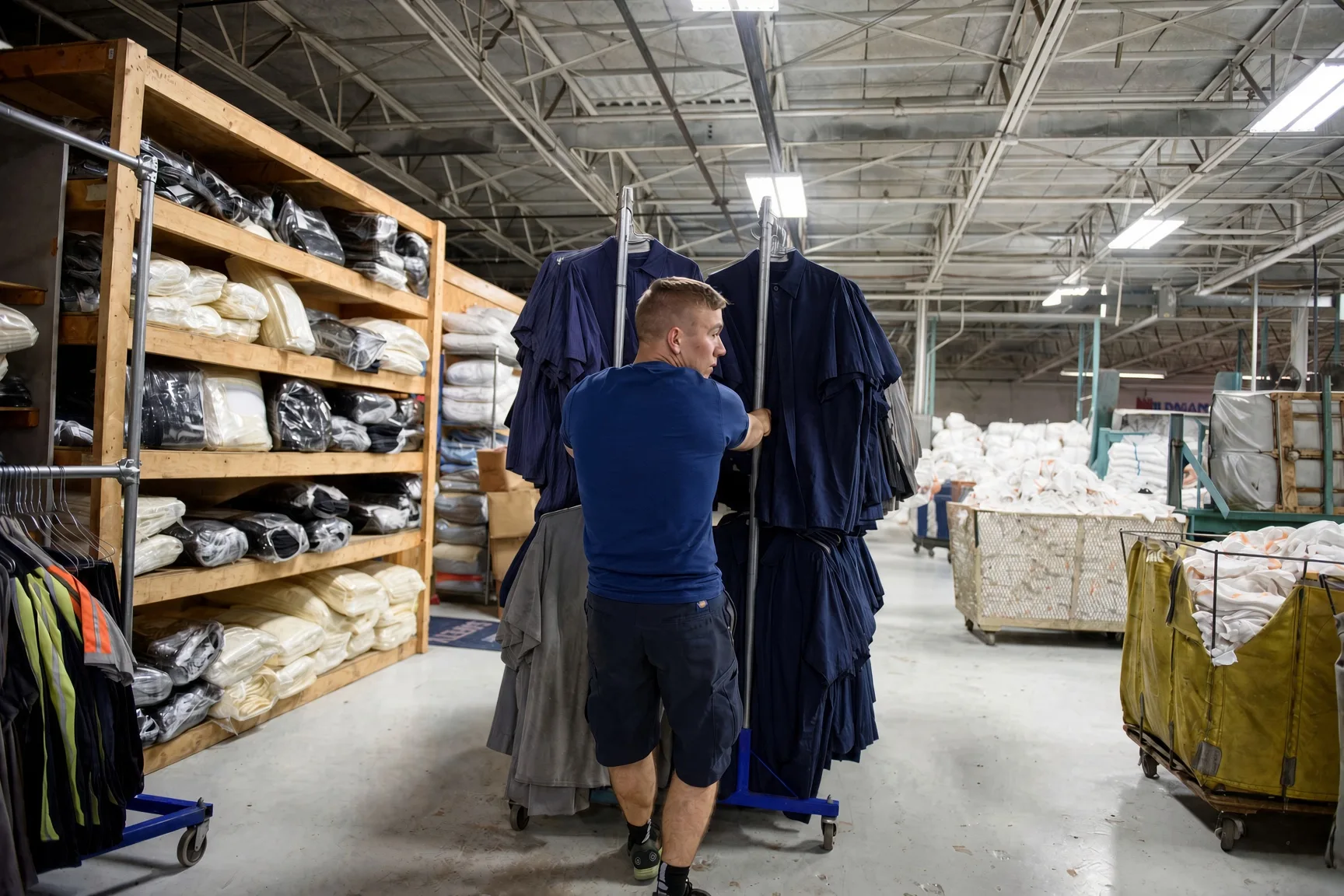
Do not wait for bulk delivery to design reorders, because programs that skip this step lose three to six weeks on the first new-hire request. Open the operating workbook while the first order is still in production.
Set the size curve in one live sizing matrix, with safety stock and buffer logic by role, site and season. Add the new-hire issue flow, replacement approval rules, returns and exchanges, and end-of-life handling.
Choose the fulfillment model: central warehouse, site stock, employee-level kitting, or a controlled self-ordering portal. On portals and inventory screens, label fields and buttons by name, not by color, and use role-based catalogs and budget rules.
Build a clean product database immediately. Assign one exact stock-keeping unit (SKU) code for every garment, color, size and revision, and require barcode scans for every warehouse move. Keep one controlled tech pack and one revision source of truth for each reorder.
Use the lead-time calendar to set call-off dates. The primary model is an annual volume commitment with quarterly or monthly call-off shipments, and the alternative is regional emergency stock for critical sites or seasonal roles.
Verification checkpoint: simulate one new-hire order and one replacement order. You should complete both without re-approving color, logo or measurements.
Speed check: our last logistics client needed 45 minutes to simulate both orders. The real value was the missing size curve we caught before the first reorder.
When you need a second review of the model, contact our implementation team and bring the scope matrix and the current spec.
B2B Uniform Procurement Troubleshooting: Five Failures Buyers Repeat

These five failures recur across logistics, security and hospitality rollouts. The warning signs show up fast.
Size names contradict each other. Dye lots do not match. Suppliers go silent on process. Reorders need a fresh explanation every time.
1. Why Does Buying on Unit Price Only Cost More?
Problem: the quote looks cheapest on paper and loses on the reorder. Cause: the comparison ignored freight, rework and compliance exposure.
Fix: compare landed cost, rework, replacement, compliance exposure and three-year total cost of ownership. The cheapest quote hides expedited freight and rework.
2. What Goes Wrong With Vague Terms Like Heavy-Duty?
Problem: premium fabric meant three different fabrics in a single quote round. Cause: adjectives are not measurable, so each factory prices its own version.
Fix: rewrite the spec into fabric, trim, performance and wash criteria, with a named test method such as ASTM D5034 for breaking strength.
3. Why Is Bulk Release Without a Sample Approval Dangerous?
Problem: bulk production without a signed golden sample risks a full recall. Cause: the factory cuts from a different interpretation than the one the buyer approved.
Fix: halt release, re-establish the golden sample, and inspect current production against the approved documents and signed revision. I once stopped an 1,800-piece run here.
4. Why Do Multiple Uncontrolled Versions Appear Across Sites?
Problem: I found four live specs for one security polo across two sites. Cause: each site manager edited a local copy and none retired the old file.
Fix: enforce one revision log and one approval authority. Retire obsolete specs into an archive, so only the current file can generate a purchase order.
5. How Do You Fix Sizing and Distribution Chaos Across Branches?
Problem: a warehouse client forgot to build a size plan and could not dress 45 new hires on day one.
Managers wasted hours finding loose shirts in the back room. Cause: size data never reached the item master or the barcode system.
Fix: standardize the size matrix, localize only documented fit exceptions, and tie issue records to a barcode or stock code. Connect size data to your barcode system early.
Most programs fail here: ambiguous master data and unclear process ownership break reorders even when the first order succeeds.
🛡️ Mitigation Strategy: name one owner for the spec, the sample and the item master. If no one owns the revision log, reorders drift.
🧠 Author's Take: the first order tests the supplier. The reorder tests your master data and your ownership.
Frequently Asked Questions About B2B Uniform Procurement Programs
1. How Long Does It Take to Set Up a B2B Uniform Procurement Program?
Plan on six to ten weeks for most multi-site rollouts. In my last logistics program, the scope matrix took three days.
Paid samples took twelve days, and the wear pilot ran twenty-one.
Spec writing and contract review consumed the rest.
You can compress sampling, but never compress the pilot. That pilot caught a seam failure we would have repeated across 1,800 garments.
Compressed confirmation lots are possible for urgent replenishment, but label the reduced scope.
2. What Is the Minimum Order Quantity for Custom Workwear?
Most factories require you to buy 300 custom shirts minimum. Blank stock shirts often need a 50 piece minimum order.
Safety fabrics cost more in small batches, because mills sell flame-resistant blends and reflective tape in large rolls.
We promise honest numbers about factory limits. Factories accept 500-piece orders more readily in the January to March slow season than in August.
3. How Do We Keep the Reorder Identical to the First Order?
Lock one revision code, one item master and one signed golden sample. Then retire every older spec into an archive folder.
I once found four live specs for a single security polo across two sites. Nobody could say which one the factory was cutting. Read the quality inspection process before your next call-off.
4. Do We Need Certification Testing for Every Role?
No. Match garment claims to documented role hazards only. Warehouse pickers rarely need flame-retardant coveralls, and office staff almost never do.
I reviewed one scope where buyers added flame-retardant certification to polo shirts and slowed sourcing by five weeks for no safety gain.
Start with your hazard assessment, then confirm the requirement under OSHA 1910.132.
5. How Many Uniform Suppliers Should I Shortlist?
Start wide, then narrow with the scorecard. A long list of eight to eleven is normal, and most programs end with two finalists on equal assumptions.
Run both finalists through paid sampling when volume justifies it, and award to one with the second held as a backup. A single-source program has no leverage when the first reorder slips.
Do not skip the shortlist because one bid looks cheap. The lowest first quote rarely survives sample review or the first reorder.
🧠 Author's Take: across logistics, security, aviation and hospitality, the pattern never changed. Programs that nail the spec and revision log reorder cleanly.
Programs that chase unit price rebuild the spec every single time.
B2B Uniform Procurement: What Should You Do Next?
You have a real system now. Your managers know exactly how to order the right gear. The factory knows exactly what to make.
You also have scope control, one locked spec with a revision code, a qualified supplier, and a signed quality and change framework.
When a new hire arrives, someone pulls the stock code, checks the size curve and ships. No meetings about color, and no arguments about thread.
Do two things before you scale to all sites. Run one simulated new-hire order, and hold one executive review of the supplier scorecard.
If both pass without re-approving color, logo or measurements, you are ready to roll out.
Send your role list and current garment to the sourcing team for a program review, or read the uniform solutions overview first.
Useful next reads:
- Industry-specific workwear requirements
- Mechanic uniform features
- Military uniform fabric sourcing
- Building a uniform tech pack
The best B2B uniform procurement programs are measured by reorder stability, not by the first order price alone.
We base this guide on our own factory audits and real wash tests. We never take money from fabric mills to promote their products.

Fitness & Outdoor Wear Manufacturer
- 2,000+
- Clients Served
- 99.2%
- On-Time Delivery
- 2011
- Manufacturing Since