










How to Build a Uniform RFP Template: A Field-Tested SOP for Enterprise Buyers
Table of contents
Key Takeaways
- Scope before you price: one reconciled grid of site, role, season, headcount and volume, with no blank cells.
- Specs with evidence: one spec block per garment, plus four hidden columns for audit and certification proof.
- Locked pricing schedule: every vendor fills the same cells, so unit prices become comparable landed costs.
- Weights before bids: publish the scorecard inside the request for proposal (RFP), not after proposals land.
- Golden sample: a paid pre-production sample and a written change-control clause govern bulk.
Most uniform bids fail before the price sheet opens. Buyers ask for quotes before they define the program.
I see the same pattern across multi-site workwear, healthcare, hospitality and tactical sourcing. Every vendor prices its own assumptions.
You get proposals you cannot line up, and scope that keeps moving after award.
This guide is a working system to compare vendors fairly. I wrote it for procurement directors, supply chain leaders and facility managers.
Five steps cover scope, technical specifications, commercial and service rules, evaluation weights, and evidence and change control.
Each supplier prices and documents the same requirement, so non-comparable bids and scope creep drop.
The same scoring method transfers to an eProcurement platform without rewriting the fields.
Uniform RFP Prerequisites: What to Collect Before You Start
Estimated time: 3 to 5 business days of data gathering. Level: intermediate.
We built this checklist from live uniform RFPs in healthcare, construction and hospitality. Every missing input forced a vendor to re-quote.
Which Inputs Must You Gather First?
- A site list with a role breakdown for every location.
- Headcount by role, location and season, using peak numbers. Averages understated our size curves by 15 to 20 percent.
- Size curves split by gender and fit class.
- Forecasts for initial issue, annual replacement and new-hire volume.
- Contract term, reorder cadence, delivery window and minimum order quantity.
- Branding files: vector logos, Pantone colors and placement limits, including clearance from reflective tape.
Who Signs Off Before the RFP Goes Out?
Name one owner per area before Step 1, and confirm the chain in writing.
- Procurement owns the document.
- Operations checks site practicality.
- Human resources or the uniform administrator confirms sizing and issue policy.
- Brand approves artwork.
- Safety and compliance confirms standards.
- Finance approves commercial terms.
Run the RFP on a spreadsheet and pair it with a scorecard.
On an eProcurement platform, keep the identical mandatory fields and weights. Different fields kill comparability.
Which Compliance Standards Should You Anchor Now?
Plan compliance before you write a single garment claim. List every requirement the role actually triggers.
That covers flame retardant, high visibility, anti-static, infection control and laundering.
Then anchor each one to a published standard, so no supplier can define the term for you.
- Hazard assessment and the protective equipment duty under OSHA 1910.132.
- Factory quality management under ISO 9001.
- Fabric safety, checked through the OEKO-TEX label check.
- Flash-fire and flame-retardant garments against NFPA 2112.
- Colorfastness to washing under ISO 105-C06.
- Bulk inspection sampling under ISO 2859-1.
🧠 Author's Take: On one clinic rollout, we left the laundering standard out of the brief. A 90°C industrial wash wrecked the embroidery in six cycles.
⚠️ Warning: Do not publish the RFP until the technical owner confirms the standards, the tolerances and who may approve a substitution.
Set document control before you share the file: a reference number, an owner, a version, an issue date and a deadline.
How Do the Five Uniform RFP Steps Fit Together?
Work through these five in order, because each one produces a document the next depends on.
Scope and specification come first, and together they pin down exactly what you are buying. Pricing schedule, scoring weights and golden-sample control follow, fixing who can build it, how you compare offers, and what proof unlocks bulk production.
Step 1: Lock the Program Scope in One Reconciled Grid

Start with the business outcome, not the garments.
Decide whether this program must standardize brand presentation, meet a safety requirement, cut replacement cost, speed onboarding, or consolidate suppliers.
In a 12-site logistics RFP, that one sentence changed the shortlist.
Build one scope table. Use one row per site, role and season, with no blank fields.
- Business unit, site or location.
- Employee role or wearer group.
- Climate or seasonal requirement.
- Headcount and expected growth.
- Initial issue quantity per employee.
- Annual replacement cycle.
- New-hire volume by month or quarter.
- Contract length and reorder expectation.
A complete scope sheet reads as a reconciled grid. Every site, season, role and volume sits in one view.
Finance can trace annual units back to headcount and issue cycle.
Vague scope lets every vendor model demand differently, and the prices become impossible to compare.
Tailor the priority too. Corporate office wear often prioritizes branding and portal fulfillment.
Tactical, logistics, healthcare and industrial programs often prioritize durability, compliance and laundering. See our workwear programs and military and tactical uniforms.
🏭 Factory Manager Callout: On a visit to our Wuhan factory last October, Manager Li walked me through a failed bid from a Texas healthcare provider.
"Buyers give us a simple small-to-extra-large average," he said. "The real order also needs 3XL, 4XL, tall and short."
"Those extremes need separate cutting, extra fabric and reliable replenishment. We priced the average, not the tail."
Verification checkpoint: scope is complete when finance, operations and the uniform owner agree. Forecasted annual units, site count and replacement assumptions must be realistic.
🧠 Author's Take: If one scope cell is blank, do not send the RFP. I have never seen a vendor guess that cell correctly.
Step 2: Build Audit-Ready Garment Specification Blocks

Turn the locked scope into one spec block per garment. Use one spreadsheet tab per item, named by garment and wearer group, not "Shirts."
A vague line item says "navy work shirt." A locked spec block names fabric, fabric weight, Pantone, seam type, tape placement and test evidence.
Complete these fields for every garment:
- Garment name and wearer group.
- Fabric composition and weight in grams per square metre.
- Yarn or performance notes, such as two-ply ring-spun or moisture-wicking.
- Color standard or Pantone reference.
- Construction details: seam type, reinforcement points, pocket layout, closures and trim.
- Fit block, size range, grade rules and tolerances.
- Logo placement, logo size, decoration method, thread or ink notes, and wash-durability requirement.
- Packaging, care-label language and carton-marking rules.
Add four hidden technical columns. The first is ISO 9001 factory audit status, and the second is OEKO-TEX or fabric-safety status.
The third is continuous dye-lot colorfastness, and the fourth is inspection method plus an acceptable quality limit (AQL).
Generic templates miss these. They stop a vendor from swapping mills, colors or quality standards after award.
Anchor the wash standard to the ISO 105-C06 method.
For flame-retardant workwear, list the compliance requirement and the test standard. For high-visibility gear, list the reflective tape class and placement.
For tactical uniforms, list ripstop, reinforcement and component brands. For healthcare and hospitality, list wash endurance, stain release and infection-control requirements.
Draw pocket and trim examples from our mechanic uniform features guide and durability specs from our uniform tech pack workflow.
As Eric Gong, a military uniform specialist, puts it, "A tactical bid lives or dies on the fabric spec, because a buyer who writes only 'ripstop' leaves the mill free to choose which ripstop."
Add an Evidence column. Require vendors to attach test reports, certificate copies or fabric data sheets. Reject marketing claims.
Verification check: hand the spec to a different stakeholder. They should order the same garment without asking follow-up questions.
⚠️ Experience Warning: We ran a scrub bid for a Boston hospital network. One vendor quietly swapped a 65/35 poly-cotton blend for 100% cotton.
The hidden OEKO-TEX and fabric-weight columns caught it before sampling.
Step 3: Issue a Fixed Pricing Schedule, Not a Pricing Request

An open-ended quote request creates chaos. One vendor sends unit prices only.
Another buries setup, freight and payment terms in different cells. You cannot line them up without reformatting both files.
Replace the pricing request with a locked schedule. Send one spreadsheet tab and lock the labels and formulas.
Make every vendor fill the same cells.
Require these rows:
- Unit price by garment and size tier.
- Setup or tooling charge.
- Sampling charge.
- Reorder price and reorder minimums.
- Decoration charge by method, placement and stitch or print count.
- Warehousing or portal fee, where used.
- Freight terms: Incoterm, delivered-duty-paid assumption, duty and tariff treatment, payment terms.
- Price-hold period of 12 or 24 months.
Add a service tab with fixed fields: production lead time after art approval, sample lead time, reorder turnaround, and delivery model to warehouse, site or end user.
Add packing and labeling rules, plus returns, warranty and defect handling.
For domestic or distributor-led bids, keep the same cells. Split manufacturer cost, decoration, freight and service fees.
This exposes middleman markups. Our quality control process explains why landed-cost comparisons depend on identical service assumptions.
Without a fixed schedule, each supplier prices a different scope and total cost of ownership becomes fiction.
A clean schedule looks boring: same rows, same units, same fields. That is the point.
Suppliers hide freight when they set the format. Give them one fixed schedule and the markups surface on their own.
🧠 Author's Take: On a 6-site hospitality bid, one distributor folded freight into the unit price.
We forced the split. The true freight line ran 11% above the delivered-duty-paid quote.
Verification check: put two vendor responses side by side. You should compare commercial terms without moving or reformatting a single cell.
Step 4: Fix the Weights Before You Open Proposals

Publish the scorecard inside the RFP, not after bids land. Weights set after opening drift toward the cheapest bid.
On an 8-site high-visibility tender, the committee tried to raise price from 30 to 55 percent after a familiar distributor came in high.
The published weights blocked it.
Fix the criteria and the weights before proposals are opened, and no one can argue the outcome later.
Follow this scoring sequence:
- Build four to six evaluation categories. More than six and evaluators start guessing.
- Assign percentage weights that reflect business risk. Safety-critical programs weight compliance higher.
- Write scoring definitions. Define what a 5, a 3 and a 1 look like. "Good quality" is not a definition.
- Log each vendor's evidence beside the score, in the same row.
- Score blind where possible, then reconcile in one meeting.
- Normalize pricing before you total. Convert every bid to landed cost per wearer per year.
- Document clarifications before final award, timestamp every answer, and re-score if a vendor changes scope.
Use this weighting as a starting point: technical compliance and sample quality at 30 percent, capacity and references at 20 percent.
Total cost of ownership counts for 30 percent, and service and change control for 20 percent.
The scorecard itself is a matrix.
Rows compare an offshore factory against a domestic middleman.
Columns cover factory ownership model, ISO 9001 audit evidence, OEKO-TEX and fabric certificates, and dye-lot consistency control.
They also cover sample pass or fail, lead-time credibility, landed cost and total cost of ownership, and the change-control process.
The weighted total column is the sum of each score times its weight. Describe every pass or fail and every score in text, never by cell color alone.
Why the gated spreadsheet matters: it ships with hidden columns for audit evidence, dye-lot control and change-control sign-off.
Vendors who skip them lose points automatically. That one mechanic stopped scope creep on two programs where a supplier tried to swap mills after award.
⚠️ Experience Warning: Price-dominant RFPs at 70% cost reward thin fabric and late delivery.
One low bidder's reflective tape delaminated after 15 industrial washes. The total-cost column caught it; the unit price never would.
Verification checkpoint: if a stakeholder challenges the award, open the published weights and score definitions. The math explains the decision without debate.
To run this scorecard with the hidden compliance columns pre-built, request the Excel uniform RFP template from our team on the contact page.
🧠 Author's Take: I score samples before I see any price. Once a number is on the page, every evaluator unconsciously grades toward it.
Step 5: Lock the Golden Sample and Change Control Before the Purchase Order
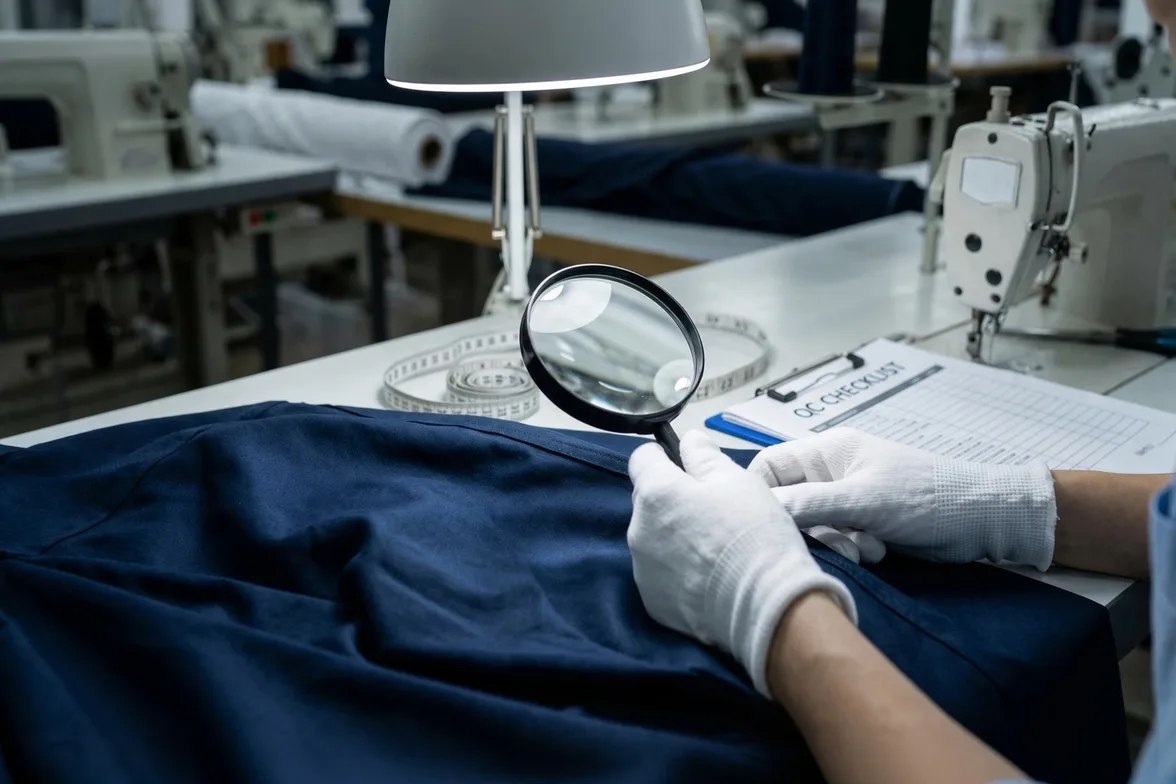
Do not approve bulk from a free "sales sample." Require a paid pre-production sample, judged against the same written specification and scorecard you issued in Step 4.
A free sample can pass review, then bulk arrives with thinner fabric. A paid sample forces a real production run through the vendor's line.
Send a mandatory evidence packet with the sample request:
- Process map or production workflow.
- Factory audit or certification evidence.
- Sample lead-time commitment.
- Inspection plan and AQL threshold, such as AQL 2.5 for bulk.
- Test reports or wash and colorfastness results, where relevant.
- Subcontracting disclosure.
Write this change-control clause into the template: "No fabric, trim, factory, or color substitution without written buyer approval."
Require version and date control on every revision, and state that the approved sample becomes the golden sample for bulk reference.
When the sample arrives, review it under daylight and factory lighting. Check fit, hand feel, stitching consistency and decoration durability.
Also check labeling accuracy, packaging and carton marking.
Approval confidence looks specific. The fabric matches the spec sheet. The color holds under both lights.
The logo sits within tolerance. The vendor can show the exact inspection gates that control bulk.
Keep a lightweight internal compliance matrix and confirm every requirement is answered before release and again before award.
The AQL 2.5 inspection guide shows how the accept and reject numbers are set.
Verification checkpoint: before you issue a purchase order, hold four things.
They are the signed golden sample, the evidence packet, the written change-control clause and an answered compliance matrix.
If any item is missing, do not release it.
⚠️ Experience Warning: On one high-visibility bid, the sample logo looked correct in the sample room.
Under site lighting, the reflective tape sat 6 mm off-center and would have failed the customer audit. The golden sample and photo evidence caught it before bulk.
For a pre-issue review of the program, bring the scope grid and the current spec to our uniform solutions overview or the hospitality program page.
Uniform RFP Troubleshooting: Four Failures That Repeat
I reviewed live uniform RFPs with buyers and factory managers. Most failures came from process, not vendors. Here is how I fix the four repeat offenders.
1. Why Do Vendors Return Wildly Different Prices?
Problem: each vendor priced a different scope. Cause: mismatched pricing tabs, reorder assumptions and Incoterms.
Fix: lock annual volumes, reorder cadence, Incoterms and the pricing grid before re-issuing.
Set one question deadline and make every vendor fill identical cells. Compare landed cost, not unit price.
2. Why Does the Cheapest Bid Win and Then Fail in the Field?
Problem: the scorecard overweights unit price. Cause: a 70% price weight rewards thin fabric and weak service.
Fix: rebalance the weights before opening bids. Give compliance, sample quality, capacity, service and total cost of ownership real weight.
Normalize every bid to landed cost per wearer per year.
3. Why Do Samples Look Right and Bulk Production Change?
Problem: no golden sample and no substitution clause. Cause: a free sample passed, then bulk arrived with lighter fabric.
Fix: make the paid pre-production sample the golden sample, and add the no-substitution clause to the RFP.
Attach the approved sample and signed clause to the purchase order file. Approve bulk against the golden sample using AQL 2.5 per ISO 2859-1.
4. Why Does the Size Rollout Fail Across Sites?
Problem: buyers use generic small-to-extra-large averages, not real size curves. Cause: size data never reached the garment matrix.
Fix: pull historic size-run data by role and location before you finalize the matrix.
In Wuhan, Manager Li walked me through the cutting floor. Averages hid 3XL, 4XL, tall and short.
Those extremes need separate cutting and replenishment, and ignoring the tail drives delays and remakes.
💡 Pro Tip: keep one master RFP folder with version control and one compliance matrix.
Buyers often lack templates and send disorganized files. One source of truth stops that.
🎯 Expert's Verdict: the most common failure is vague garment descriptions plus weak change-control language. Fix the spec block and the clause together before you re-issue.
Frequently Asked Questions About Uniform RFP Templates
1. What Should a Uniform RFP Template Include?
At minimum, five pieces: a reconciled scope grid, one spec block per garment, a locked pricing schedule, a published weighted scorecard and a written change-control clause.
I also add four verification columns for factory audit status, fabric safety, dye-lot control and AQL inspection. Skip those and a vendor will swap mills after award.
2. How Many Vendors Should I Invite to Bid?
Six to eight. In our tests, three bids created no price tension and twelve buried the evaluation team in clarifications.
Pre-qualify on factory ownership, certification evidence and peak-month capacity. Stagger the send by 48 hours so no vendor recognizes a competitor's name in a forwarded thread.
3. How Do I Score Uniform Proposals Fairly?
Fix the criteria and weights before you open any file. Score blind, log evidence beside every score, and convert every bid to landed cost per wearer per year.
On an 8-site high-visibility tender, the committee tried to raise the price weight from 30 to 55 percent after a familiar distributor bid high. The published matrix blocked it.
4. Do I Need a Paid Pre-Production Sample?
Yes. A free sales sample is not a production run. Buy a paid pre-production sample, judge it against the same written spec, and make it the golden reference for bulk.
One client's free sample passed review, then bulk arrived with lighter fabric and the reflective tape delaminated after 15 industrial washes.
5. What Certifications Should a Uniform Supplier Provide?
Ask for ISO 9001 audit evidence, OEKO-TEX or equivalent fabric-safety certification, and test reports against the exact standard your garment must meet.
For high visibility in the United States, that means ANSI/ISEA 107; for flame retardant, NFPA 2112.
Reject marketing claims, and require the certificate number and expiry date in the same cell as the claim.
6. How Long Does a Uniform RFP Take From Issue to Award?
Budget 6 to 10 weeks. Scope and spec work takes 3 to 5 business days when your data is clean, and vendors need 2 to 3 weeks to quote.
Paid sampling adds 7 to 14 days for technical fabrics, and certification checks add another week. Rushing the sample stage is how bad programs start.
Uniform RFP Template: What to Do Next
You now hold the full structure: one reconciled scope grid, audit-ready spec blocks, a locked pricing schedule, published weights and golden-sample control.
That is what turns a pricing request into a uniform RFP template that produces comparable bids.
Your next move is to issue the RFP to a pre-qualified shortlist, not a mailing list.
Collect proposals on identical tabs. Score every response against the same weighted matrix you published on day one.
Then run paid samples against the written spec before you award a single unit.
Do not rebuild the sheet from scratch. Request our Excel uniform RFP template and scorecard from the sourcing team.
Bring your scope grid to the first call so the hidden compliance columns are wired to your program from the start.
Useful next reads:
- Industry-specific workwear requirements
- Military uniform fabric sourcing
- Building a uniform tech pack
- AQL 2.5 garment inspection
We base this guide on real factory data. We buy our own test samples. We never accept money from factories to promote their fabric.

Fitness & Outdoor Wear Manufacturer
- 2,000+
- Clients Served
- 99.2%
- On-Time Delivery
- 2011
- Manufacturing Since