








Table of contents
Key Takeaways
- AQL 2.5 is a decision rule: it sets how many units you inspect and how many defects fail the lot. It is not a licence to ship 2.5% bad garments.
- Buyers need three limits: Critical 0 / Major 2.5 / Minor 4.0, read from the same sample.
- Lot size drives the plan: General Inspection Level II turns 3,201–10,000 pieces into sample 200, with an accept number of 10 and a reject number of 11 for major defects.
- The purchase order carries the rule: standard, level, defect definitions and tolerances belong in writing before an inspector opens a carton.
- Critical is always zero: needle fragments, missing safety labels and uncertified tape do not sit inside a major-defect allowance.
One failed workwear shipment can delay a product launch, expose a brand to compliance risk and trigger field complaints. When you cannot inspect every unit, sampling has to do the risk control.
AQL 2.5 inspection is the most common major-defect acceptance benchmark for global workwear buyers. The part buyers get wrong is the meaning. It is a sampling decision rule, not permission for 2.5% bad goods.
Misread it and you accept defects you should reject. Apply it correctly and you get shipment-level control without opening every carton. Most of the damage happens before the inspector arrives, when the purchase order is vague about defect classes, sample size and acceptance thresholds.
This guide covers the definition, the acceptance table, garment defect classification, the pre-shipment workflow and the purchase order wording that ends the argument.
What Does AQL 2.5 Mean in Garment Inspection?
AQL stands for Acceptance Quality Limit. Older buyer documents still say "acceptable quality level", which is where much of the confusion starts. In practice, AQL answers one question: should we accept this lot?
The framework comes from ISO 2859-1 and its United States counterpart, ANSI/ASQ Z1.4. Both tables produce the same code letters and sample sizes, so a purchase order can cite either. Think of a building inspection: you do not test every brick. You check a defined sample, then judge the whole structure against clear pass/fail limits.
That is how an acceptable quality limit table works. It ties lot size to sample size and to accept/reject thresholds. It is not a factory's internal quality system. AQL governs lot-by-lot final inspection, which is why procurement, quality control and the supplier can share one acceptance rule.
What AQL Limits Do Garment Programs Use?
Most programmes set AQL 2.5 for major defects and AQL 4.0 for minor defects. Critical defects get zero tolerance. A broken stitch is major. A loose thread is minor. A missing flame-resistant label is critical.
In workwear and industrial safety apparel, visual quality and compliance risk overlap. That overlap is why labels, trims and bar-tacks never count as cosmetic details. A small label error has stopped shipments that looked fine at a glance.
Compared with AQL 4.0, the 2.5 limit covers defects that affect saleability, wearability or function. The 4.0 limit covers cosmetic imperfections with lower business impact. The difference changes which defects count against acceptance.
Why Is the 2.5% Defect Allowance a Myth?
Clients sometimes ask me to inspect every unit in a 10,000-piece order. My first question is what risk they are trying to control, because full inspection adds cost, time and handling damage.
AQL 2.5 does not mean the shipment may contain 2.5% defective garments. It means the lot passes or fails using a pre-defined sample size and accept/reject thresholds. A clean report proves the lot met the rule. It does not prove the lot is clean.
💡 Our Verdict: AQL 2.5 is a lot decision rule. It never promises a 2.5% defect allowance.
How the AQL 2.5 Sampling Plan Works in 2 Steps
Every inspection follows the same two-step lookup. Start with the lot size. Translate it into a sample size code letter. Convert that letter into a sample size and an accept/reject pair for each defect class.
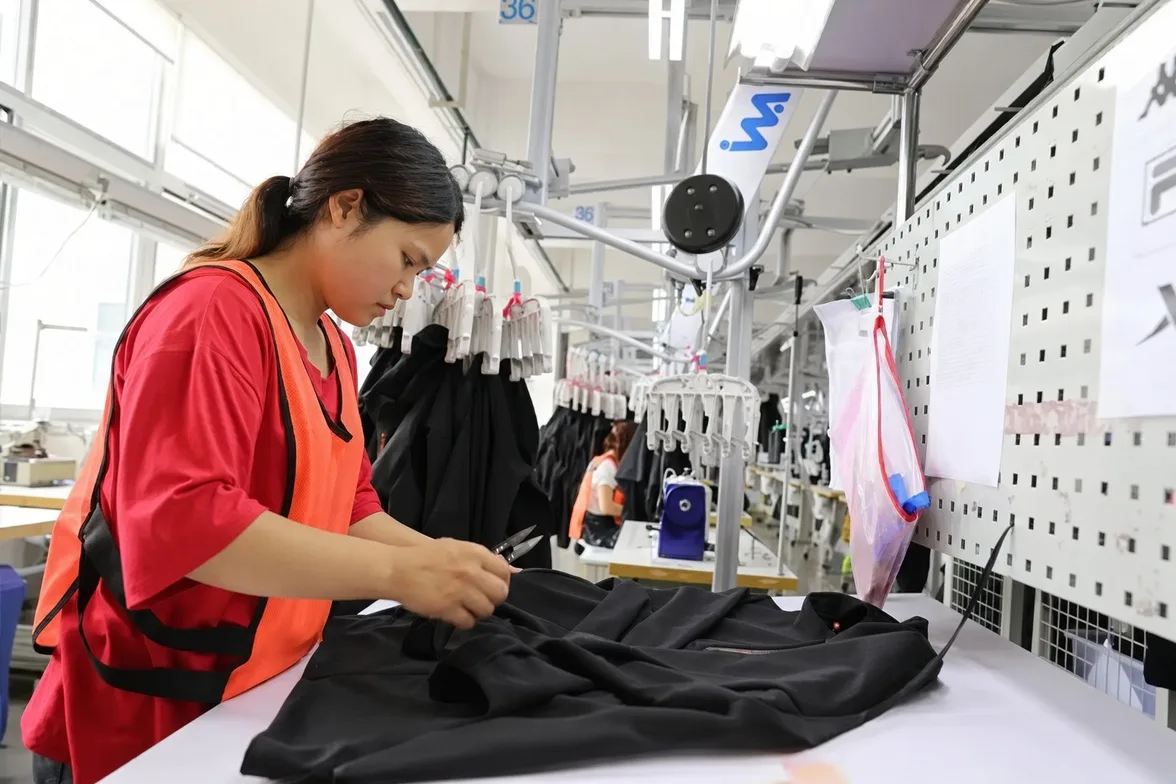
I walked this sequence on the floor of a Guangdong workwear plant last spring, stopwatch in hand. The inspector did not guess. She ran the table once for major defects and once for minor defects, then counted.
Step 1: Match Lot Size to a Sample Size Code Letter
Match your packed quantity against General Inspection Level II. Level II is the default commercial choice for garment final inspection, because it balances inspection cost against the risk of missing bad units.
Higher levels mean larger samples and more labour hours. Level III is used for high-risk orders. The S-4 special level is used when a buyer wants a tighter read on a specific defect class.
Step 2: Read the Accept and Reject Limits for Each Defect Class
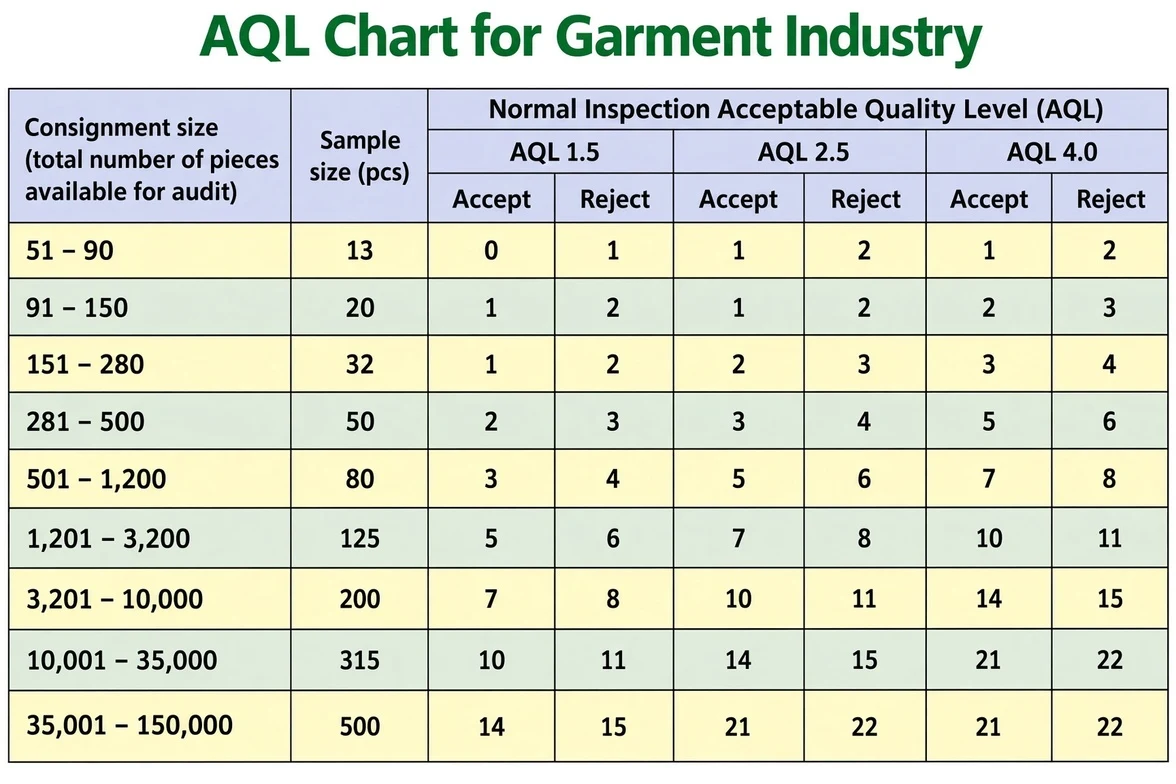
Take that code letter to the chart. Read across to your sample size, then down to the accept and reject numbers for each class. The accept number (Ac) is the maximum number of defect instances you accept. The reject number (Re) is the number that fails the lot.
There is no middle ground. One defect instance over the accept number and the whole shipment is rejected or held for rework. That is the decision rule in its entirety, and both standards apply it identically.
Which Code Letter Fits Your Lot Size?
Here is the mapping most workwear orders need. It fits on one laminated card for the quality control team.
| Lot size (pieces) | Code letter | Sample size |
|---|---|---|
| 281–500 | H | 50 |
| 501–1,200 | J | 80 |
| 1,201–3,200 | K | 125 |
| 3,201–10,000 | L | 200 |
Watch the boundary. A 3,200-piece lot stays at code K with sample 125. One piece more, at 3,201, jumps to code L and sample 200. I have watched a supplier argue that a 3,250-piece lot sits in K. It does not.
Verify lot size against the packing list before the inspector opens a carton, not after. The count you inspect against has to match the count you are buying.
What Are the AQL 2.5 Accept and Reject Limits for Garment Orders?
| Code / sample | Critical 0 accept / reject | Major 2.5 accept / reject | Minor 4.0 accept / reject |
|---|---|---|---|
| K / 125 | 0 / 1 | 7 / 8 | 10 / 11 |
| L / 200 | 0 / 1 | 10 / 11 | 14 / 15 |
Work the example. A 6,000-piece high-vis jacket order lands in code L, so you inspect 200 pieces. Ten major defects are allowed. At 11 the lot fails. Critical defects are zero, so one needle fragment ends the inspection on the spot.
Buyers often ask for a calculator at this point. A calculator helps only if you understand the table underneath it. See our uniform manufacturing process for where this check sits in the production timeline.
How Do You Classify Garment Defects as Critical, Major or Minor?
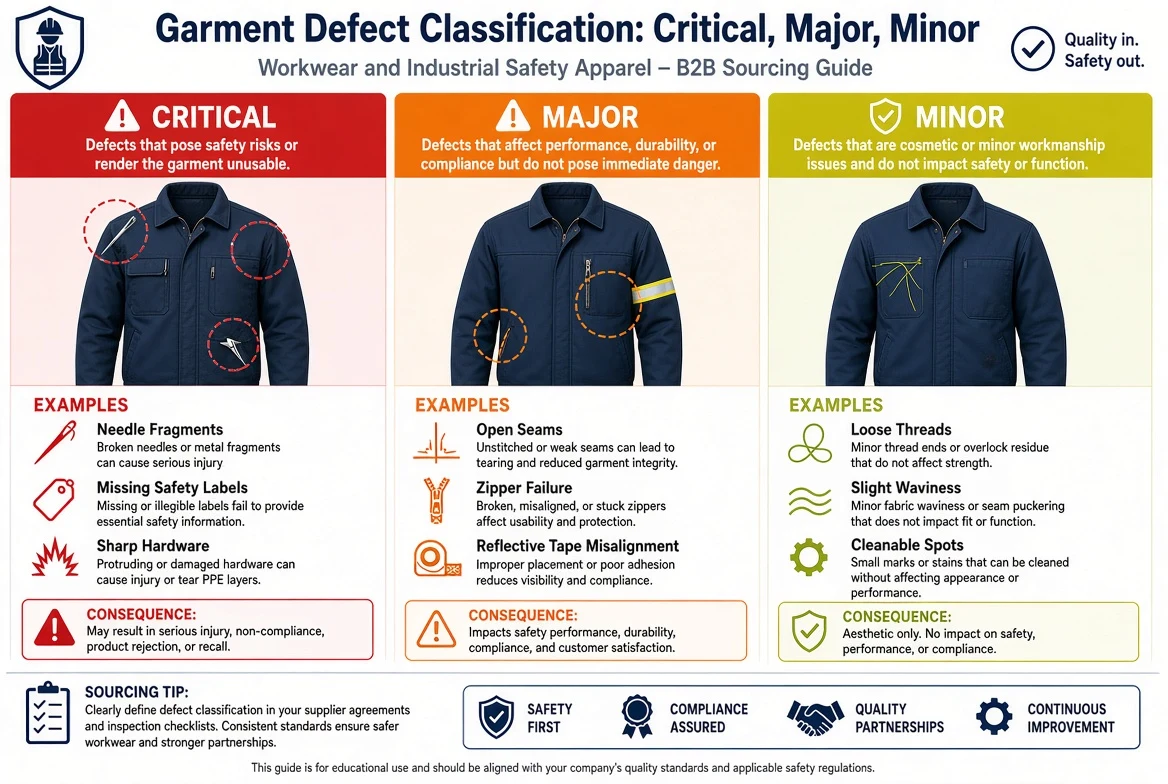
Classification is where contracts are won or lost. Definitions stay vague until someone is standing in a warehouse, so write them down first.
- Critical: needle fragments, sharp hardware edges, missing required safety labels or care tags, missing compliant reflective tape. Any hazard or compliance failure.
- Major: open seams, skipped structural stitches, zipper failure, measurements outside tolerance, reflective tape misalignment that reduces visibility, holes, severe shading, wrong size labels.
- Minor: loose threads, slight topstitch waviness, cleanable spots, mild presentation flaws that do not affect function.
When appearance and function overlap, the class follows function and safety. A wavy topstitch on a back yoke is minor. The same waviness on a high-vis shoulder, where it displaces the tape, is major. Tie definitions to safety vest class requirements whenever the garment carries visibility requirements.
🚀 Actionable Insight: The AQL chart counts defect instances, not units. A single jacket with four major defects adds four to your major total, so inspectors log each finding separately.
How Does a Floor Quality Inspector Decide Between Major and Minor?
Q: A technician says the defect is cosmetic. What decides it?
A: If it compromises function, safety or labelling, it is major. Cosmetic stays minor only when it survives a wash test and does not touch a structural seam.
Q: What happens when function and appearance overlap?
A: Two questions settle it. Does it reduce visibility or protection? Does the buyer's spec name it? If either answer is yes, it is major. Nobody debates taste on the floor.
Those two answers only hold if the purchase order already carries them. As Zhihang Wu, who works in garment quality control, puts it: "The defect you argue about on the floor is the defect your purchase order failed to define."
A defect class left open in the annex turns every inspection into a negotiation, and the inspector is rarely the person with authority to settle it. Name the class, the example and the limit, and the argument ends before the carton opens.
What Happens in a Pre-Shipment Inspection for Workwear?
The inspection itself is short. The preparation decides whether it means anything. This is the sequence used on industrial workwear programmes.
- Verify quantity: packed quantity and carton count against the purchase order and packing list.
- Pull random cartons: sample across the lot, not from the top stack.
- Inspect against the checklist: structural seams, closures, measurements, labels and packing details.
- Count by class: total critical, major and minor findings separately.
- Decide: pass, fail or hold for rework against the agreed accept and reject limits.
The field failures photographed most are reflective tape misalignment and dropped stitches at stress points. Our industrial sewing techniques guide covers the stitch faults behind the second one.
How Do You Write AQL 2.5 Into a Purchase Order?
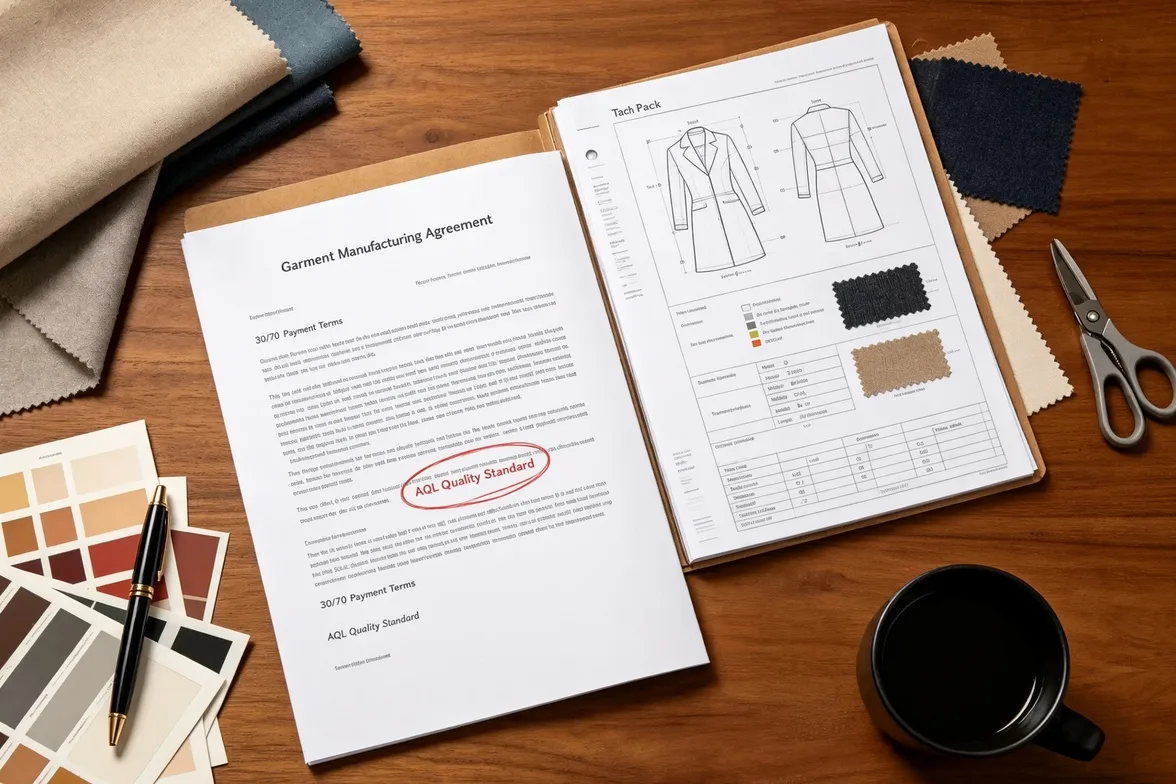
Write the rule into the purchase order, not the email thread. A clause in the contract survives a change of account manager; a verbal agreement does not.
Use One Clause That Removes the Argument
Clause to add: "Final random inspection to follow ANSI/ASQ Z1.4, General Inspection Level II, Single Sampling Plan, Critical 0 / Major 2.5 / Minor 4.0."
That sentence fixes the standard, the inspection level and all three limits in one line. Any report that arrives with a different sample size or a different limit is no longer a judgment call. It is out of contract.
Attach a Defect Checklist and Tolerances
A one-line clause still leaves room to argue. Add measurement tolerances, shade and colour standards, wash and colourfastness tests, packaging rules and labelling or certification requirements.
Then attach exact defect definitions in an annex and sign the plan as part of the purchase order. Include reinspection and corrective-action terms so a failed lot has a defined path. For cut-and-sew programmes, align the annex with our cut-and-sew manufacturer controls.
Medical garments need a different annex again, tied to the clinical and regulatory requirements in our medical garment quality control guide.
What Does the Data Show After 10,000 Pieces?
I reviewed the last 10,000 safety vests off our line. First-pass yield was 93.4% and rework was 6.6%. Major defects clustered around reflective tape misalignment at 38%, skipped side seams at 24% and size-label mismatch at 11%.
Tracebacks linked the tape drift to raw material roll inconsistency. Seam skips tracked to sewing tension variation after shift changes. The data turned a vague supplier claim into two specific corrective actions.
🧠 Author's Take: Publish anonymised yield and defect data responsibly. It strengthens authority and shows suppliers that you measure what they ship.
What Are the Limits of AQL 2.5 Inspection? 5 Risks to Control
AQL 2.5 is a lot-acceptance rule, not a quality guarantee. Five failure points show up again and again in pre-shipment audits.
1. Passing AQL 2.5 Does Not Mean Zero Defects
Sampling accepts risk. We seeded 2% major defects into a 5,000-piece jacket lot. It passed AQL 2.5 with sample 200 and an accept number of 10, and roughly 100 bad jackets remained in the shipment.
The rule limits lot risk, not unit risk. Tightening the limit or raising the inspection level reduces escapes, and both add cost.
2. Critical Defects Are Non-Negotiable
Most workwear programmes set critical at zero. That covers needle fragments, missing flame-retardant labels and uncertified reflective tape. We found one needle fragment in a vest, failed the lot and the supplier reworked 3,200 pieces.
Never fold a critical defect into the Major 2.5 count. A critical finding is an automatic fail, whatever the major total says.
3. Final Inspection Alone Is Not Enough
Final inspection catches defects after they are built. On a 6,000-piece uniform order, final AQL passed while inline checks later showed 38% reflective tape misalignment from inconsistent rolls.
Combine final AQL with pre-production review, inline sewing checks and measurement audits. For high-visibility garments, set the tape specification alongside the inspection plan with our reflective tape standards guide.
4. Visual AQL Cannot Replace Compliance Testing
A visual check cannot prove flame-retardant performance, high-visibility colourfastness or anti-static properties. Pair inspection with certified laboratory reports for EN ISO 20471, NFPA 2112 or your market standard.
A garment can pass every visual criterion and still fail the property the buyer needed. Compliance evidence comes from a laboratory, not an inspector's eye.
5. Incomplete Purchase Order Language Invites Disputes
"AQL 2.5" on its own is incomplete. We reviewed 20 supplier disputes last year, and all 20 traced to vague definitions, tolerances or test requirements.
Attach a defect classification annex. Specify General Inspection Level II, measurement tolerances and the exact class of every defect you care about. Most disputes end before they start when the purchase order answers the question.
Pre-Shipment Inspection Checklist Before You Release the Lot
Lock these eight items into the purchase order and the inspection annex before production closes.
- Standard referenced: ANSI/ASQ Z1.4 or ISO 2859-1.
- Inspection level: General Inspection Level II, single sampling.
- AQL values: Critical 0, Major 2.5, Minor 4.0.
- Defect definitions: examples and classification rules for critical, major and minor.
- Measurements and tolerances: measurement points, methods and pass/fail limits.
- Colour and shade: approved standard, lighting condition and tolerance.
- Wash and functional tests: colourfastness, shrinkage and performance checks.
- Reporting and reinspection: photos, defect logs, rework and recheck terms.
🔒 Procurement Tip: Tighter AQL limits cut buyer risk but add inspection time, rework and friction. Safety apparel needs Critical 0. Non-safety workwear can sit at Major 4.0 without hiding a real problem.
Frequently Asked Questions About AQL 2.5 Garment Inspection
These are the questions sourcing teams ask most before they approve an inspection plan.
1. What Does AQL 2.5 Mean in Garment Inspection?
AQL 2.5 is the acceptance quality limit for major defects in a lot-by-lot sampling plan. It sets how many units you inspect and how many defect instances fail the lot. It is a decision rule, not a target defect rate.
The limit applies to the sample, and the sample decides the lot. That is why the same 2.5 figure can accept a clean-looking shipment or reject one with the same average defect rate.
2. What AQL Limits Are Standard for Apparel?
Critical 0, Major 2.5 and Minor 4.0 is the common garment baseline. Critical covers safety and compliance failures. Major covers function and saleability. Minor covers cosmetic issues with low business impact.
Buyers in regulated categories sometimes tighten major to 1.5. Expect more inspection hours, more rework and more disputes at that level.
3. How Many Pieces Are Inspected in a 3,200-Piece Lot?
A 3,200-piece lot sits at code K under General Inspection Level II, so the sample is 125 pieces. For major defects at AQL 2.5 the accept number is 7 and the reject number is 8. For minor defects at AQL 4.0 they are 10 and 11.
At 3,201 pieces the code letter jumps to L and the sample doubles to 200. That boundary is worth checking against the packing list before inspection starts.
4. What Is the Difference Between Critical and Major Defects?
Critical defects create a safety hazard or a compliance failure, such as a needle fragment or a missing flame-resistant label. The acceptance number is zero, so a single finding fails the lot.
Major defects affect function or saleability, such as an open seam or a zipper failure, and they move onto the 2.5 plan. Minor defects stay cosmetic.
5. What Must an AQL Inspection Report Show?
The report should list lot size, sample size, code letter, the accept and reject limits for each defect class, the defects found and the pass/fail result. Photos and defect logs should tie back to the cartons sampled.
A report that shows only a pass stamp is not auditable. Ask for the sampling data before you accept the conclusion.
Final Thoughts: Why AQL 2.5 Fails Without a Written Rule
AQL 2.5 is the most practical major-defect benchmark in garment inspection. It gives buyers one shared pass/fail target without opening every carton, and it works only when the sample and the defect definitions are documented.
The limitation is real. Sampling accepts risk, and visual inspection cannot prove flame-retardant performance or high-visibility colourfastness. Write Critical 0 / Major 2.5 / Minor 4.0, General Inspection Level II and a defect checklist into the purchase order, then inspect against that document.
If you need supplier-side implementation support, contact LeelineWork with your order size and compliance requirements. For the wider sourcing picture, read our workwear sourcing guide.
Disclosure: The garments and inspection data in this guide come from our own production and private quality assurance budget. I receive no manufacturer kickbacks for these findings.

Fitness & Outdoor Wear Manufacturer
- 2,000+
- Clients Served
- 99.2%
- On-Time Delivery
- 2011
- Manufacturing Since