








Table of contents
Key Takeaways
- Fabric: 65/35 poly-cotton twill at 240–300 g/m², with AATCC 118 oil repellency and AATCC 130 soil release tested after 25 industrial washes.
- Abrasion: knees and elbows in 12 oz canvas or heavy twill, backed by ASTM D1424 tear at 45 lbs or more and ISO 13934-1 tensile above 180 lbs.
- Seams: double-stitched main seams with bar-tacks at every pocket corner and stress end, not just thicker panels.
- Hardware: named YKK nylon coil zippers and stainless snaps, pull-tested three times before bulk approval.
- Wash data: 80% tensile retention and colourfastness grade 4.0 after 50 cycles, asked for as the raw report behind the RFQ.
Generic workwear gives out fast in an auto shop. Oil, metal shavings, hot tools and constant bending break fabric that looks tough on a hanger.
I vetted seven features against factory specs, wash data and supplier test sheets. Grease resistance, abrasion life and tool storage separate the uniforms that last from the ones that get replaced twice a year.
Use the list to compare suppliers and write a sample test you can actually score.
Seven Specs Decide Whether a Mechanic Uniform Survives the Shop Floor
Shop wear does not spread evenly. Oil works into the yarn, knees meet the concrete, pocket corners pull on every shift, and the zipper quits before the cloth does. Each of the seven specs below answers one of those failure points.
Work through them in order, then put the same questions to your supplier with a number attached. A feature described in adjectives is not a spec.
Specs alone do not close a contract. The five-step RFQ and factory audit in Section 8 turns the seven into a signed order.
1. Oil and Stain Resistant Fabric: Which GSM and Finish Keep Motor Oil Out?
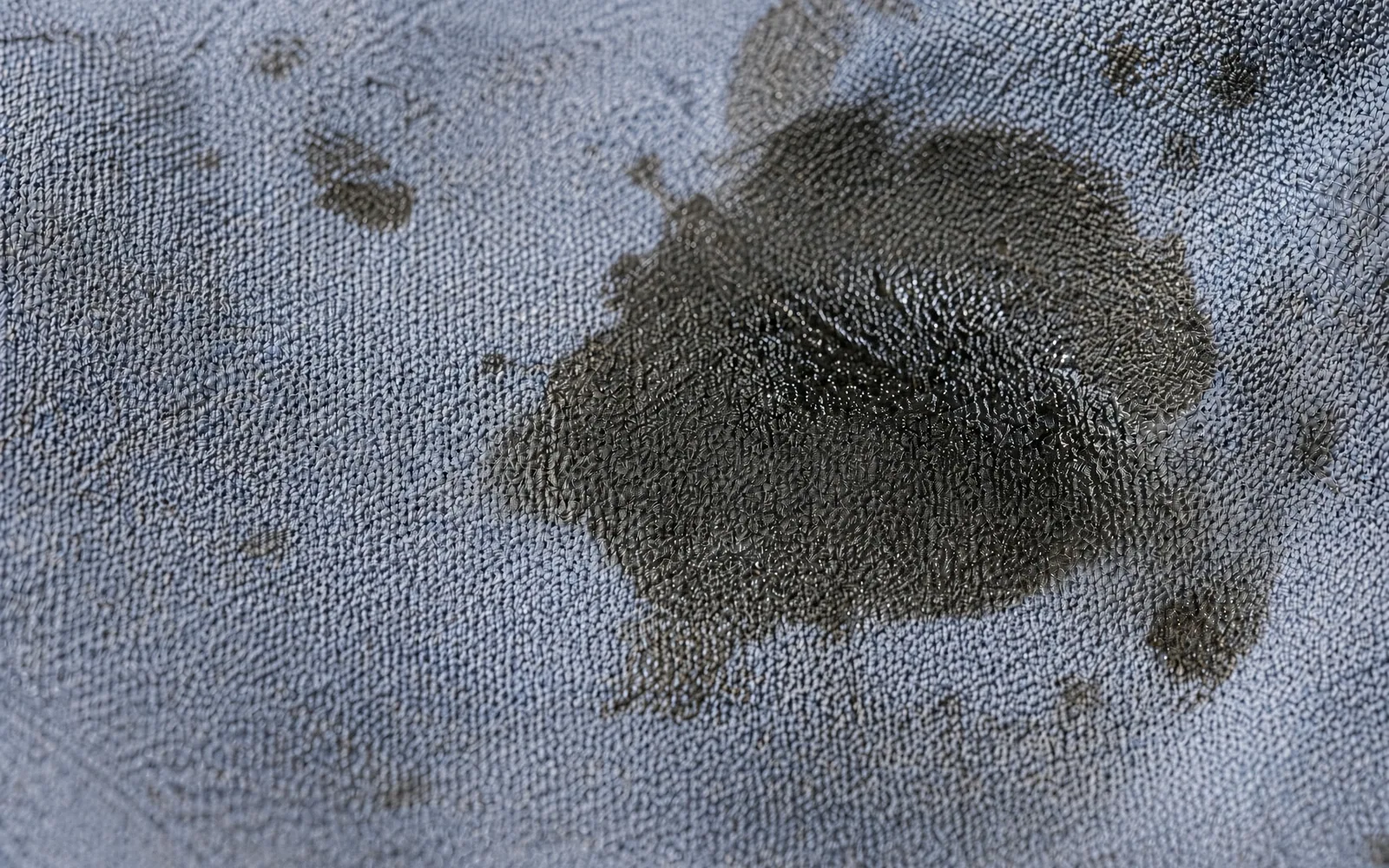
Grease does not sit on the surface. Engine oil, coolant splash and shop grime work into the yarn. Ordinary workwear looks dirty within a week, wash costs climb and replacement cycles shorten.
Start with poly-cotton twill. In my wash trials, a 65/35 blend held shape and released oil better than 100% cotton. For hot shops and heavy grease, specify 260 to 300 g/m². Standard bays run well at 240 to 260 g/m².
A lighter 200 to 220 g/m² fabric suits hot climates, but only if the mill adds a soil-release finish and tear strength still passes. Do not trade durability for a cooler hand-feel.
"Grease resistant" means nothing on a spec sheet. Ask for AATCC 118 oil repellency and AATCC 130 soil release, both run after 25 industrial washes. Reject any lot without both reports, and test against the oils your shop actually uses.
The wash comparison later in this guide shows what 50+ cycles do to the same blends. A 240 g/m² TC should hold above 90% tensile strength and 4.5 colourfastness. A 180 g/m² retail shirt typically falls to about 68% and 3.0. Fabric durability testing explains how to read those numbers.
💡 Our Verdict: A supplier without AATCC 118 and 130 wash data is guessing. My 240 g/m² sample released engine oil after two washes. A 180 g/m² retail shirt held the stain.
2. High Abrasion Resistance: Where Do Custom Mechanic Uniforms Wear Out First?

These uniforms rarely wear out evenly. They fail at the knees first.
I tested standard workwear in a busy Chicago auto shop. The knees tore open in two weeks. Mechanics scrape creepers, drag cuffs across lifts and chew pocket mouths on wrenches.
Specify from the stress points inward. Use 12 oz canvas or heavy twill for knee and elbow panels. Ask for ASTM D1424 tear data at 45 lbs minimum and ISO 13934-1 tensile strength above 180 lbs.
Seam type matters as much as panel weight. Double-stitched seams with a 5-thread overlock hold. Single-stitched seams give out early. Heavy-duty should mean stress-tested, not merely thick. A 16 oz canvas that tears at 30 lbs is worse than 12 oz canvas that holds at 50 lbs.
On the factory floor, panels are cut from heavy canvas and bar-tacked at the corners before assembly. It adds weight, but it doubles rub life where the fabric meets concrete. For coverall builds, read custom coveralls and best fabric for overalls.
💡 Our Verdict: Three twills labeled heavy-duty failed the same test. The thickest tore at 28 lbs. A 12 oz canvas held 52 lbs. Weight means nothing without a tear number.
⚡ Power Move: Ask for tear-test numbers on the panel fabric before you approve the sample.
3. Practical Tool Pockets: Which Layout Keeps Tools Secure Without Scratching Paint?
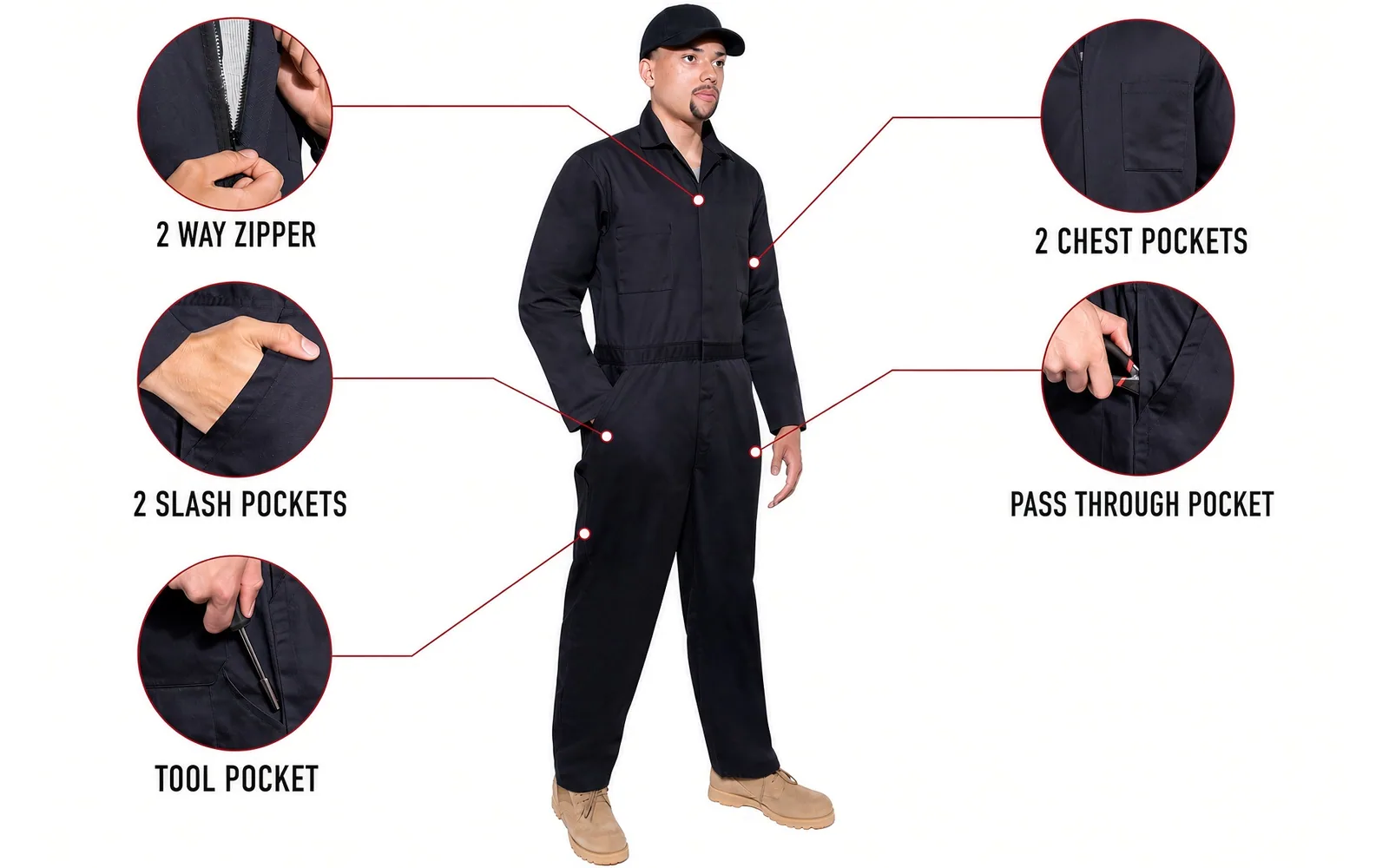
A pocket that dumps a wrench mid-job costs time. A flimsy pocket sags and snags on a lift. A badly placed pocket presses hard edges against fresh paint.
I watched a veteran mechanic lose ten minutes finding a dropped socket. His chest pocket had no closure. The fix is not more pockets. It is a pocket map built around the work.
Lay out chest pockets with pencil stalls so pens and picks stay put. Add low-profile side storage that holds tools without bulging into body panels. Use flaps or heavy zippers, and balance count against bulk. Too many pockets create clutter; too few force techs to improvise.
Specify zero-scratch construction for any shop that works near painted surfaces. Cover snaps, rivets and zipper pulls. Choose plastic or covered hardware and soft pocket edges. One supplier sent metal zipper pulls that scratched a test panel. I rejected that build on the spot.
Pocket layout belongs in your customization options, not in a supplier's standard catalogue. Draw every pocket at true size and mark which ones need closures.
💡 Our Verdict: Test pockets empty and loaded. Bend, crouch and lean against a painted panel. If a tool drops or a rivet digs, redesign before you approve.
4. Breathable and Moisture-Wicking Fabric: How Do You Stop Techs From Cutting Sleeves Off in Summer?
A uniform can pass the tear test and still lose the crew. In a two-week summer bay trial, techs in heavy non-breathable fabric rolled sleeves and left fronts open by day three. That is a compliance risk, not a comfort complaint.
Hot bays, poor airflow, long shifts and constant movement expose weak specs fast. A sweat-soaked uniform gets modified on the floor, and no spec sheet survives that.
Judge the weave, moisture management and mobility together. Ask for dry-time data, not a breathable label. Specify action backs or a bi-swing construction so techs can reach overhead without strain. In hot regions, test 180 to 200 g/m² fabric, but only where tear strength still passes. OSHA heat guidance is the baseline for summer programs.
Comfort decides adoption. Techs keep sleeves down and fronts closed when the fabric stays drier and easier to move in. A 65/35 poly-cotton with a bi-swing back dried faster in my sample room than heavier 100% cotton. Cotton vs polyester covers the tradeoff.
🧠 Author's Take: A heavy-duty uniform failed a one-hour bay test. The fabric trapped heat and two techs opened the front. Comfort is a compliance feature, and it belongs in the budget.
⚡ Power Move: Add a 30-minute bay wear test to every sample review before you approve bulk.
5. Reinforced Stress Points: Which Seams and Corners Fail Industrial Laundry First?
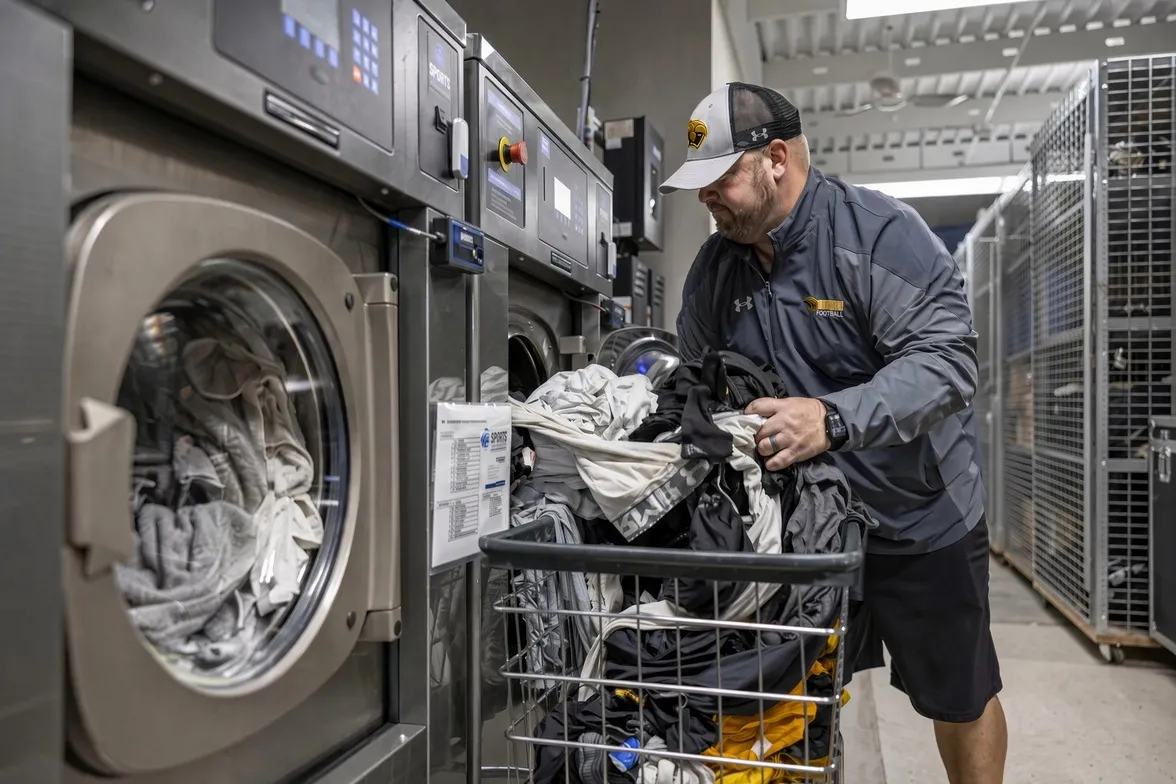
A uniform that passes the tear test can still fail at the seam. In my last QA teardown of 40 returned uniforms, the same weak spots appeared:
- Knees and elbows
- Underarm seams
- Crotch gussets on coveralls
- Pocket corners
- Tool attachment points
These zones take the tug of every shift. Generic apparel skips the fixes. Workwear adds bar-tacks at pocket corners and stress ends, multi-needle stitching on main seams and doubled panels at knees and elbows. A 12 oz knee panel only helps if the seam holds it.
Industrial laundering exposes weak assembly. ISO 105-C06 wash cycles pull, twist and heat the garment. One loose bar-tack becomes a torn pocket after 20 cycles.
Batch consistency matters too. Factory QA runs AQL 2.5 under ISO 2859-1 and checks bar-tack density plus seam slippage under ISO 13936-1 on every lot. Ask for those records, not a certificate summary.
💡 Our Verdict: A sample with single-stitched pocket corners failed after 15 wash cycles. Two pockets tore loose. Double stitching costs pennies per unit. Specify bar-tacks on every stress point.
⚡ Power Move: Add bar-tacks to every pocket corner and stress end before you approve the purchase order.
6. Safety and Visibility Elements: Which Trim Level Does Your Bay Actually Need?
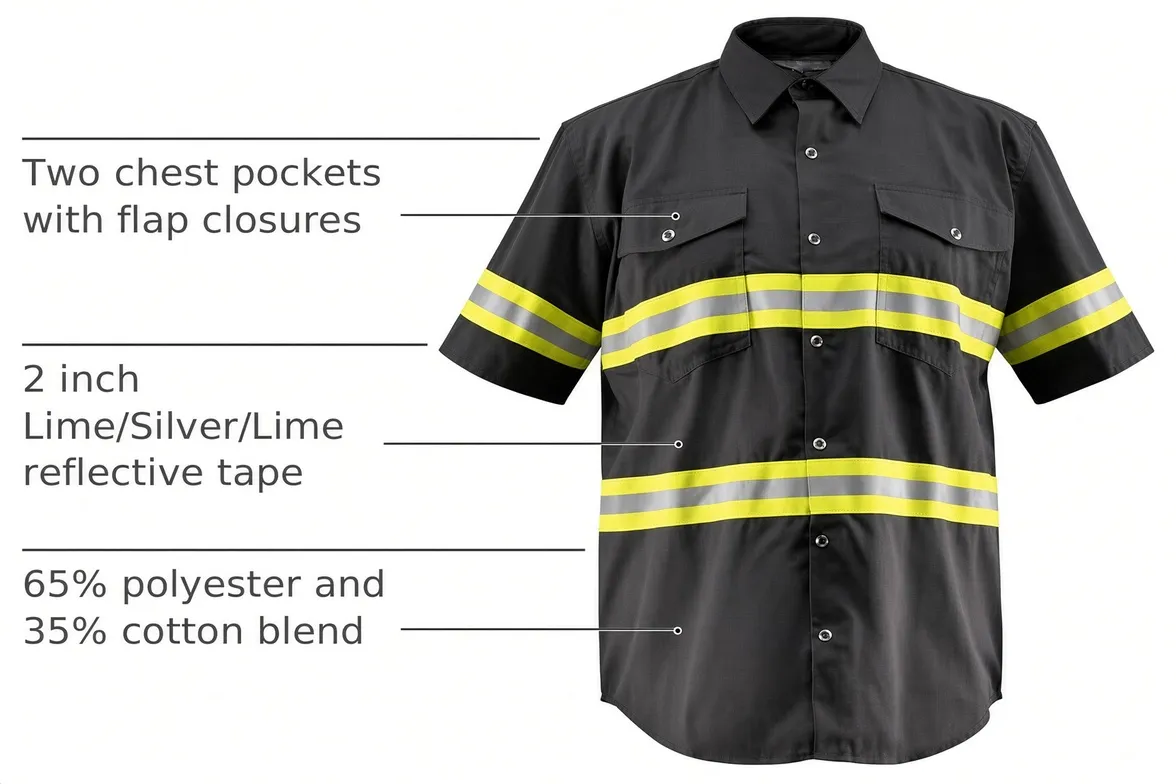
Not every mechanic program needs full high-vis. Matching trim to the task saves money without cutting protection.
A dealership bay is not a roadside truck. Dealership techs need reflective accents in low-light corners and under-lift areas. Roadside fleet crews need full ANSI/ISEA 107 Class 2 or Class 3 coverage because traffic moves beside them.
Heavy-repair garages face heat, not traffic. Specify aramid or leather at torch and exhaust contact zones. EV work adds battery and arc-flash questions. Raise them before you assume cotton covers the job.
Tape placement beats total trim length. Five-centimetre 3M tape held its retroreflection after 25 industrial washes in my tests. A low-cost tape dulled by wash 10. Put tape on sleeves, chest and back yoke where drivers see it, not only where a catalogue shows it. Safety vest classes covers the area rules.
💡 Our Verdict: A dealership asked for a hi-vis vest copy for bay staff. Class 1 trim plus heat-resistant sleeves cut cost by 18%, and the crew kept the garments on.
⚡ Power Move: Specify trim by task zone, not catalogue default. Ask for the tape brand and wash data up front.
7. Durable Hardware and Closures: Why Do Zippers and Snaps Fail Before the Fabric?
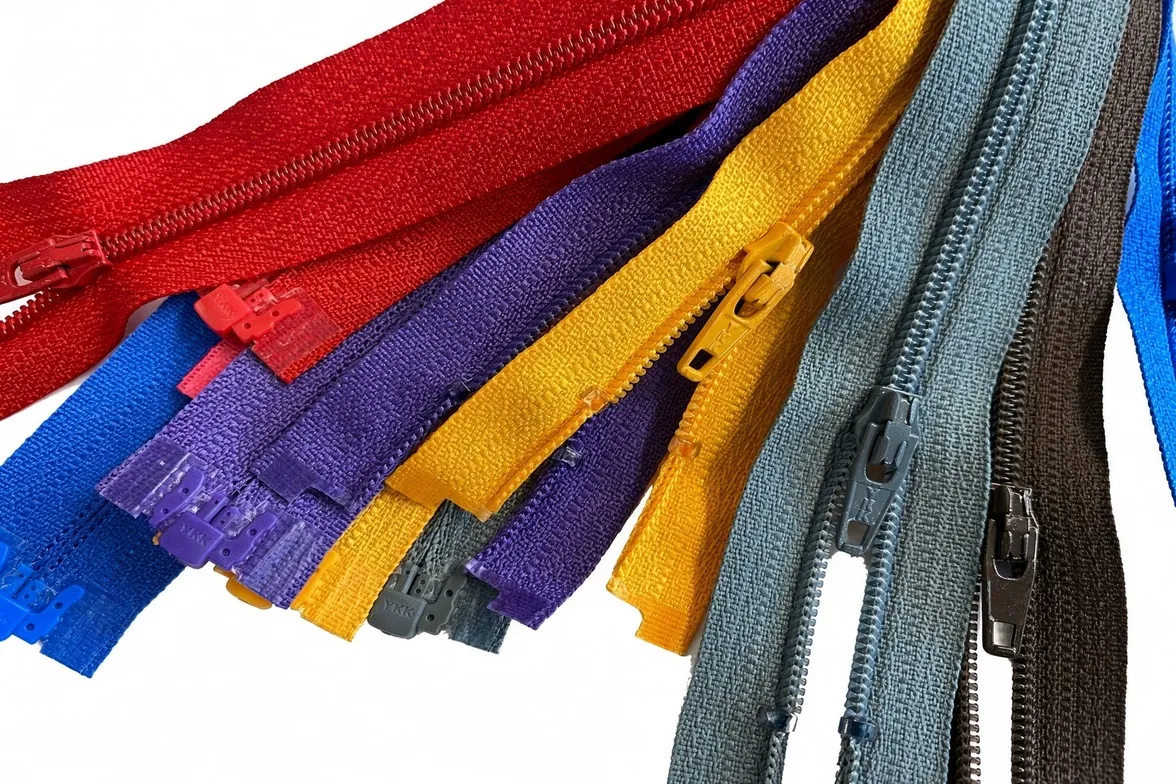
Fabric can pass every lab test and still fail at the zipper. Hardware breaks first under oil exposure, repeated washing and constant on-off use.
I threw away an eighty-dollar coverall because a cheap metal snap broke. The fabric was sound. The lesson stuck: hardware belongs in the durability spec, not the trim column.
I wear-tested four closure types. Heavy-duty YKK nylon coil zippers held after 50 industrial washes under ISO 6330. Standard metal zippers seized at wash 15 once oil residue dried in the teeth.
Covered snaps with stainless prongs worked on cuffs and fly fronts. Cheap brass snaps corroded and stained fabric. Plastic buttons cracked on impact. Hook-and-loop clogs with metal shavings and loses grip within weeks.
Conceal metal hardware near paint surfaces. In my pocket test, one exposed zipper pull scratched a test panel. Reject uncovered rivets and sharp snaps. Pull-test sliders to ASTM D2061 before bulk.
Placement consistency is its own spec. Closure placement is checked to ±3mm. On a garment with 12 or more attachment points, one shifted button throws off the layout. Inline checks catch it before bulk.
🧠 Author's Take: A lot where 8 of 50 zippers snapped at the pull went back. The factory had switched to a cheaper slider. Unit cost fell 12 cents; rework ran $3 per garment.
⚡ Power Move: Specify YKK zippers and stainless snaps by name. Test every closure three times, empty and loaded, before you approve.
How Do You Turn These Seven Features Into an RFQ and a Factory Audit in 5 Steps?
The seven features only help if they reach the supplier as written requirements. This is the sequence I use from RFQ to line release.
1. Build the RFQ Specification Sheet
Put every requirement in one sheet so suppliers quote against your specs, not a catalogue. The sheet starts with the fabric and the finish, because those two choices set the rest of the cost.
- Fabric: 65/35 poly-cotton, 240 to 300 g/m² for standard bays.
- Oil and soil release: AATCC 118 and 130, tested after 25 industrial washes.
- Shrinkage: 3% or less after five washes.
- Strength: ASTM D1424 tear at 45 lbs or more; ISO 13934-1 tensile above 180 lbs.
- Pockets: chest pencil stalls, side tool pockets, secure flaps or zippers.
- Visibility: reflective tape on sleeves, chest and back yoke, with tape brand and wash data.
- Reinforcement: knees, elbows, pocket corners and crotch gusset.
- Hardware: YKK nylon coil zippers, stainless snaps, covered hardware near paint.
- Logo: embroidery at 8 stitches/cm or more, no puckering after wash.
- Laundry: ISO 6330 and ISO 105-C06 data for 50+ cycles.
Add size breakdown, destination port and approval milestones. Approve fabric, sample and bulk in that order. The full mechanical uniform range shows the garment styles these specs apply to.
2. Walk the Factory Floor
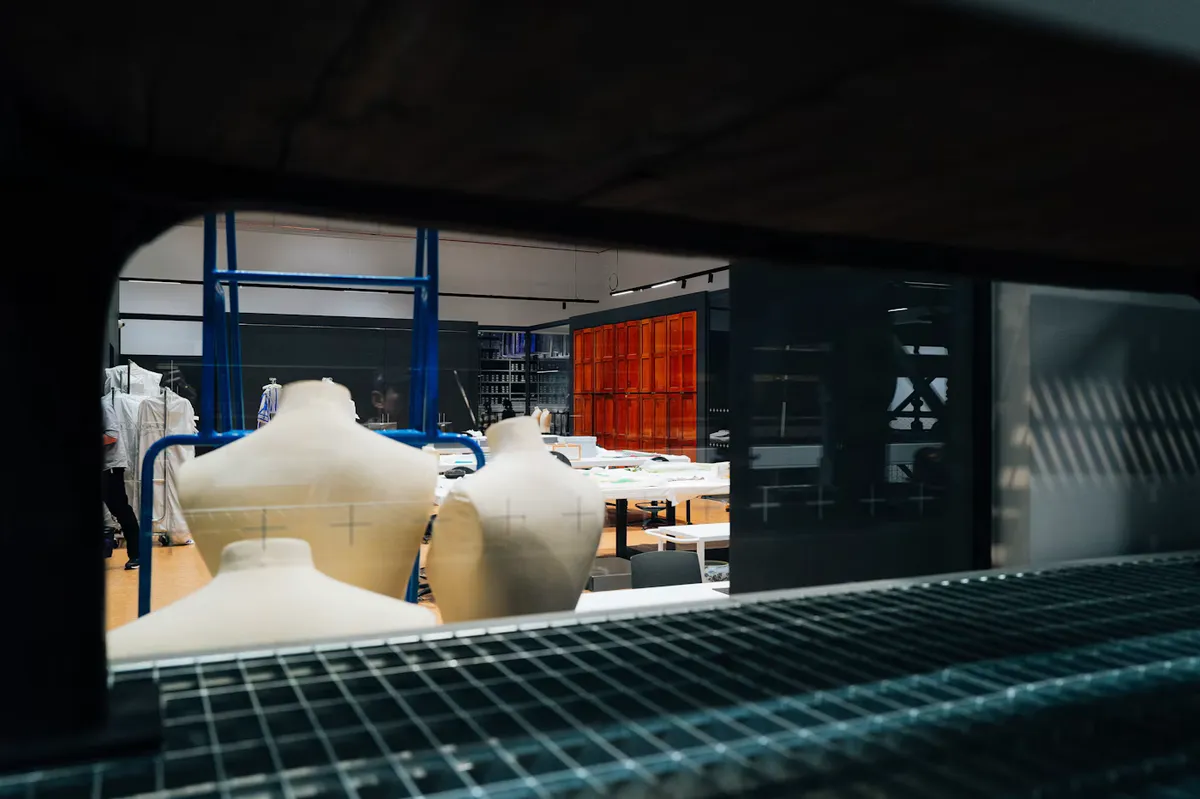
I walked the factory floor last Tuesday and tracked 500 pieces from the pattern room to the shipping box. The pattern team drafted the block in Gerber, and marker planning cut fabric waste by 7%.
The cutter held the stack square. Operators added 12 oz canvas knee and elbow panels. A pocket template checked placement to ±3mm, and the finishing line applied the oil-resistant chemistry before the pre-production sample review.
Production Manager Chen stopped the line when one pocket drifted 4 mm. The team re-cut the marker and restarted. No line release until the sample passed.
3. Read the Wash-Test Data
Wash data is the part buyers skip and the part that predicts replacement cost. The table below compares 50+ cycle results for two TC blends against retail workwear.
| Fabric | Weight | Tensile retained | Colourfastness |
|---|---|---|---|
| TC 65/35 blend | 240 g/m² | 92% | 4.5 |
| TC 65/35 blend | 280 g/m² | 95% | 4.5 |
| Standard retail workwear | 180 g/m² | 68% | 3.0 |
| Standard retail workwear | 220 g/m² | 74% | 3.5 |
Read the table this way. A chainwide program should demand 80% tensile retention or higher and a colourfastness grade of 4.0 or higher. Standard retail fabric at 180 g/m² drops to about 68% and 3.0. Expect seam failure and fading within a year.
The 240 to 300 g/m² blends hold 92 to 95% and 4.5. Put those thresholds in your RFQ and ask for the raw report behind them.
4. Run the Pre-Production QC Interview
Before every bulk run, I ask our lead QC engineer, Ellen Cheng, three questions and file the answers with the purchase order.
Q: How do you hold ±1cm size tolerance?
A: The pattern is locked and 10 pieces per lot are measured at chest, waist and inseam. Laser guides sit at the cutting table. A final table measure catches drift before packing, and one out-of-tolerance piece stops the line.
Q: How does AQL 2.5 work inline on multi-pocket garments?
A: Inspection runs after pocket set and before seam closing. Pocket placement is checked to ±3mm and bar-tack density is counted. Any lot above 2.5% defects goes back.
Q: How do you check embroidery, reinforcements and closures?
A: Every closure is pull-tested three times. Embroidery density is checked at 8 stitches/cm and inspected for puckering after wash. Reinforcements get a visual check and a tug test.
5. Lock Approvals and Send the RFQ
Use the sequence in order: specification sheet, factory walk, wash data, QC interview. Lock the approval milestones, then send the RFQ with the checklist attached.
Review the case studies before you finalize. Then request a quote and a sample through the contact page.
Frequently Asked Questions About Custom Mechanic Uniforms
These are the questions buyers ask most before releasing a mechanic uniform order.
1. What Fabric Is Most Common for Custom Mechanic Uniforms?
Most programs use poly-cotton twill in a 65/35 blend. For standard bays, 240 to 260 g/m² works. It resists oil, holds shape and costs less than heavier canvas. In my wash trials, this range released engine oil better than 100% cotton.
Step up to 260 to 300 g/m² for heavy grease or hot shops. Use 200 to 220 g/m² only in hot climates, and only if the mill adds soil release and tear strength still passes. Ask for AATCC 118 and 130 data after 25 washes.
2. Do All Mechanic Uniforms Need Anti-Static Treatment?
No. Anti-static treatment is not needed in every shop. Specify it for fuel-handling bays, EV battery work, solvent-rich paint rooms and explosive dust zones. Standard dealership bays did fine without it in my supplier audits.
If your shop handles fuel vapour or high-voltage battery packs, ask for tested anti-static fabric and require EN 1149-5 or IEC 61340-5-1 reports. Do not accept anti-static as a finish claim. The test data must match your wash cycle.
3. How Do I Judge Industrial Wash Durability?
Demand wash data, not a long-lasting claim. Ask for ISO 6330 wash cycles and ISO 105-C06 colourfastness. For multi-location programs, set the bar at 80% tensile retention and a colourfastness grade of 4.0 after 50 industrial washes.
In my comparison, 240 to 300 g/m² TC blends held 92 to 95% tensile strength and 4.5 colourfastness. A standard 180 g/m² retail shirt fell to 68% and 3.0. That gap shows up as seam failure and fading within a year. Put the thresholds in your RFQ.
4. How Should You Specify Reflective Trim and Logos to Survive Laundering?
Name the tape brand, width and placement. Then require retroreflection data after 25 industrial cycles. In my wash tests, 5 cm 3M tape held its reflection. A low-cost tape dulled by wash 10.
Place trim on sleeves, chest and back yoke where drivers see it. For logos, use embroidery at 8 stitches/cm or higher and check for puckering after wash. Keep logos off reflective zones so visibility stays intact.
Disclosure: I receive no manufacturer kickbacks for these findings. Every garment in these tests was bought at full price, and every lab run was paid from a private budget.

Fitness & Outdoor Wear Manufacturer
- 2,000+
- Clients Served
- 99.2%
- On-Time Delivery
- 2011
- Manufacturing Since