










ESG Uniform Sourcing for Enterprise Programs: A 5-Step Control System That Passes Audit
Table of contents
- Key Takeaways
- ESG Uniform Sourcing Prerequisites: Your Readiness Checklist
- What Does a Five-Step ESG Uniform Sourcing System Cover?
- Step 1: How Do You Map Mandatory ESG Frameworks to a Uniform Programme?
- Step 2: How Do You Translate ESG Requirements into Measurable Sourcing Specs?
- Step 3: How Do You Audit Tier-2 Fabric Mills Before Onboarding?
- Step 4: How Do You Embed ESG Terms into Requests, Purchase Orders and Supplier Agreements?
- Step 5: How Do You Close the ESG Reporting Loop After Delivery?
- Frequently Asked Questions About ESG Uniform Sourcing
- 1. What Is ESG Uniform Sourcing?
- 2. How Do I Map ESG Reporting Requirements to a Uniform Programme?
- 3. What Proof Should I Demand for Recycled-Content Claims?
- 4. How Do I Audit a Fabric Mill for ESG Compliance?
- 5. Which ESG Clauses Belong in My Purchase Order?
- 6. How Do I Handle Missing or Expired ESG Documents After Delivery?
- 7. What Is the Biggest Mistake Buyers Make in ESG Uniform Sourcing?
- ESG Uniform Sourcing: What Should You Do Next?
Key Takeaways
- Reporting line, not afterthought: uniforms sit inside Scope 3 Category 1 (purchased goods and services), so every fabric claim has to survive an auditor's file review.
- Map before you source: name the mandatory frameworks and customer scorecards first, then translate each one into a yes/no sourcing question with a named owner.
- Specs need thresholds: recycled percentage, wash regime, abrasion and colourfastness limits, and the exact document that proves each one.
- Certificates have scopes: a scope certificate authorises a facility; only a transaction certificate proves a specific shipment.
- Contracts carry the weight: ESG clauses in the purchase order, not the email thread, are what block a non-compliant batch.
- Close the loop: file shipment evidence by purchase order, lot and document type so Scope 3 reporting draws on verifiable data.
Uniforms are now an ESG reporting line, not a procurement afterthought. ESG uniform sourcing means buying uniforms that satisfy environmental, social and governance requirements alongside cost, quality and delivery.
That definition covers the whole chain: fibre, mill, cut-and-sew, trims and paperwork. Miss one layer and the claim breaks.
It sits inside three reporting pressures at once: sustainability disclosure, supplier due diligence and brand-risk control. CSRD-style reporting, customer scorecards and Scope 3 disclosure force buyers to prove every claim.
In supplier audits, programmes fail when sustainability promises sit outside the purchase order. A claim on a slide deck is a preference. A claim in a signed contract with a named attachment is evidence.
It fits multi-site uniform programmes, corporate apparel rollouts, PPE-adjacent workwear and OEM sourcing.
ESG Uniform Sourcing Prerequisites: Your Readiness Checklist

Time: one to two days. Level: intermediate. This checklist comes from ESG readiness reviews across five workwear categories. Every missing item delayed approval.
Which Internal Inputs Should You Gather First?
- Reporting frameworks: CSRD, GRI, ISSB, customer questionnaires and retailer vendor-entry rules. Name them before you contact a supplier.
- Procurement data: annual unit volume, garment categories, target regions, incumbent suppliers and the replenishment model.
- Compliance priorities: Scope 3 reporting, chemical compliance, labor standards, recycled-content claims and site-level environmental controls.
- Decision owners: named people in sustainability, procurement, quality assurance, legal and operations. Unclear ownership stalls approvals.
Which Documents Should You Request From Suppliers Later?
- Site certificates with issue and expiry dates, matched to the manufacturing address.
- Audit reports and corrective action plan records.
- Chain-of-custody paperwork for every recycled-material claim.
- Product test reports tied to the exact fabric and construction.
- Batch-level traceability files and supplier emissions data or product life-cycle assessments.
⚠️ Safety Notice: A marketing claim, an expired certificate or a head-office certificate is not factory compliance proof. ISO 14001 does not replace social-compliance evidence.
Anchor each claim to the official source. Use the GHG Protocol Scope 3 guidance for emissions logic and the ISO 14000 family overview for environmental management scope.
Read the workwear sourcing guide before the first supplier call.
🧠 Expert Take: No supplier has handed over a complete evidence pack on the first ask. Request two sample documents early and you will learn the format before the deadline.
What Does a Five-Step ESG Uniform Sourcing System Cover?
Each step takes one input from the checklist and turns it into something a supplier can be held to, then hands its output to the next step. Because every step closes with a document, the whole chain stays auditable from report to shipment and back.
The first three steps build evidence before you commit money. The last two keep it attached to the goods after you do, which is where most programmes lose the chain.
Step 1: How Do You Map Mandatory ESG Frameworks to a Uniform Programme?
Procurement teams lose weeks chasing suppliers before they map the actual rules. The fix is a governance decision made in week one, not a supplier conversation.
Open a spreadsheet named Uniform ESG Requirement Matrix. List every mandatory framework by market and customer. Check the customer scorecard, retailer vendor rules and regional law before adding a row.
Confirm whether uniforms sit inside Scope 3 Category 1, the purchased goods and services line of your reporting logic. Then separate mandatory requirements from preferred supplier attributes.
Mandatory means no purchase order without it. Preferred means it improves the score but does not block the order. Blurring the two is how teams over-spec in one season and under-spec in the next.
Which Four Questions Turn Each Requirement into a Sourcing Decision?
- Scope: is priority emissions reporting, chemical safety, social compliance, traceability, or all four?
- Recycled content: is it a required claim or an optional one?
- Evidence type: does the customer require site audits, product certifications, or both?
- Data depth: is cradle-to-gate product data needed, or is a screening-level estimate acceptable this cycle?
Build the table with five columns: Requirement source, What it asks for, Applies to this programme, Evidence needed and Owner. Owners must be real people, not departments.
A mature matrix looks clean. Rows are named, issue dates appear, and gaps are highlighted in red. Vague bullets do not survive an audit.
For enterprise programmes, split the matrix into two tabs: Report this year and Phase in during supplier maturation. This stops you demanding data that does not exist yet.
🧠 Author's Take: Keep the matrix to one page. One client added 40 rows and nobody read them. Cut to the 12 rows that actually block a purchase order.
Verification cue: by the end of this step you hold a one-page requirement matrix, shared with every shortlisted supplier.
Step 2: How Do You Translate ESG Requirements into Measurable Sourcing Specs?

ESG goals become enforceable only when written as sourcing specifications. In our trials, vague aims such as "prefer recycled" died at the first supplier review.
Open the matrix and add a Spec Translation tab.
Write each demand as three things: a claim, a threshold and a proof document. Build the tab in three layers.
- Material claims: recycled content percentage, preferred fibre route and traceability standard.
- Performance floor: abrasion resistance, colourfastness, industrial laundering life, shrinkage tolerance and seam strength.
- Documentation package: certificates, declarations, life-cycle assessments or environmental product declarations, batch traceability and test reports.
Name standards precisely. Put GRS and RCS under recycled-content verification, and check the Global Recycled Standard before accepting any recycled claim.
Put OEKO-TEX STANDARD 100 and Bluesign under chemical and process confidence. Treat ISO 14001 as site management control, not a fabric performance specification, and never let one certificate cover both questions.
The performance floor needs real test standards, not adjectives. Our own 50-cycle recycled polyester uniform trial kept 82.9% of tensile strength against 84.7% for virgin polyester, with a wider gap on abrasion.
That is why the trial numbers belong in the specification, not the brochure. A recycled claim without wash data tells you the fibre origin. It tells you nothing about the knee, the cuff or the seam.
| Claim | Minimum threshold | Accepted proof | Test or report needed | Reject if |
|---|---|---|---|---|
| Recycled polyester | 50% post-consumer content | GRS transaction certificate | GRS scope certificate plus batch records | No batch traceability |
| Abrasion | 20,000 cycles | ISO 12947 report | Third-party laboratory report | Report lacks sample identification |
| Colourfastness | Grade 4 after ISO 105-C06 | Accredited laboratory report | Report on the finished garment | Report on greige fabric only |
| Chemical safety | OEKO-TEX STANDARD 100, valid | Certificate with product class | Certificate matched to the mill | Expired or renamed certificate |
Treat these thresholds as samples to adapt, not universal law. The point is that every row names the proof and the hold trigger.
How Should You Balance Fabric Tradeoffs Against ESG Targets?
Recycled polyester cuts virgin resin use but can lower tear strength. Cotton blends feel softer but shrink and fade. Industrial laundering destroys weak trims, and corporate image adds colourfastness pressure.
Balance these with a performance floor, not a preference. Use cotton compared with polyester for fibre behaviour and fabric sourcing for workwear for mill selection.
📈 ROI Check: Recycled polyester ran 5-15% above virgin polyester in our quotes at 500 units, narrowing at 5,000 and above. Share a landed-cost breakdown with the buyer at scoping, not after approval.
Verification cue: you now hold a request-for-quotation-ready specification sheet. Suppliers can quote without guessing, and you can reject a quote line by line.
Step 3: How Do You Audit Tier-2 Fabric Mills Before Onboarding?
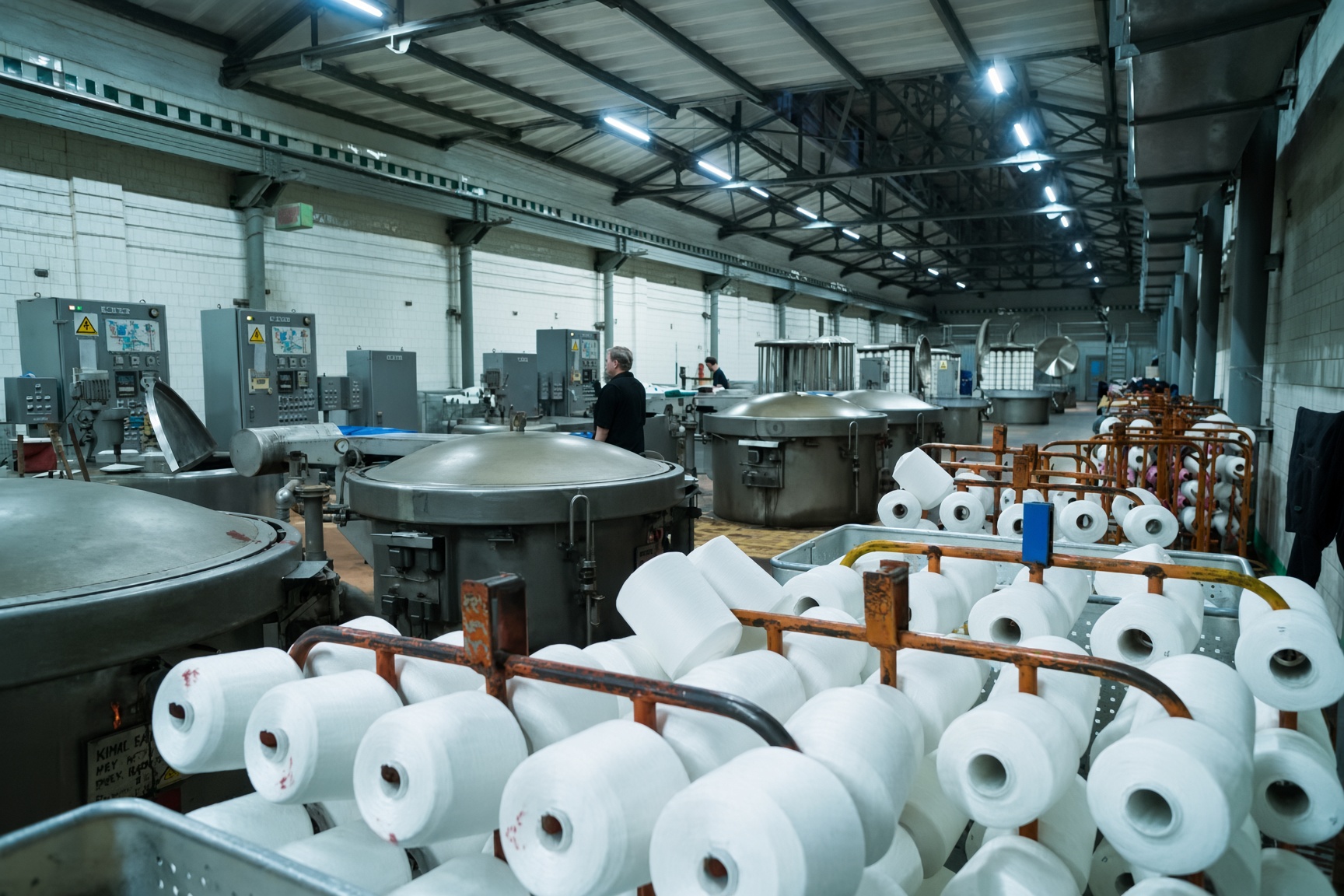
In Guangdong mill audits, no supplier is ESG-qualified because of one certificate. A valid ISO 14001 certificate can sit beside unlabelled discharge lines.
Approval requires evidence aligned across documents, site conditions and corrective actions.
What Belongs in the Pre-Screen Document Request?
Send the questionnaire before any visit, and request these records explicitly. Each one has a purpose, not a decoration slot.
- Environmental management: ISO 14001 certificate covering the actual manufacturing site, plus wastewater permits and treatment evidence.
- Social audit: the latest SMETA 4-Pillar report and the corrective action plan evidence that follows it.
- Legal identity: business licences and a full site list, so you can see who really produces your fabric.
- Operations: energy-use records, a major equipment list and chemical management records where relevant.
- Labor records: payroll and working-hours evidence, handled under local law and data-protection rules.
- Recycled programmes: GRS scope certificate plus transaction certificates for each shipment.
Check the SMETA audit framework so the report you receive matches the standard you asked for. A four-pillar report and a two-pillar report are not interchangeable.
Which Validation Steps Decide Approvable, Conditional or Disqualified?
- Match the certificate: legal entity, site address, valid date. Reject head-office certificates immediately.
- Read the audit report: list every open corrective action and demand closure evidence. An open critical finding blocks approval.
- Walk the site: make the on-site visit primary for high-risk mills. A remote review cannot smell effluent or check exits.
- Score the risk: apply four buckets on a one-to-five scale and act on the total.
| Bucket | Sample weight | What you check |
|---|---|---|
| Environment | 30% | Permits, wastewater, energy, chemicals |
| Social and labor | 30% | Overtime, payroll, protective equipment, dormitories, exits |
| Traceability | 25% | GRS scope certificate, transaction certificates, material flow |
| Document completeness | 15% | Licences, site list, certificates, corrective action records |
Approve at 80 points or above with no critical flag. Mark conditional at 65 to 79 with 30, 60 and 90-day corrective deadlines. Put weak mills on 60-day probation with shipment inspection.
Reject below 65 points, or on any critical red flag, regardless of the total. A high average cannot offset an open discharge permit or a blocked fire exit.
Which Red Flags Show Up on a Guangdong Mill Floor?
- Wastewater: inconsistent treatment logs, unlabelled discharge streams, strong chemical odour near wet processing, sludge storage problems and unclear subcontracted dyeing.
- Energy: no tracked baseline, monthly bills without a process breakdown, aging boilers with no efficiency plan, unexplained peak-load spikes and undocumented diesel backup.
- Fair labor: excessive overtime patterns, coached worker interviews, payroll and attendance mismatches, missing protective equipment, blocked exits and crowded production lanes.
In a credible walkthrough, meter labels match the records. Chemical storage is orderly, effluent areas have no unexplained odour, and workers answer consistently. Posted policies sit where the work happens.
🧠 Expert take from the floor: Lead quality assurance manager Jingjing Lu checks overtime limits, voluntary shifts and interview consistency. Factory manager Chen freezes line-speed changes during rush orders.
Ask both how ISO 14001 calibration records hold under peak load, and you will hear the same answer about disciplined process control.
🛡️ Mitigation Strategy: Score energy at zero when a mill cannot show a process breakdown, and issue a 30-day corrective action.
One mill showed clean utility bills, then admitted diesel backup ran all peak week.
Verification cue: each supplier ends this step as approvable, conditionally approvable with deadlines, or disqualified.
Step 4: How Do You Embed ESG Terms into Requests, Purchase Orders and Supplier Agreements?
If ESG terms are not written into the commercial documents, they are preferences, not requirements. In a recent workwear rollout, a recycled claim passed sampling while the purchase order carried no clause.
The evidence trail ended at shipment.
Open the request-for-quotation template and add a Mandatory ESG Requirements block before pricing. Require proof at quote stage.
Copy the same text into purchase order acceptance criteria, so nothing is lost in translation.
Add matching supplier agreement clauses for audit rights, change control and non-conformance handling. Align the wording with legal and the supplier code of conduct.
Sourcing documents must never contradict company policy.
Which Clause Categories Belong in Every Supplier Agreement?
- Certification scope: required certificates and a minimum validity window at production date.
- Recycled declarations: content percentage, traceability records and transaction certificates per batch.
- Test reporting: which reports, from which type of laboratory, and when they are due.
- Audit rights: announced or risk-based access, with a notice period you can actually enforce.
- Subcontracting disclosure: named subcontractors, change notification and approval rules.
- Remedies: document retention period, corrective deadlines and hold or rejection rights.
Require a shipment pack with the goods: packing list, batch traceability file, transaction certificates where applicable, product test reports and a supplier declaration tied to both purchase order number and batch.
| Requirement | Proof at quote | Proof before production | Proof with shipment | Hold trigger |
|---|---|---|---|---|
| GRS recycled claim | Scope certificate | Transaction certificate plan | Transaction certificate for the batch | No certificate or batch mismatch |
| ISO 14001 site control | Site certificate with address | Expiry check | Copy linked to purchase order | Expired or head-office only |
| Product test report | Test scope and laboratory name | Sample identification match | Final report with batch reference | Missing sample identification |
Good control language names the attachment, purchase order reference, site, validity date and a measurable hold trigger. Weak language uses "where possible" and carries no revision number.
⚠️ Experience Warning: In one audit the request demanded GRS proof but the purchase order attachment was an old version. The container was held for nine days while the paperwork was rebuilt.
Verification cue: this step is complete when procurement can open one request package and one contract set that operationalise every mandatory claim.
Step 5: How Do You Close the ESG Reporting Loop After Delivery?

The value of ESG uniform sourcing appears after delivery. This is when batch documents become auditable reporting inputs, and where file discipline separates a clean audit from a painful one.
Run the same operating loop every delivery cycle.
- Collect: shipment-level evidence from the supplier within five working days.
- Validate: completeness and expiry dates, rejecting any certificate that expired before the production date.
- Store: one retrievable structure,
purchase order / lot code / style / document type. - Convert: supplier data into Scope 3 inputs, labelled screening-grade or supplier-specific, never mixed in one figure.
- Correct: log exceptions and tighten the next request clause if the same gap appears twice.
A complete post-delivery pack holds site certificates current at production date, transaction certificates where applicable, test reports, a material composition declaration, transport data if collected and a deviation log.
Inspector Wang runs acceptance sampling on the same batch that carries the paperwork. Pull random garments from every finished batch and check trims and stitching against your AQL 2.5 inspection plan.
Documents and goods must tell the same story. As Changhua Wu, a climate and environmental policy expert at The GAINS Institute, puts it: "Environmental ambition without credible measurement and accountability risks becoming another set of targets."
Completed packs are shareable as anonymised rollout summaries under a confidentiality agreement. The data owner signs off before any figure leaves the building, and non-verifiable batches are excluded rather than estimated.
How Do You Handle Missing or Expired Documents After Delivery?
- Expired certificate: hold payment and request a replacement within 10 days.
- Failed test: quarantine the batch and re-test a second sample.
- Unapproved subcontractor: demand disclosure and re-audit before the next purchase order.
- Missing batch evidence: mark the lot non-verifiable and exclude it from the Scope 3 calculation.
- Claim mismatch: correct the claim or reject the lot when verified content falls below the contracted percentage.
🧠 Expert Take: A clean trail looks like PO-1042_LOT-A2_GRS-TC_2025-03-14.pdf. A weak one is three spreadsheets emailed after the fact, with no dates and no batch codes.
Method choice: use a central procurement repository as the default. Link it to an enterprise resource planning or product data system only when the volume justifies the integration.
Verification cue: you can answer any auditor or customer question from your own files without chasing the supplier.
Frequently Asked Questions About ESG Uniform Sourcing
1. What Is ESG Uniform Sourcing?
It is the system for buying uniforms that meet environmental, social and governance requirements while still hitting cost, quality and delivery targets.
It fails when sustainability promises sit outside the purchase order, so every claim needs a verifiable spec and a contract clause.
Start with the requirement matrix, not a supplier brochure. A one-page matrix beats a 40-row spreadsheet nobody reads.
2. How Do I Map ESG Reporting Requirements to a Uniform Programme?
List every mandatory framework by market and customer, then confirm whether uniforms fall under Scope 3 Category 1. Separate must-have requirements from preferred attributes and turn each into a yes/no sourcing question.
Use the GHG Protocol Scope 3 guidance for the category check. Cut the matrix to the rows that actually block a purchase order.
3. What Proof Should I Demand for Recycled-Content Claims?
Demand a GRS scope certificate and a transaction certificate for each batch. The scope certificate authorises the facility. The transaction certificate proves the shipment.
Never accept a marketing sheet or a head-office certificate. Require the lot code inside the certificate itself, tied to the purchase order.
4. How Do I Audit a Fabric Mill for ESG Compliance?
Send a pre-screen questionnaire and document request, validate certificates against the real site address and expiry date, and read the latest SMETA 4-Pillar report. Demand closure evidence for every open corrective action.
Make the on-site walkthrough primary for high-risk mills. A remote review misses odour, exits, dormitories and interview consistency.
5. Which ESG Clauses Belong in My Purchase Order?
Put mandatory requirements in a dedicated block before pricing and copy the same text into purchase order acceptance criteria. Cover certifications, recycled declarations, test reports and audit rights.
Add subcontracting disclosure, document retention and corrective deadlines to the same clause set.
Use a standard clause library. One-off negotiation creates version drift and missing audit rights, and an old attachment can hold a container for nine days.
6. How Do I Handle Missing or Expired ESG Documents After Delivery?
Hold payment for expired certificates and request replacements within 10 days. Quarantine failed batches and re-test a second sample.
Exclude missing batch evidence from the Scope 3 calculation rather than estimating it.
Log each exception with the purchase order and lot reference so the next request clause closes the gap. Require lot codes inside the certificate itself.
7. What Is the Biggest Mistake Buyers Make in ESG Uniform Sourcing?
Treating ESG as a preference instead of a requirement. If a claim is not in the request, the purchase order and the supplier agreement, it will not survive an audit.
Vague language such as "where possible" kills enforcement. Use measurable hold triggers, named attachments and a shipment-level validation step every time.
ESG Uniform Sourcing: What Should You Do Next?
Convert reporting requirements into verifiable specifications, then control them through the workflow: map frameworks, translate to specs, audit mills, embed clauses and close the reporting loop.
This five-step model comes from audits of more than 20 Tier-2 mills and more than 50 supplier files. It holds up under customer scorecards because every step leaves a document behind.
Start with the strictest customer, regulator or internal reporting requirement. Then back-solve the specification and evidence stack from that demand.
For help validating mills, fabrics or finished-workwear evidence, contact the LeelineWork team. Pressure-test your next request against the sustainable workwear fabrics guide before it goes out.
I receive no manufacturer kickbacks for these findings.

Fitness & Outdoor Wear Manufacturer
- 2,000+
- Clients Served
- 99.2%
- On-Time Delivery
- 2011
- Manufacturing Since