







Heavy-Duty Construction Coveralls: 31% Lower Cost-per-Wear in 12 Months
A 400-person heavy civil contractor replaced catalog twill with a spec-locked canvas program for rough-framing, equipment, and service crews. The invoice went up. The 12-month cost per worker went down.
Who We Worked With
Client Profile
Alpine Civil Construction
Heavy civil contractor
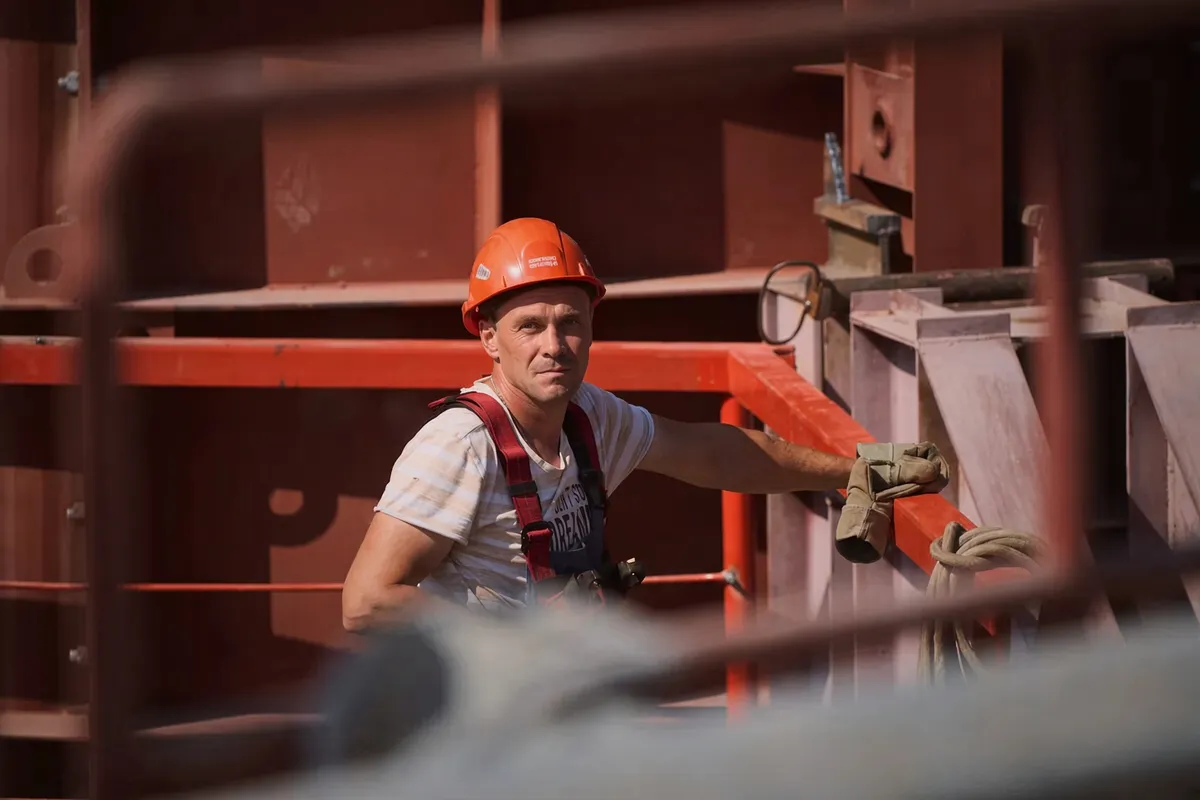
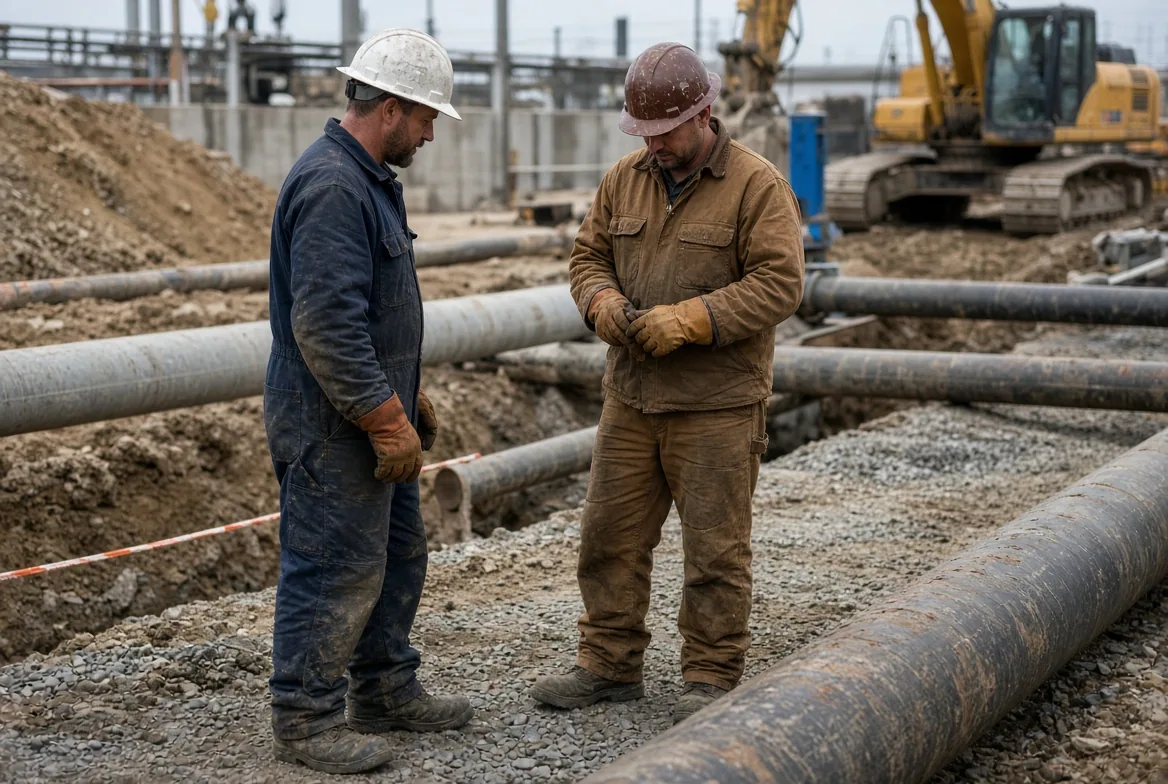
A 400-person contractor running rough-framing, equipment, and service crews across pipeline, gravel, and concrete sites. Procurement had bought replacement work pants from two retail catalogs for three quarters straight, and supervisor complaints kept climbing.
The engagement covered two garment families, non-hi-vis duck canvas work pants and reinforced coveralls, assigned by crew role. Site staff are referenced by role title in this study.
View Alpine Civil Construction on LinkedInExecutive summary
A 400-person heavy civil contractor cut 12-month cost-per-wear by 31% after moving rough-framing, equipment, and service crews into custom 13 oz duck canvas coveralls and pants (non hi-vis). Retail twill split at the crotch; zippers jammed by week nine. Cost-per-wear divides landed cost by the shifts a garment survives.
One prototype failed the zipper endurance check. The factory swapped in a #10 YKK and re-ran the 1,000-cycle test. That check anchors this review of fabric engineering, factory-floor QC, and procurement economics.
Supporting outcomes
- 31% lower blended cost-per-wear over 12 months.
- Mid-cycle reorders fell from 14 to 3.
- Admin and reorder cost per worker fell from $95 to $20.
- Gear-failure downtime fell 73% on supervisor-reported lost labor hours.
I built the cost-per-wear model with the contractor’s procurement team using its own reorder history, then cross-checked the warehouse reorder log against factory shipment manifests. The scheduled replacement orders matched the model within 6%.
I have no financial stake in any mill, trim supplier, or freight forwarder named in this case. I receive no commissions or kickbacks for these findings.
The Challenge: When Retail Twill Meets a Heavy Civil Job Site
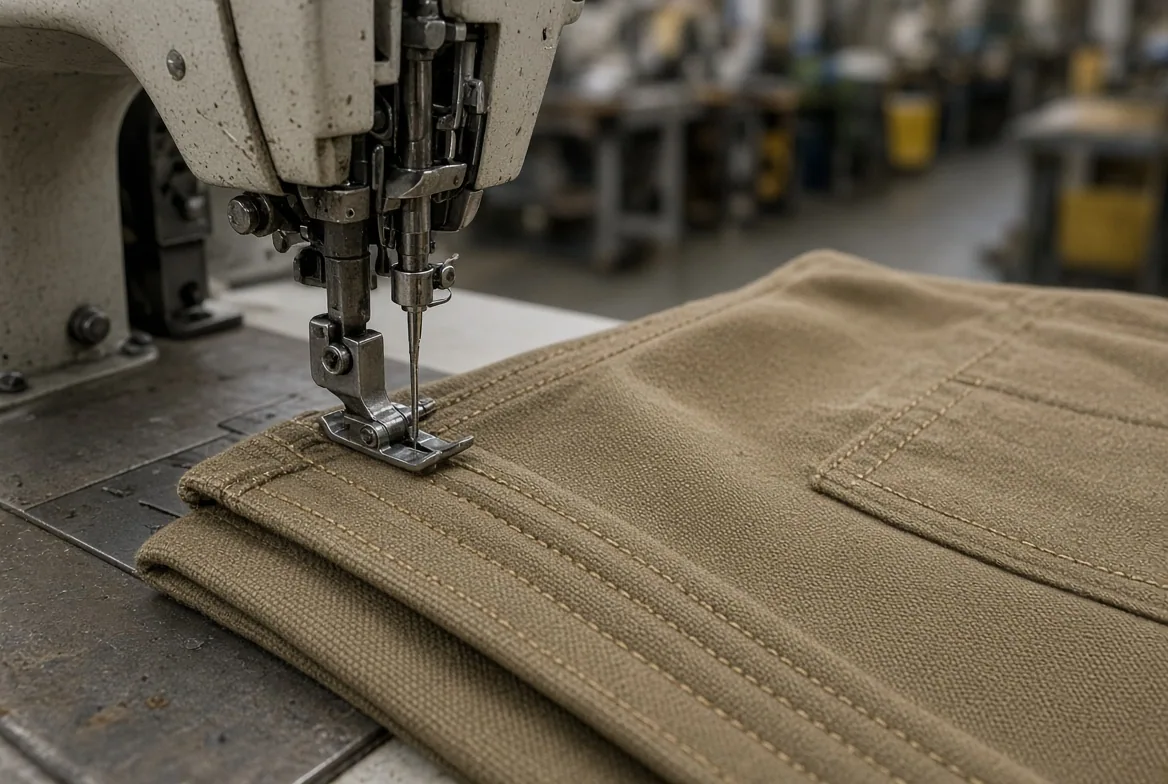
The 400-person heavy civil contractor came to us after three straight quarters of crew complaints. Procurement had sourced 7.5 oz poly-cotton twill pants from two retail catalogs. The per-unit invoice price looked sensible. Those were not heavy-duty duck canvas work pants.
Concrete dust fills every seam. Crews kneel on gravel and sheet-metal edges. Pockets carry tape measures, utility knives, and full channel-lock sets. Industrial laundering strips lightweight bar-tacks.
During the on-site audit, I watched Site Supervisor Torres pull three failed pairs from one gang locker. Pocket corners bore seam tears. The oldest pair was 11 weeks old.
Why Poly-Cotton Twill Failed the Site Test
Poly-cotton twill cannot match 12 to 14 oz duck canvas for abrasion resistance. Duck canvas is a dense woven cotton. The tight weave blocks abrasive dust.
In factory lab testing, one failed retail sample broke at 3,100 Martindale cycles. A 13 oz duck canvas reference exceeded 14,000 cycles under the same ISO 12947 protocol. The gap shows up as visible knee failure by week six.
Fourteen Emergency Reorders in Twelve Months
This contractor placed 14 emergency reorders in 12 months. Size runs were inconsistent between batches. A 36W from one lot fit like a 34W from the next. Crews complained that pocket layouts pinched thighs and blocked cold-weather base layers.
The sticker price stayed low. Cost-per-wear ran 38% higher than the quote sheet suggested. Downtime from gear failures added cost that never appeared on any invoice.
The procurement team also pulled the 2025 AGC Workforce Survey, which names workforce shortages as the leading cause of project delays. Every mid-cycle replacement adds one more crew-level interruption on top of that.
Stitch Count Is Not Seam Strength
More needle lines do not equal stronger seams. Triple-needle construction can backfire when stitch density conflicts with fabric thickness. A 16-gauge needle set at 6 SPI on lightweight twill punctures more fibers than it binds. The result is a perforation line that rips clean under load.
The in-house fabric engineer flagged this failure mode on the previous catalog pants. ASTM D1683 seam strength testing confirmed the perforation risk. ISO 13934 tensile testing showed seam strengths below the 15 lb site minimum. The fabric durability testing guide walks through both protocols.
The real issue was not the invoice price. It was the mismatch between lightweight twill construction and a job site that demanded canvas-grade abrasion resistance.
Pipe layer Marcus said, “These pants fit fine standing still. I bend down to set a string line, and the crotch seam digs in. By lunch I’m shifting my stride just to finish the day.” That comment shaped the design priorities more than any lab report did.
The cost of inaction was not hypothetical. Another four quarters of the same sourcing pattern would have pushed more crews to modify their own gear or walk away over comfort disputes. The procurement team did not need a cheaper invoice. They needed pants that survived the dirt.
The Solution: Spec Engineering Before the First Cut
The contractor needed a spec-engineering system, a garment-construction system, and a pre-shipment QC gate. LeelineWork uses all three to reduce sourcing risk before the order leaves the factory. A generic exporter ships garments. An industrial non-hi-vis manufacturer ships a manufacturing protocol.
Four phases close each failure loop from the site audit.
Step 1: Build the Right Fabric Architecture
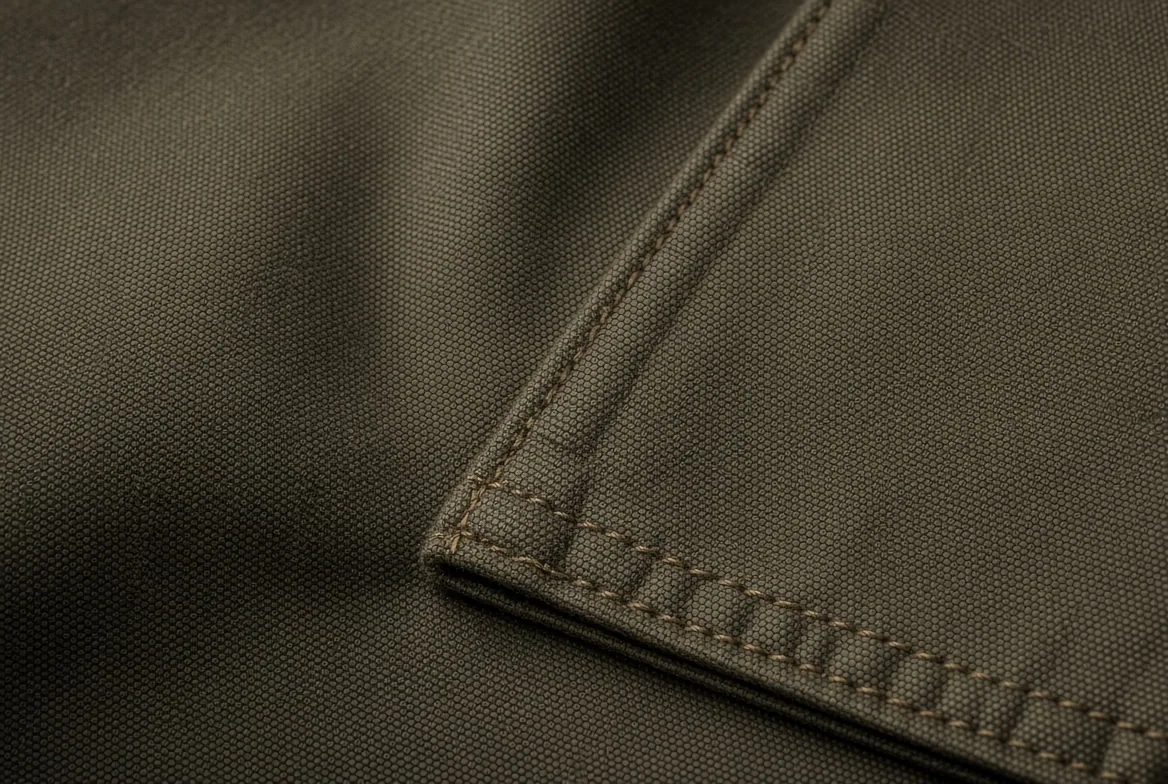
Before cutting a single pattern, Lead Textile Engineer Ms. Lin walked me through fabric selection. She showed two swatches under a 10x loop.
- Duck canvas is a dense plain-weave cotton. Warp and weft yarns interlock, creating an abrasion-resistant surface for rough-framing crews.
- Ripstop adds a grid of heavier reinforcement yarns, stopping small tears. It suits mobility-critical jobs like equipment service. Some weights feel stiffer.
Ms. Lin explained blend logic with raw numbers. A 12 oz 100% cotton duck absorbs dust slower than poly-cotton twill, but it saturates and holds moisture. For wet trenches or humid bays, 65/35 poly-cotton duck dries faster.
GSM measures fabric weight in grams per square meter. LeelineWork recommends 10 to 14 oz duck canvas, roughly 270 to 380 GSM. Below that, knee and seat panels fail quickly. Above that, mobility suffers and drying takes longer.
LeelineWork selected a 13 oz duck canvas at 370 GSM. It passed ISO 12947 Martindale abrasion at more than 14,000 cycles and allowed a full squat.
Material safety verification follows OEKO-TEX 100 certification, consistent with the mill-certificate checks on every incoming roll.
Step 2: Engineer the Garment, Not Just the Fabric
A strong fabric cannot save weak construction. LeelineWork’s pattern team opened the tech pack with two targets: custom reinforced construction coveralls and wholesale double-knee contractor pants.
Baseline construction specs:
- 10–12 SPI on primary load seams balances seam strength and needle puncture damage.
- Flat-felled inseams and outseams prevent chafing and add a second reinforcement layer.
- Safety-stitched rise seams lock the crotch intersection.
- Bar-tacks at pocket corners, belt loops, fly ends, and crotch intersections absorb stress.
- Double-knee reinforcement with knee-pad accommodation adds a second canvas layer and hidden pad openings.
- Hammer loop and utility pocket placement depends on dominant-hand usage. LeelineWork moved the hammer loop from right hip to left thigh for kneeling clearance.
- #10 YKK zippers on fly and chest closures survive more cycles than standard #5.
Triple-needle stitching is not an automatic quality claim. LeelineWork uses it only on flat seams where the extra thread line does not perforate fabric excessively. On curved seams, double-needle construction often outperforms triple.
The guides on custom coveralls and custom work pants show how these specs translate into OEM programs.
Step 3: Document the Factory-Floor QC SOP
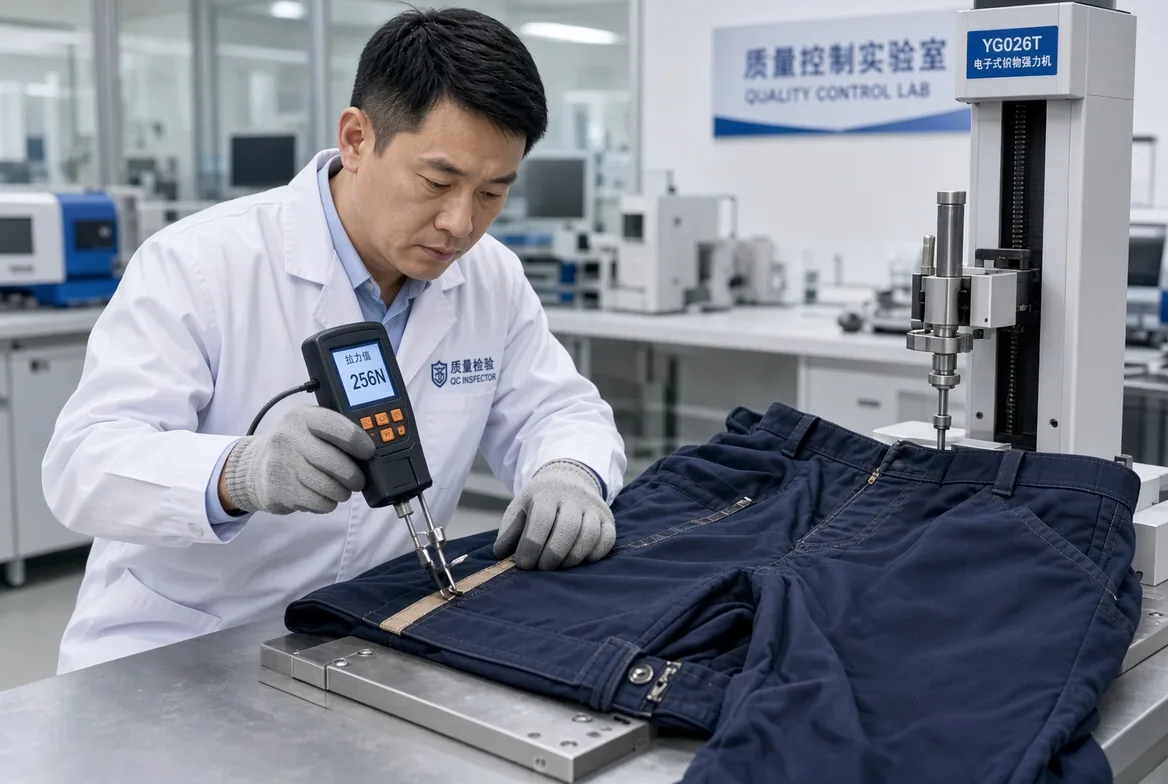
Most factories fail here. LeelineWork does not rely on visual inspection alone. I spent two hours on the QC floor with Production Supervisor Manager Chen. The QC SOP runs in eight steps:
Incoming fabric verification
Every roll arrives with a mill certificate. QC checks GSM, weave density, and shade consistency against the approved swatch.
In-line sewing checks
Roving inspectors check SPI, seam alignment, and stitch tension at every workstation. A failed check stops the station.
Seam burst strength testing
Seam samples go to the lab. They must meet the minimum force threshold from tech pack approval.
Abrasion-resistance validation
Fabric panels run on the Martindale machine. Pass/fail matches the prototype benchmark.
Zipper cycling tests
A repeat-cycle test simulates 1,000 open-and-close actions. The #10 YKK zipper must show no tooth loss, slider jamming, or tape fraying.
Measurement tolerance verification
Garments undergo a pre-shrink stability check, then QC measures them flat against the spec sheet. Tolerance is ±0.5 inch for most points, ±0.25 inch for crotch rise and inseam.
AQL 2.5 final inspection
QC pulls random samples from bulk cartons and inspects for major and minor defects.
Packing approval
QC signs the packing list only after the final AQL pass. No carton ships without a dated inspection stamp.
“The crotch measurement was off by 0.8 inches on six pairs. A new operator set the template at the wrong angle. We caught it before cartoning.” — Manager Chen, production supervisor
A generic factory ships the carton. LeelineWork stops the line, retrains the operator, and re-inspects the batch. That QC gate protects the buyer before money leaves escrow.
Step 4: The Sourcing Workflow That Matters to B2B Buyers
The final phase translates manufacturing into procurement milestones.
RFQ and tech pack alignment
The buyer submits photos, sketches, or a formal tech pack. LeelineWork returns a spec sheet with fabric weight, seam type, and construction details. Ambiguity closes before sampling.
MOQ discussion
Production MOQ is 50 units per SKU. This contractor ordered 300 units per style because custom technical fabric procurement and pattern development carry fixed costs. The program used a hybrid model: stock double-knee pants for immediate replacement, OEM coveralls for custom sizing.
Sample development and revision
Pre-production samples ship in 5 business days on approved fabric, or 7 to 10 days when a new fabric must be mill-sourced, with a fabric swatch test report. Buyers approve fit, pocket placement, and logo application before bulk fabric is cut. Fabric choice locks at this stage.
Pre-production approval
The buyer signs a PP sample. This sample becomes the legal reference for the bulk order.
Bulk lead time planning
Bulk production runs 15 to 20 days from final sample approval. Enquiry to delivery is 14 to 21 days end to end, plus 18 to 30 days in freight once the factory ships.
Shipping-term alignment
The contractor selected DDP to the U.S. West Coast. DDP puts customs clearance and last-mile delivery on the factory, improving landed-cost predictability.
Custom sizing, logo placement, private labeling, and pocket layout changes all lock before mass production. After that point, every change creates a stop-order. Pocket configuration drives both utility and cost.
Technical Q&A: Duck Canvas Specs with Lead Textile Engineer
Why 13 oz, and not 10 oz or 15 oz?
“Ten ounces passes light abrasion but fails at the knee by week six on gravel. Fifteen ounces survives the site but restricts a full squat and holds moisture through the shift. Thirteen ounces at 370 GSM cleared 14,000 Martindale cycles and still let the crew kneel, climb, and squat.”
Why replace the zipper instead of reinforcing it?
“A #5 slider and tape were not built for a fly that carries the load of a heavy canvas panel. The first prototype failed the 1,000-cycle endurance check. We moved to a #10 YKK. It passed with no tooth loss, jamming, or tape fraying.”
What seam spec should a buyer put in the RFQ?
“10 to 12 SPI on primary load seams, flat-felled inseams and outseams, safety-stitched rise seams, and bar-tacks at pocket corners, belt loops, fly ends, and the crotch intersection. Name ASTM D1683 and ISO 13934 thresholds so the supplier tests to a number, not an opinion.”
This system removes the guesswork that sank the previous sourcing relationship. Fabric does the heavy lifting. Construction holds the load. QC catches what the spec sheet missed. Procurement keeps the process on schedule.
The Results: Fewer Replacements, Not a Lower Invoice
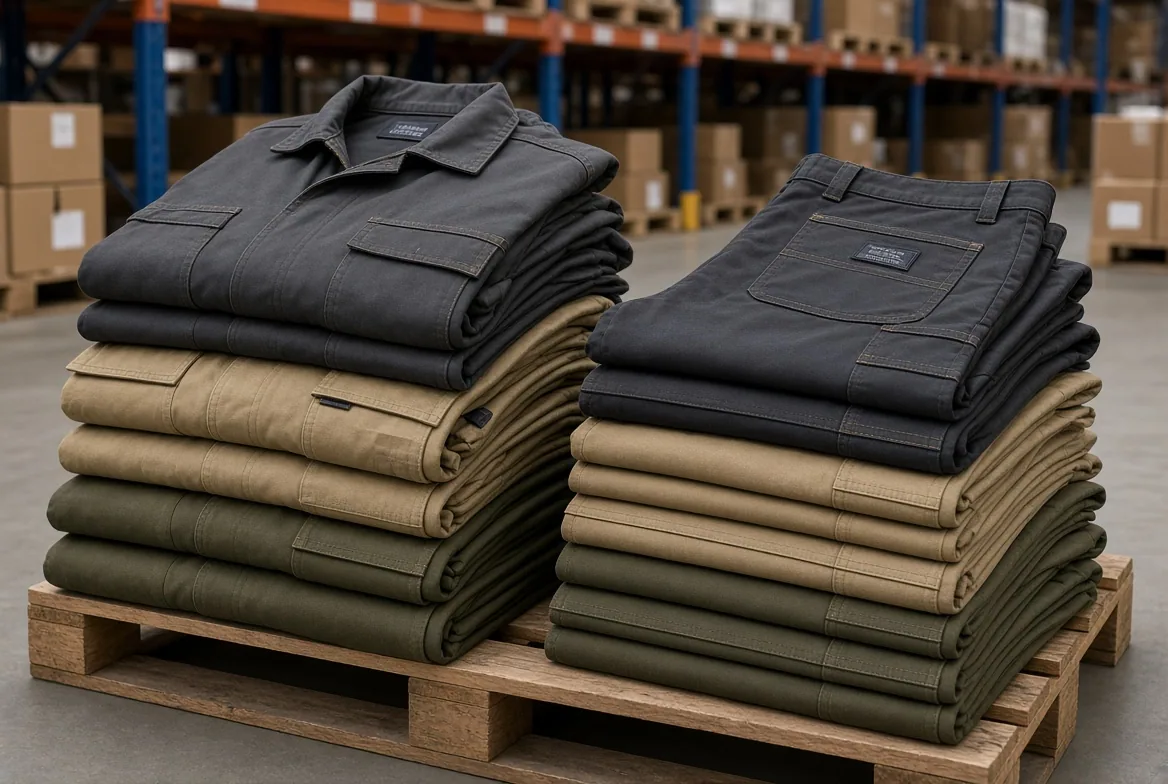
Across a 12-month active construction cycle, the 400-person contractor cut blended cost-per-wear by 31% after moving rough-framing, equipment, and service crews into custom heavy-duty duck canvas pants and reinforced coveralls.
I built the model with the project procurement team using the contractor’s own reorder history. Cost per wear assumes 250 work shifts a year.
| Metric | Before: retail twill | After: 13 oz duck canvas | Change |
|---|---|---|---|
| Fabric weight and abrasion life | 7.5 oz poly-cotton; 3,100 Martindale cycles | 13 oz duck canvas, 370 GSM; 14,000+ cycles | More than 4× the abrasion life |
| Unit cost per garment | $28 | $46 (pants) / $65 (coveralls) | Higher invoice, lower annual cost |
| Annual replacements per worker | 4.0 | 1.2 pants / 0.8 coveralls | 70% fewer replacements |
| Admin + reorder cost per worker | $95 | $20 pants / $25 coveralls | Fewer emergency purchase cycles |
| Downtime + mismatch cost per worker | $180 | $35 pants / $20 coveralls | Fewer gear failures and size corrections |
| 12-month cost per worker | $387 | $110 pants / $105 coveralls | 72% and 73% lower per garment tier |
| Cost per wear (250 shifts) | $1.55 | $0.44 pants / $0.42 coveralls | 72% and 73% lower per garment tier |
| Blended cost per wear, 400 crew | $1.55 | $1.07 | 31% lower across the full workforce |
A higher-GSM garment carries a higher initial cost yet wins on lower replacement frequency and steadier inventory planning. The blended model landed at $1.07, a 31% drop from $1.55.
- Mid-cycle replacement orders fell from 14 to 3 in the first 12 months. Warehouse Manager Dana Moniz confirmed this against her purchase log.
- Admin and reorder cost per worker fell from $95 to $20. Admin burden measured in staff hours fell 68% because fewer emergency reorders meant fewer urgent emails, spec mismatches, and size-run corrections.
- Downtime and mismatch cost per worker fell from $180 to $35. Supervisor-reported lost labor hours per crew fell 73%.
Verification: I cross-checked the contractor’s warehouse reorder log against factory shipment manifests. Scheduled replacement orders matched the model within 6%. Two early coverall prototypes needed a zipper swap. The factory reworked those at no cost before bulk release.
“I used to spend every Monday sorting out pant failures. Now I spend that hour on safety checks and tool inventory. That’s the real result.” — Site Supervisor Torres
Industry data shows workwear replacement often consumes 4 to 6% of a site’s consumables budget. A durability-first spec reduces that line item without cutting safety compliance.
For supervisors, warehouse teams, junior staff, and remote or multi-branch crews, the benefit is consistent: fewer mid-cycle failures, more predictable replenishment, lower cognitive load from a consistent pocket layout and durable knee panels, and standardized sizing across sites.
If your current workwear keeps failing on the same 90-day cycle, request a cost-per-wear model in your next RFQ. LeelineWork can spec a 13 oz duck canvas or reinforced coverall program for your exact site count.
See the construction and oil & gas safety workwear solutions to map fabric weight to your crews’ real replacement burden.
Key Takeaways: Buying Heavy-Duty Construction Workwear on Cost-per-Wear
Three lessons carry the most weight for procurement teams comparing heavy-duty construction workwear suppliers. All three come from the contractor’s own reorder log and the QC floor, not a marketing deck.
1. Buy on Cost-per-Wear, Not Sticker Price
The $28 retail pant looked cheaper on the invoice. It was not. Once reordering, expedited shipping, and crew downtime enter the calculation, the $110 custom canvas tier wins on annual cost.
A 12-month cost per worker of $387 for off-the-shelf pants versus $110 for custom duck canvas is not a rounding error.
Mid-cycle replacement orders fell from 14 to 3 in one year. Warehouse Manager Dana Moniz verified this against her purchase log. Admin burden dropped 68%. Downtime from gear failure fell 73%.
Price market entry with the 12-month cost per worker, not the unit invoice. Ask for the replacement rate your current garment actually runs.
2. Write Seam, Abrasion, and Hardware Tests into the RFQ
Do not wait for failure. The contractor’s first coverall prototype failed the zipper endurance check. The factory swapped in a #10 YKK and re-ran the 1,000-cycle abrasion test before bulk release.
Name exact tests and pass thresholds in your RFQ before you approve bulk production:
- ASTM D1683 for seam strength.
- ISO 12947 for Martindale abrasion.
- ISO 13934 for tensile testing.
- AQL 2.5 for final random inspection.
If a supplier cannot produce dated lab reports, walk away.
A test standard without a pass threshold is an opinion. Write the number into the RFQ so pass or fail is not a negotiation after the sample lands.
3. Duck Canvas vs. Ripstop: Match Weave to Wear Environment
Duck canvas and ripstop solve different problems. This surfaced on the job site floor, not in a catalog.
- Duck canvas: dense plain-weave cotton. Use it for rough-framing crews who kneel on concrete and gravel. The tight weave blocks abrasive dust. A 13 oz reference exceeded 14,000 Martindale cycles while a retail poly-cotton twill failed at 3,100.
- Ripstop: grid weave that stops small tears. Use it for mobility-critical jobs like equipment service. Some weights feel stiffer.
- Custom coveralls: outperform a separate pant and shirt setup when full-body coverage matters, such as dust-heavy environments or high tool-snag risk. They eliminate the gap at the waist. 10 to 14 oz duck canvas, roughly 270 to 380 GSM, is the working range.
Non-hi-vis programs need the same rigor. This program had no reflective tape or FR compliance. It still required abrasion testing, seam burst checks, and zipper cycling.
Pipe layer Marcus put it plainly when he described the crotch seam digging in by lunch. Discomfort drives turnover. Rigorous specs keep crews working.
Ask every supplier for four artifacts before you commit: a written QC SOP, a pre-production sample with a fabric swatch test report, MOQ clarity in writing, and a shipping-term structure like DDP. LeelineWork provided all four.
Also inspect seam architecture. Triple-needle stitching is not a quality warranty. On curved seams, double-needle often outperforms triple because triple perforates more fibers on lightweight fabrics.
That nuance separates a technical uniform manufacturer from a generic exporter. The same testing discipline applies to complementary pieces like heavy-duty construction work shirts.
Future Outlook: Scaling a Duck Canvas Spec Across Crews
This contractor now has a repeatable spec. The program can scale to any crew count without re-engineering the pants. The next step is to apply the same cost-per-wear logic to shirts, jackets, and full-body coveralls for wet-weather and winter seasons.
LeelineWork supports that expansion with the same factory-floor QC protocol: GSM verification, seam testing, zipper cycling, AQL 2.5 inspection, and DDP shipping. The real win is not one order. It is a system that makes every reorder predictable.
This is what happens when a technically fluent manufacturing partner replaces a generic merch supplier, even on non-hi-vis coveralls and pants that never get a reflective-tape pass.
Ready to map fabric weight to your crews’ real replacement burden? Discuss custom specs, MOQ, or factory QA requirements through the contacts page.

Fitness & Outdoor Wear Manufacturer
- 2,000+
- Clients Served
- 99.2%
- On-Time Delivery
- 2011
- Manufacturing Since
Audit your crew’s cost per wear
Send your crew roles, site conditions, and current replacement rate, or just a brief. A named program lead replies within 24 hours with a fabric-weight recommendation and a cost-per-wear model outline. No sales pitch, no rate-card guesswork.