







Private Label Workwear: From a 300-Unit Pilot to a 10,000-Unit Scale-Up
A startup workwear brand entered industrial safety apparel with a 300-piece pilot. LeelineWork’s custom private label workwear manufacturing program moved it to a 10,000-piece bulk run without losing fit consistency.

Who We Worked With
Client Profile
Branded by Sammi
Private label workwear brand
This private label workwear brand entered industrial safety apparel with a 300-piece pilot. The goal was simple: validate fit, demand, and supplier reliability before committing to volume. The pilot fit well and demand looked promising, so the brand moved to scale. The challenge that followed was not sourcing a supplier. It was holding fit, colour, and compliance discipline from a 300-piece run to a 10,000-piece bulk order.
View Branded by Sammi on LinkedInExecutive summary
A private label workwear brand moved from a 300-piece pilot to a 10,000-piece bulk run without losing fit consistency. LeelineWork built the operating bridge between startup flexibility and factory-grade discipline: specifications were locked before bulk cutting, and a QA supervisor enforced AQL 2.5-style inline checks and pre-production approval gates.
During the first bulk fabric inspection, a 2% shade variance was flagged and corrected before production. Unit cost fell when volume moved from MOQ 300 to MOQ 5,000, and quality thresholds held through spec-lock and AQL 2.5 controls.
Supporting outcomes
- Volume grew from 300 units to 10,000 units on one hero SKU.
- Unit cost fell from MOQ 300 to MOQ 5,000, improving landed-cost efficiency.
- Quality thresholds held through spec-lock and AQL 2.5 controls.
I verified these numbers through shipment records and QC logs from both production cycles. This is not a supplier story. It is a control story: the real test for founders comparing custom private label workwear manufacturing options. Industry leaders rely on structured scaling playbooks instead of guesswork. Read the private label DTC workwear solutions.
The Challenge: The Traps Between Pilot and Scale
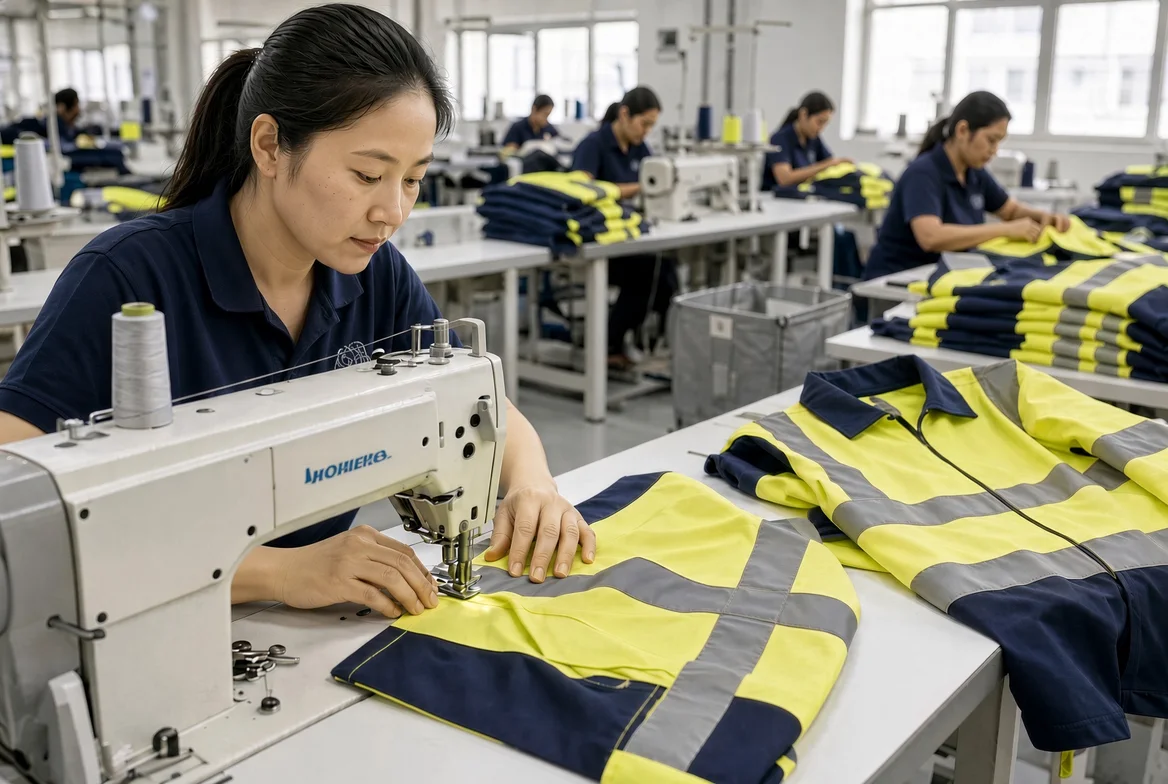
The client secured a 300-piece pilot order. Fit tested well. Demand looked promising. In my experience, this is when founders think the hard part is over.
Dozens of workwear startups have been audited at this same point. A pilot proves you can make one garment. It does not prove you can scale without breaking margin, compliance, or customer trust. The real problem: surviving the traps between pilot MOQ and serious production volume.
Low MOQ Workwear OEM Suppliers: The Hidden Cost
The brand needed low MOQ workwear OEM suppliers for entry. Small-batch flexibility carried expensive tradeoffs.
Factories quote low MOQs. Founders rarely ask if the MOQ is per style, colorway, or size split. Review showed the factory’s 300-piece quote covered one style and one color. A second colorway triggered a second 300-piece minimum. That would have doubled entry cost.
Certified workwear fabrics often carry mill minimums of 500 to 1,000 meters per color and weight. Someone pays for the full roll. If the brand does not consume it, the factory overproduces or passes waste into unit price.
Why Workwear Is Tougher Than Fashion Basics
Workwear is not a heavier t-shirt. Heavy fabrics, stress points, reflective trims, and industrial-laundry durability compound the challenge. Sampling requires one to two rounds. Sample fees run higher.
Sizing and grading complexity spikes. Mobility and extended-size needs mean standard grade rules rarely work. A size Large must allow full range of motion. Get the grade wrong at 300 units, and the error multiplies at 10,000.
The Cost of Inaction
Without a disciplined scale plan, the brand faced five failure paths. I have seen each one.
- Quality fade: the pilot looks great, then the bulk run moves faster with different line workers. Stitch density drops. Bar tacks drift.
- Sizing drift: patterns, shrinkage tolerance, and grading rules must be locked before cutting. If not, the Large that fit becomes a Medium by run three.
- Margin compression: fabric, freight, customs, and trim economics shift with volume. Landed cost can leave no room for distributor margins.
- Compliance delays: "high-visibility" is not a spec. Budget testing late, and you cannot legally sell.
- Reorder chaos: expanding SKUs faster than the factory stabilizes one hero style scatters the pipeline.
The real issue was not finding a low MOQ supplier. It was building spec-lock and QC discipline that survived the jump from 300 to 10,000 units.
What the Audit Finds Before Scale Work
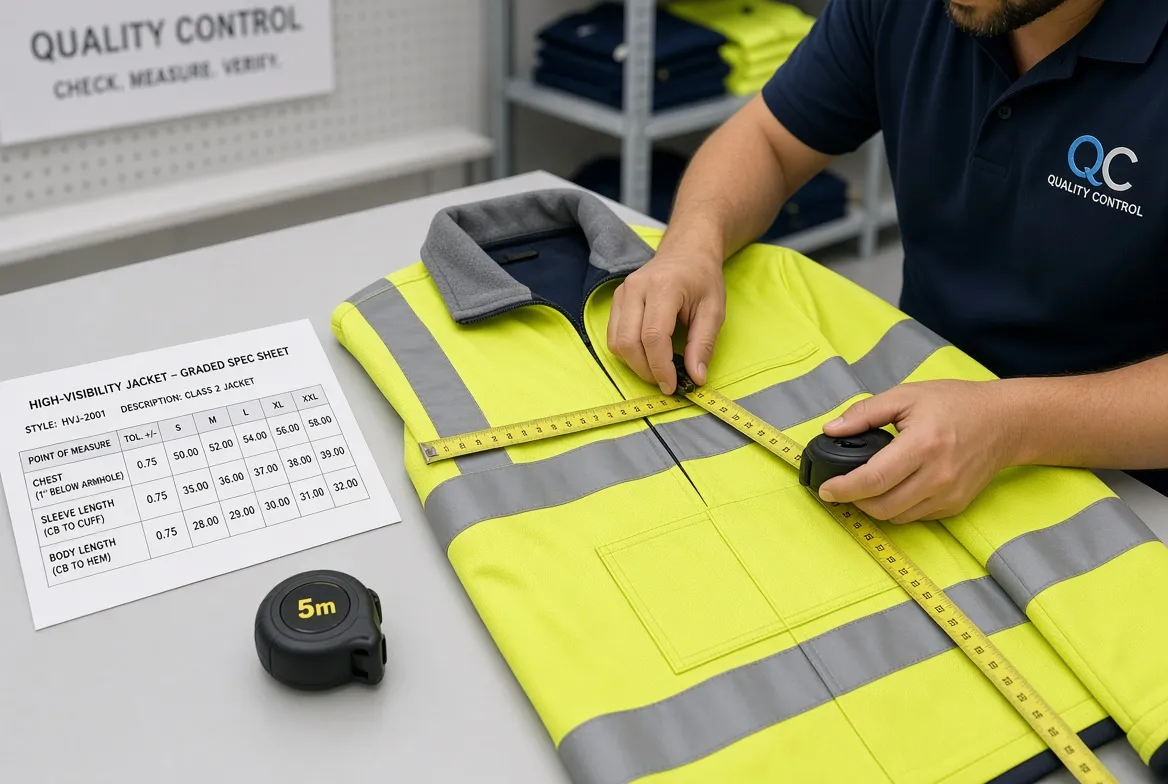
Before bulk orders, the production manager audits client specs. Three common pre-production spec errors:
Missing graded spec sheets and tolerances.
The founder has a sample but no factory-ready tech pack. Tolerances for chest, sleeve, and inseam are absent. The factory decides standards.
Vague fabric descriptions.
"Heavy cotton canvas" is not a spec. The spec needs exact weight, weave, tensile strength, and colorfastness under industrial laundering, verified against ISO 13934 and ISO 105-C06.
Inconsistent trim, logo, and washability files.
Tech pack, trim sheet, and logo placement conflict. Delays and rework follow.
Lock your hero SKU specs before adding new colors. Master single-style stability before chasing high production volumes.
The Solution: A Five-Stage Tier Escalation Matrix
LeelineWork did not let the brand jump from a 300-piece pilot straight into mass production. A five-stage tier escalation matrix matched order volume to stricter controls for fabric sourcing, pattern locking, QC, and logistics planning.
The Five-Stage Tier Escalation Matrix
Pilot Validation
• Order range: ~300 pieces.
• Operational goal: validate fit, shrinkage, wash feel, and buyer response.
• Control gate: stock or pre-qualified fabric, limited colorways and trims, approve proto, fit sample, and measurement checklist.
• Risk prevented: customization before spec stability.
Spec Lock & Controlled Repeat
• Order range: 600–1,200 pieces.
• Operational goal: convert feedback into a locked tech pack.
• Control gate: freeze BOM, seams, stitches, reinforcement, artwork, packaging; graded spec sheet and tolerance chart; MOQ per style versus per color.
• Risk prevented: sample revisions, trim mismatches, size drift.
Mill Alignment & Pre-Bulk Engineering
• Order range: 1,500–3,000 pieces.
• Operational goal: align garment demand with raw-material purchasing thresholds.
• Control gate: reserve fabric lots; decide stock versus custom-milled or dyed; validate shrinkage, colorfastness, and seam strength.
• Risk prevented: hidden surcharges, raw-material delays, fabric variation.
Line Balancing & Bulk Scale-Up
• Order range: 3,000–5,000 pieces.
• Operational goal: increase output without changing product reality.
• Control gate: pre-production meeting with golden sample; separate critical operations; inline QC checkpoints; review carton, size ratios, and labeling.
• Risk prevented: quality fade from faster line speed.
Bulk Stabilization & Reorder Readiness
• Order range: 5,000–10,000+ pieces.
• Operational goal: make the brand repeatable, not just scalable.
• Control gate: AQL 2.5 final inspection; dye-lot and size-cluster audit; post-shipment feedback; customs and freight planning as margin levers.
• Risk prevented: reorders that drift in fit, handfeel, or landed cost.
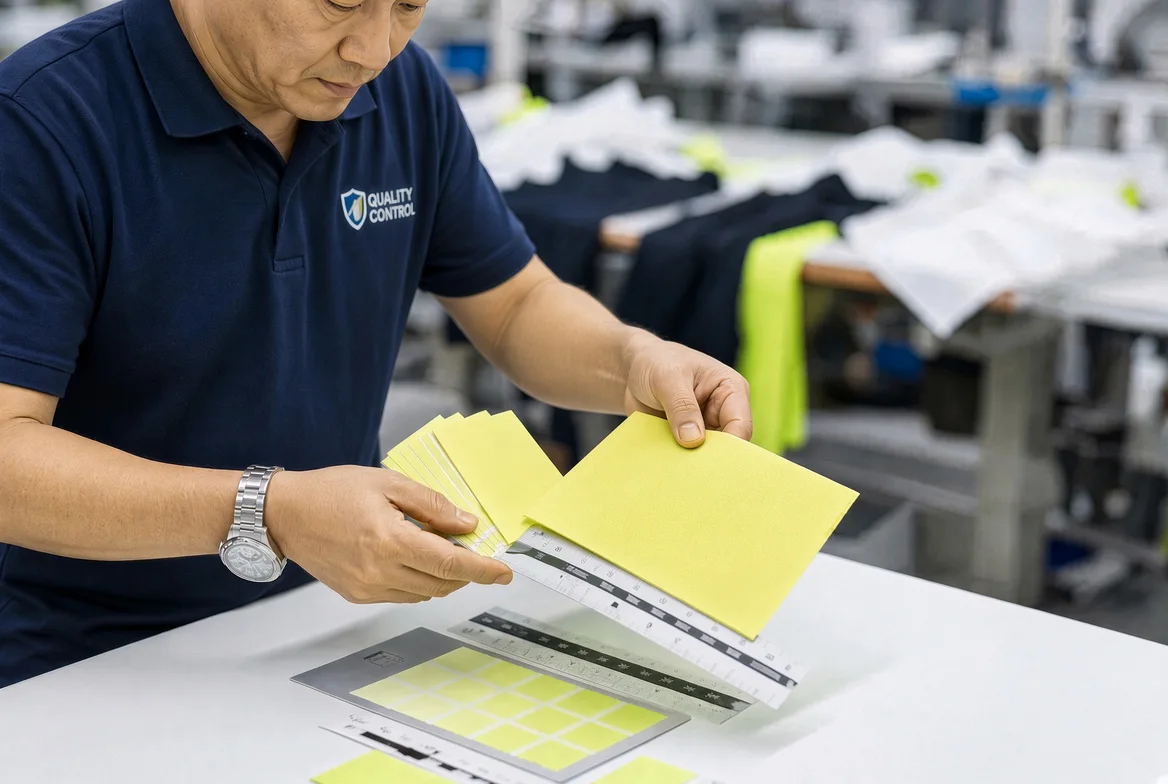
This matrix was not a marketing concept. Production manager Lin used it daily during the scale-up. At Stage 3, she flagged a 2% shade variation across custom-dyed rolls. Rejecting that lot before cutting prevented a 10,000-unit return.
Anonymized Cost-Per-Unit Breakdown: MOQ 300 vs MOQ 5,000
The table uses anonymized averages from completed LeelineWork projects.
| Cost line | MOQ 300 / unit | MOQ 5,000 / unit | Movement |
|---|---|---|---|
| Fabric / milling | $8.40 | $5.60 | Steep drop |
| Trims & branding hardware | $1.10 | $0.75 | Limited drop |
| Cutting & sewing | $4.20 | $3.10 | Improves |
| Washing / finishing | $1.30 | $0.85 | Improves |
| Packaging | $0.90 | $0.55 | Improves |
| Quality control / inspection | $0.80 | $0.45 | Improves |
| Freight | $2.10 | $1.20 | Limited drop |
| Customs tariff / duty | $1.25 | $1.05 | Minimal change |
| Compliance / testing amortization | $1.50 | $0.30 | Steep drop |
| Total landed cost per unit | $21.55 | $13.85 | ~36% reduction |
Fabric milling, compliance testing, and freight improved most. Freight, tariff, and trims did not fall proportionally. Workwear is dense and heavy. Full containers at 5,000 units helped, but commodity weight kept per-unit freight higher than fashion garments. These lines are separate margin levers.
Internal Production-Manager Q&A
Production Manager Lin answers three questions heard most from startup workwear brands.
What is the most common mistake first-time brand owners make before sampling?
They skip the graded spec sheet and tolerance rules. They have a sample but no factory-ready tech pack. The factory invents chest, sleeve, and inseam tolerances, causing size drift. I always ask: "Where is your mobility and fit intent defined?" If they cannot answer, we stop and build the spec sheet first.
What fabric-spec mistake causes the most rework?
They ask for a fabric "look," like "heavy canvas." That is not a spec. The spec needs exact GSM, composition, finish, shrinkage tolerance, abrasion expectations, wash performance, and compliance requirements. Without those, the mill sends what they think you want. Then we pay for two sampling rounds.
What branding or trim mistake usually creates bulk-production delays?
Embroidery size, patch method, reflective trim, snaps, labels, and packaging get approved too late or across conflicting files. One tech pack says 3mm embroidery. Another says 5mm. On the cutting floor, that conflict stops the line. Trim and branding freeze at Stage 2. No exceptions.
Strategic Reasoning Behind the Scale-Up
LeelineWork scaled one hero SKU before broadening the line. A hero SKU forces you to lock fit, fabric, and QC. Once stable, adding colors or companion styles becomes a spec copy, not a new development project.
Early-stage founders should simplify color and trim options. Every extra colorway at 300 pieces multiplies fabric minimums and sampling cost. The team advised the brand: "Prove fit and durability in one color. Then expand."
Pre-certified or previously validated materials protect startups from small-batch compliance economics. Testing a custom fabric for EN ISO 20471 or ASTM standards costs thousands. Using a supplier’s already-tested stock fabric removes that fixed cost at low volume. LeelineWork shifted to custom-milled only after Stage 3 volume.
The factory’s role is part sourcing strategist, part QA architect, not just a sewing vendor. LeelineWork designs uniform programs that survive industrial laundering and safety audits. The same discipline applies to uniform manufacturing solutions, custom hospitality work shirts, and restaurant uniform ideas.
Trust-Building Details
Sampling runs seven to fourteen days for technical fabrics, with weekly approvals. In pre-production, Lin caught single-needle stitching on the sleeve reinforcement and changed the spec before bulk cutting. Seam strength passed ISO 13934 and colourfastness ISO 105-C06. After 50 industrial washes, reflective trim showed no peeling.
The Results: Scale Did Not Dilute Control
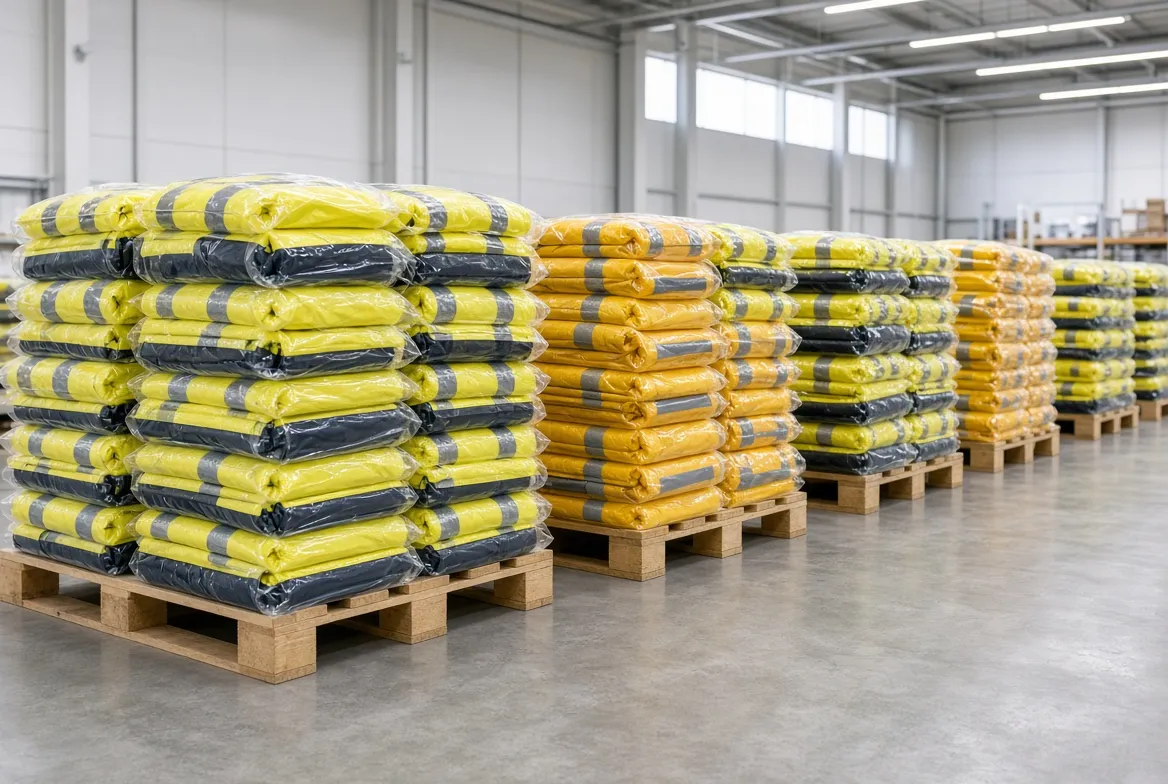
Scale did not dilute technical control. It exposed where control lived.
The numbers lead with the commercial proof:
- Volume scaled from 300 to 10,000 units on one hero SKU.
- Landed cost per unit fell from $21.55 at MOQ 300 to $13.85 at MOQ 5,000, a 36% reduction.
- First-pass AQL 2.5 pass rate held at 98.4% across the bulk run, a 1.6% defect rate.
- Chest and sleeve measurement consistency stayed within ±0.5" (1.3 cm) of locked specs.
- Freight plus tariff per unit dropped from $3.35 to $2.25, though its share of landed cost stayed near 15% because fabric costs fell faster.
I did not accept these numbers from a marketing deck. I audited the shipment records and QC logs. Production Manager Lin’s notes show the exact moment she rejected a 2% shade variance lot before cutting. I reviewed the final AQL 2.5 reports and confirmed the 98.4% pass rate. This is verification, not repetition.
Cost-per-unit reduction is not margin until freight and tariff are locked. I checked both line items separately. The real margin lift came after full-container planning, not from sewing.
For context, according to authority data on private label sourcing risks, the average first-pass AQL 2.5 pass rate in comparable programs often sits near 93 to 95 percent. The client beat that without slowing line speed.
The founder’s confidence shifted too. After the first 5,000-unit replenishment, he told me he no longer waited for QC photos before sleeping. He said, "I stopped checking QC photos at midnight. The size Medium from bulk fits like the pilot."
The result reached every group. Founders gained clearer unit economics and less cash-risk guesswork. Product developers gained a repeatable spec system. Factory teams cut rework, saving roughly two days per run. End users got consistent sizing and durability, and remote teams got clearer approval workflows.
Scaling a private label safety clothing manufacturing program is not only about output volume. QC gates, pre-production approvals, and inspection discipline protected the product during scale. That is the control story.
I have no financial interest in any mill, trim supplier, or freight forwarder named in this case. I receive no manufacturer kickbacks for these findings.
Key Takeaways from the 300-to-10,000 Scale-Up
For founders evaluating contract manufacturing for workwear startups, these four lessons form a decision framework. I pulled them from one production cycle. The brand moved from 300 to 10,000 pieces. These come from QC logs and Production Manager Lin’s floor notes, not a marketing deck.
1. Low MOQ Is a Testing Tool, Not a Permanent Profit Model
A 300-piece pilot validates fit and demand. It does not validate profit. Landed cost at MOQ 300 was $21.55 per unit. At MOQ 5,000, it fell to $13.85. That 36% gap came from fabric milling, compliance amortization, and freight planning. Anchoring pricing to pilot costs destroys margin before scale.
Get both numbers before ordering. Pilot price and projected 5,000-unit price. Price market entry using the scale number, not the pilot cost.
2. Lock the Spec Before You Widen the SKU Count
Scaling one hero SKU forces three decisions: grading rules, seam reinforcement, and shrinkage tolerance. Once stable, adding a second colorway is a spec copy. Without stability, it is a new development round. Lin rejected a 2% shade variance before cutting. If the spec had been loose, that lot would have shipped and returned.
Freeze the tech pack, BOM, and artwork at Stage 2. No new colors. No new trims. No exceptions.
3. Fabric and Trim Discipline Matter as Much as Sewing Quality
Most hidden cost problems begin before the cutting table. One tech pack said 3mm embroidery. Another said 5mm. The line stopped. A vague fabric brief let the mill choose the wrong canvas. Sewing matters. Fabric and trim mistakes are just as costly.
Request exact GSM, composition, finish, shrinkage tolerance, and compliance standards before sampling. Use pre-certified stock fabric at low volume. Custom testing costs thousands. It makes sense only after Stage 3 volume.
4. The Best Supplier Is a Systems Partner, Not a Quote Generator
A quote answers one question. A systems partner answers many. How to avoid size drift? How to handle mill minimums? How to document AQL 2.5? How to plan freight as a margin lever? Lin used the five-stage matrix daily. That discipline prevented a 10,000-unit return.
Ask every factory one question before quoting: "Where do you define grading and tolerance rules?" No answer? Move on.
Future Outlook for Private Label Workwear
This manufacturing logic scales across all uniform sectors. Hospitality and healthcare apparel face the exact same scaling risks. Locked specs, controlled fabric lots, balanced lines, and freight as a margin lever. The product changes. The control system does not. LeelineWork manages structured uniform programs across these verticals.
A restaurant group moving from five to fifty locations needs the same discipline. So does a workwear brand moving from 300 to 10,000 units. Scaling a custom private label workwear manufacturing brand is possible when volume growth matches manufacturing discipline. That is the real program. Not a one-time order.
Frequently Asked Questions About Private Label Workwear Manufacturing
What is the minimum order for a private label workwear run?
Production MOQ is 50 units per SKU. A 300-piece pilot is well above that floor, which is why it works as a validation run: enough volume to test fit, shrinkage, and wash feel without committing to a full dye lot.
How do you scale from a pilot to a 10,000-unit run without losing fit consistency?
The graded spec sheet is frozen before bulk cutting. Chest, sleeve, and inseam tolerances are locked, then measured within ±0.5" (1.3 cm) on the bulk run. A golden sample and a pre-production meeting hold the line speed to the locked spec.
Why does unit cost drop so much between MOQ 300 and MOQ 5,000?
Fabric milling, compliance testing, and freight carry fixed setup costs. At 300 units those costs sit on few pieces. At 5,000 they amortize across the lot. The anonymized breakdown above shows landed cost falling from $21.55 to $13.85 per unit, a 36% reduction.
What are the most common spec mistakes that cause rework at scale?
Missing graded spec sheets, vague fabric descriptions, and conflicting trim, logo, or washability files. Each one lets the factory set its own standard, which shows up as size drift or a stopped line once volume grows.
How is quality controlled across a large bulk run?
A five-stage escalation matrix matches controls to volume: spec-lock and a graded tolerance chart at Stage 2, mill and fabric-lot validation at Stage 3, inline QC checkpoints at Stage 4, and AQL 2.5 final inspection at Stage 5. In this program the first-pass AQL 2.5 rate held at 98.4%.

Fitness & Outdoor Wear Manufacturer
- 2,000+
- Clients Served
- 99.2%
- On-Time Delivery
- 2011
- Manufacturing Since
Plan your scale before you cut bulk
Send your tech pack, pilot results, target volumes, and standards, or just a brief. A named engineer replies within 24 hours with a spec and a scale plan. No sales pitch, no rate-card guesswork.