













Table of contents
Key Takeaways
- A system, not an apparel buy: cleanroom uniforms control particle shedding and, in many electronics rooms, static. Miss either and you create real risk.
- Classify first: set the ISO class and the GMP grade per room before you spec a garment. Mixed classes need separate specifications.
- Lock the pack early: confirm the specification with quality assurance or environment, health and safety before any request for quotation leaves.
- Demand evidence: electrostatic discharge, particle-shedding, wash or autoclave and sterility reports come before a sales call, not after.
- Validate, then lock: wear trials and a small pilot come first, then garment control after the purchase order.

Cleanroom uniforms are a contamination-control system, not an apparel buy. Each garment must control particle shedding and, in many electronics environments, dissipate static. Miss either requirement and you create real risk.
Bad sourcing has caused three failures on site: static-related component damage, particle excursions, and audit findings that stall production. One non-compliant fabric lot cost a buyer a week of yield.
This guide is for quality assurance directors, facility managers, environment, health and safety (EHS) leaders, and procurement teams at pharma, biotech, semiconductor and medical-device sites.
Seven steps cover requirements, supplier comparison, sample approval and a low-risk order process.
Cleanroom Uniform Sourcing Prerequisites: Lock Five Inputs First
This guide was built from five gowning audits and 40 requests for quotation (RFQs). Every stalled quote traced to one missing input.
- Zone map or classification. ISO class per room, plus the GMP grade if pharma. One audit client mixed ISO 5 and ISO 7, needed two gown specifications, and lost three weeks.
- Process type and electrostatic discharge (ESD) need. Aseptic pharma, medical device assembly, semiconductor, electronics or mixed-use. Confirm ESD yes or no in writing, with the target surface resistivity.
- Headcount, shifts and garment turns per week. Turns drive cost per shift harder than unit price does.
- Ownership model. Internal purchase, managed rental or hybrid. Choose before the RFQ.
- Document pack and owner. Certificate of conformance, sterility documents where relevant, test reports, laundering limits, size matrix, change-control expectations, and one named quality assurance or EHS signatory. Committee approval kills timelines.
⚠️ Safety Warning: never let garment choice outrun your contamination-control strategy or validated gowning procedure. Grade A and Grade B rooms, or Grade A interventions, require stricter sterile gowns and validated procedures. Involve quality assurance early.
Read the EU GMP Annex 1 and the FDA aseptic processing guidance for the regulatory baseline.
For garment-system practice, the IEST-RP-CC003 garment-system guidance covers selection, maintenance and testing.
⚡ Power Move: lock the specification pack with quality assurance or EHS before the RFQ.
Seven Steps from Room Classification to a Locked Reorder
Each step below moves from room classification to a locked reorder, and closes before the next opens. Skipping one is how a cheap quote turns into an audit finding three months later.
Step 1: Classify the Room and Define the Garment System

Start with the same question every serious supplier asks: what cleanroom grade or ISO class are you gowning for? I keep the Ansell cleanroom apparel guide open when I check interfaces.
ISO 5 and GMP A/B buyers need a complete garment system. Specify the hood, coverall and boot interfaces together. Full coverage is one sealed system: hood over mask, coverall over hood, gloves over sleeves, boots over legs.
A gap at any interface is a particle path. One clean rule from Judy Li, Sales Manager: "lower-class rooms can run a simpler system — but lock the grade before you cut the spec, not after."
Split the decision by use case:
- Pharma or sterile processing: sterilized garments, aseptic donning, quality assurance approval.
- Semiconductor or electronics: ESD control plus low-lint construction.
- Medical device or general controlled manufacturing: classification-based fit for use. Do not overspecify by default.
Build a one-page requirement matrix. Name the room grade, body coverage, sterility expectation and whether static control is mandatory. If any cell is blank, stop the RFQ.
On a gowning diagram, name the component and the risk. Say "hood-to-coverall seal controls neck shedding, Grade A risk." Do not say "click the green option."
⚠️ Experience Warning: a buyer once ordered ISO 5 coveralls without the hood and boot interface. Our pre-audit review caught it. Both interfaces went into the spec before quote; the missing seal would have failed gowning validation.
Step 2: Choose the Ownership Model That Fits Your Site
Use the interface matrix from Step 1. Confirm whether the system is coverall-only, integrated hood-and-boot, or coverall plus separate accessories. In our RFQs, neck, wrist, ankle and footwear gaps drove the system choice more than unit price did.
Compare ownership models in this order. First, compare disposable versus reusable. Packaged sterile garments fit one-time use. Reusable programs feel heavier because they live inside laundry, tracking and repair workflows.
Second, compare rental or managed service versus direct purchase. Qualify direct purchase first. Price rental or managed service when headcount swings, inventory control is weak, or internal validation capacity is limited. Direct purchase fits stable specifications and tighter cost and product control.
Build a simple total cost of ownership (TCO) lens before you quote:
- Unit price.
- Laundry or sterilization cost.
- Barcode or radio-frequency identification (RFID) tracking cost.
- Damage, loss and replacement rate.
- Internal storage and validation burden.
I pressure-test this rule with the Cintas cleanroom garment service checklist. For a side-by-side with other safety categories, read our industry-specific workwear guide.
This step worked when finance and quality assurance agree on one ownership model and one TCO sheet.
⚠️ Experience Warning: a client picked direct purchase on a low unit price. Damage and tracking costs added 22% per shift in the first quarter.
Step 3: Build the Specification Checklist and Teardown Proof
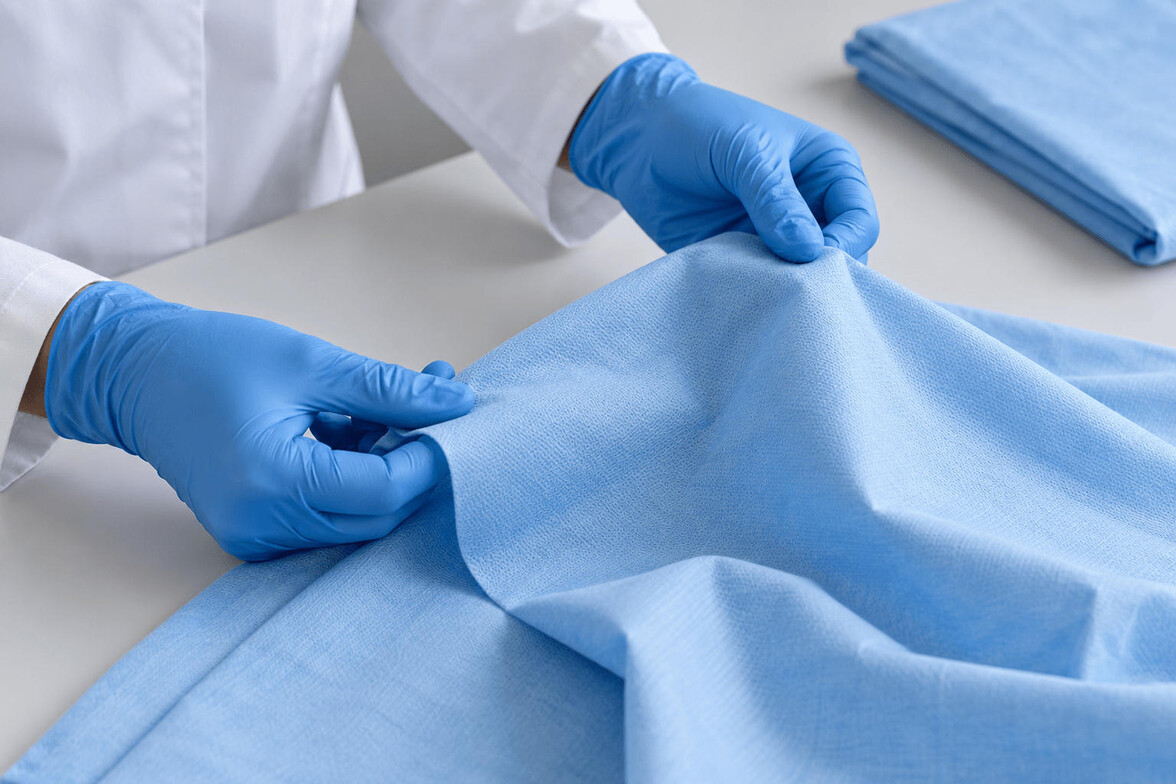
In our last teardown, a low-cost stitched suit and an ISO Class 5 uniform were clipped to the bench side by side. The macro shots exposed raw edges and loose seam bulk.
Paste this checklist into your RFQ:
- Fabric: continuous-filament polyester base. Add conductive yarn or a carbon grid or stripe where ESD is required.
- Electrical target: state your surface-resistance or resistivity window from the internal standard.
- Particle performance: require shedding or cleanliness test evidence.
- Construction: demand bound, sealed or encapsulated seams. DuPont notes that bound seams beat serged seams for particle barrier in its PPE catalogue.
- Closure details: concealed zipper, covered snaps, cuff and ankle control, hood compatibility, boot integration.
- Packaging and sterility status.
- Wash or autoclave cycles for reusable programs.
⚠️ Experience Warning: one low-cost sample passed visual inspection. The teardown showed serged seams and exposed elastic. That lot was rejected before sampling.
Step 4: Send a Structured RFQ and Score the Responses
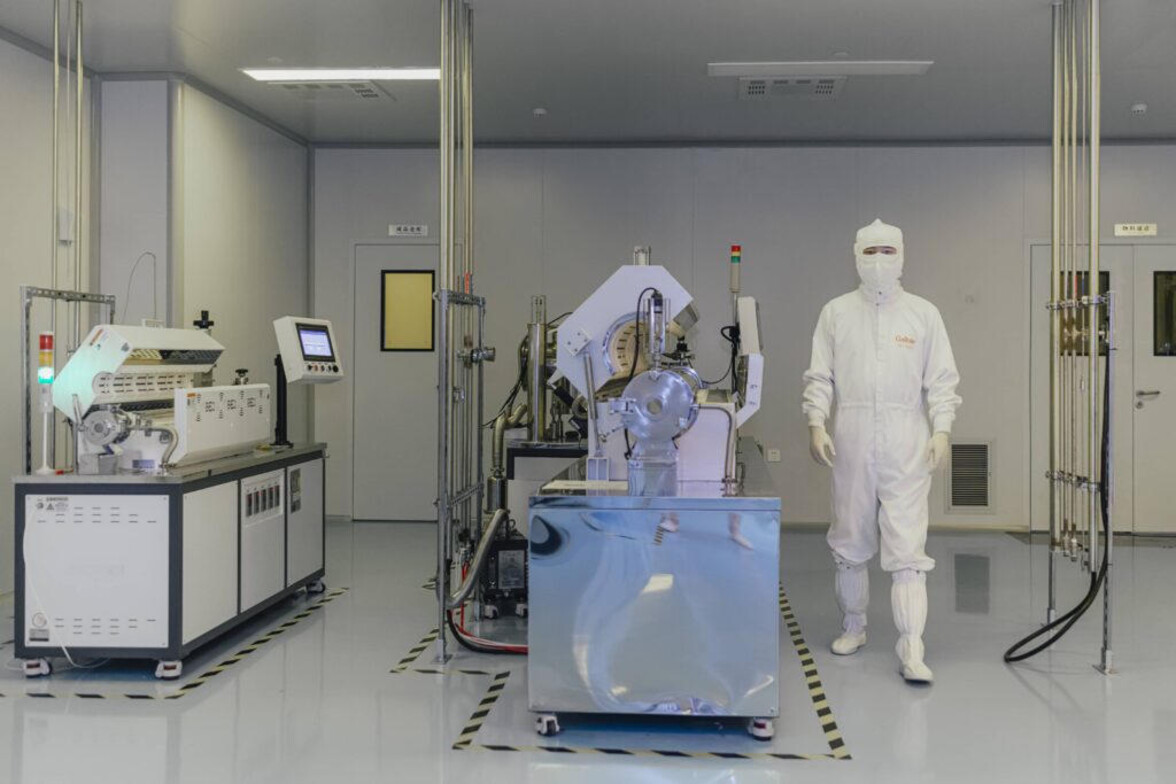
Do not send a one-line email asking for price. In our last 40 RFQs, those replies were unusable. Build the RFQ from the Step 3 checklist and ask for a written response with documents attached.
Open every attachment before reading the cover note. A credible package feels specific. It includes test reports, clear minimum order bands, stated sample and bulk lead times, and clean production photos of the actual line. Vague promises and stock photos fail this screen.
Require answers to these questions:
- Is the garment made or processed in a clean-controlled environment?
- Which third-party reports cover ESD, particle performance, laundering durability or sterilization status?
- Which certifications apply to the factory or quality management system (QMS), such as ISO 9001?
- What are the minimum order bands for stock versus original equipment manufacturer (OEM) cleanroom programs?
- What are the sample and bulk lead times?
- Can the supplier support custom sizing matrices, labeling, packaging and documentation?
Use a shortlist score table. Score each supplier 1 to 5 on technical fit, documents, minimum order, lead time and service responsiveness. Add weighted totals before you shortlist.
Strong providers explain garment processing, inspection, service-life management and inventory support. They do not just ship apparel. For a managed service alternative, apply the same screen to the Cintas-style service providers.
For the supplier side, read our workwear sourcing guide and industrial uniform manufacturers guide.
This step worked when every shortlisted supplier returns a complete document pack and a clear minimum-order and lead-time table.
⚠️ Experience Warning: in our last screen, one supplier sent stock photos and a one-line price. We cut it that day.
Step 5: Demand Evidence: The Document Pack That Passes Audit

Sales claims are worthless. Documents come before a call. In our last 40 RFQs, suppliers who hesitated on documentation failed the audit.
Request these documents where relevant:
- ESD performance report with surface resistivity and decay time.
- Particle-shedding or cleanroom suitability report, such as a Helmke drum test.
- Wash or autoclave durability data with cycle counts and tensile retention.
- Sterility documentation including validation and dose audit if using ISO 11137.
- Certificate of compliance and certificate of sterility for sterile programs.
Pre-shipment inspection runs in six steps, as our lead textile engineer walked me through:
- Seam strength: pull test per ISO 13935-2, minimum 100 N.
- Conductive continuity: surface resistivity across seams, under 1E6 ohms.
- Pore-size or barrier review: bubble point or air permeability test.
- Visual defects: 100% inspection under D65 lighting, AQL 2.5.
- Sizing: flat measurement against specification, tolerance ±0.5 cm.
- Packaging: double-bag, desiccant, lot label with date and operator ID.
Documentation matters because regulators require proof, not promises. The FDA aseptic processing guidance sets the level of evidence expected.
Say yes or no to each supplier on the strength of the document pack. If they hesitate, walk away.
⚠️ Experience Warning: one supplier sent a "certificate" that was just a logo on letterhead, with no test data. That supplier was rejected immediately.
Step 6: Validate Samples with Laboratory and Wear Tests
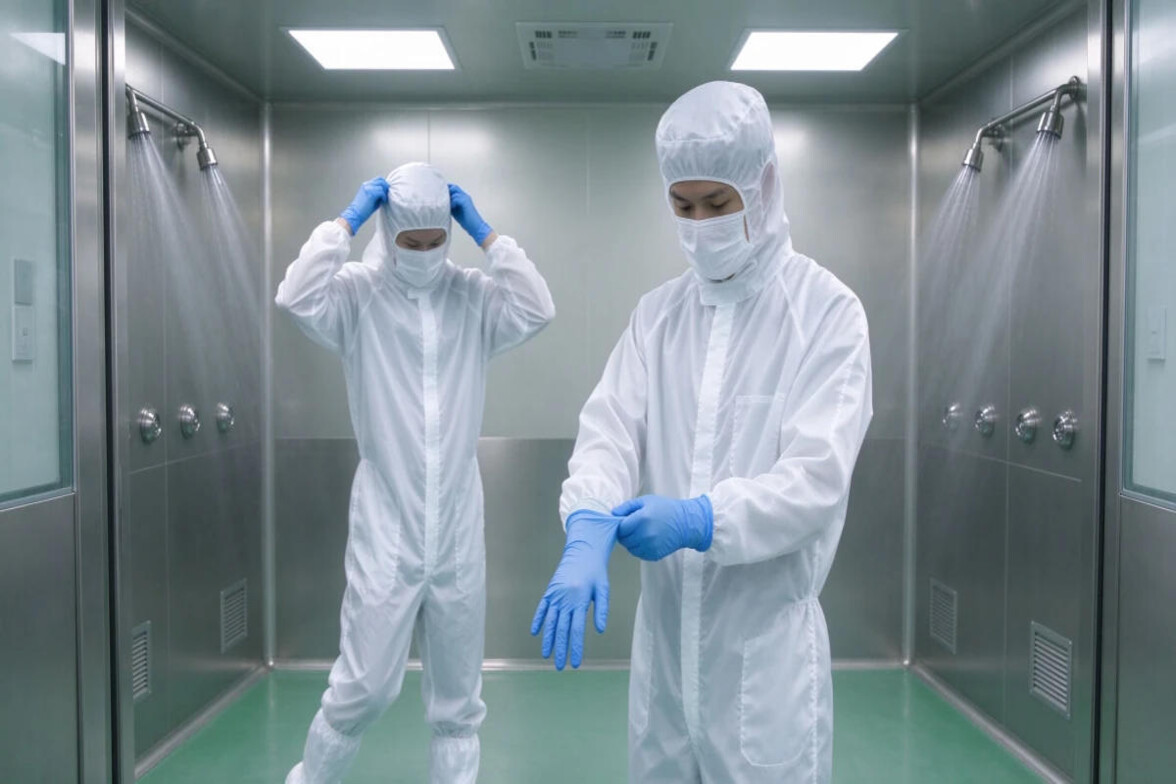
Samples often pass the desk review and fail on the floor. Treat sampling as validation, not a formality. On a recent semiconductor client review, the laboratory report looked clean. A 30-minute wear trial exposed a hood that lifted when operators reached overhead.
Run this sample-approval checklist before signing:
- Static attenuation or resistivity confirmation against your target window.
- Particle-shedding or cleanliness verification, such as Helmke drum.
- Post-wash or post-autoclave performance retention at your cycle count.
- Seam durability and closure integrity under pull and flex.
- Size consistency and wearer comfort across your size matrix.
Do not stop at desk review. Run wear trials with real operators. Check donning and doffing ease. Confirm the hood, mask, glove and boot interfaces stay closed during movement. Document complaints about heat, stiffness, noise, drag or restricted reach.
Then place a small pilot order before full rollout. For lower-risk ESD zones, read our anti-static work shirts guide.
⚠️ Experience Warning: one suit passed resistivity but failed after 25 washes. The pilot caught it, not bulk.
Step 7: Lock Garment Control After the Purchase Order

On our last rollout, the signed purchase order was the easy part. A stable program looks boring on the floor: labelled size runs sit on zone shelves, operators scan in and out, packaging stays sealed, and worn garments leave on a clear retirement trigger.
Start with incoming inspection on the first bulk lot. Check lot labels, packaging integrity, seams, closures and size runs. Quarantine the lot until quality assurance signs off.
Assign stock-keeping unit and size by department or cleanroom zone. Label shelves. Track each garment by barcode or RFID for issue, return, wash count and retirement. Set buffer stock by headcount, shift pattern and turnaround time.
Define replacement criteria: damage, failed test or cycle-life limit. In the contract, require corrective and preventive action (CAPA), reorder rules and change control for fabric or construction changes. For vendor-managed replenishment, name the escalation contact and service response time.
I pressure-test lifecycle management and inventory reliability with the Cintas cleanroom garment service checklist. These are supplier-evaluation criteria, especially in service-heavy programs.
You are done when a live garment-control standard operating procedure (SOP) exists, not just a vendor list.
⚠️ Experience Warning: a perfect specification once failed because returns went unscanned for two shifts. The fix was a one-page scan-in SOP, not a new supplier.
Cleanroom Uniform Sourcing Troubleshooting: Five Failures That Repeat
These five failures keep returning, and almost every one traces back to a step skipped earlier in the process. None of them shows up at the quoting stage — they surface on the floor, in a wash log or at an audit, months after the order is signed. Below is why each one repeats, and the fix that stops it at the source.
1. A Cheap Quote Arrives With No Usable ESD, Particle or Wash Reports
Why it happens: low-cost suppliers skip testing. Some "certificates" are just logos on letterhead.
Fix: freeze the purchase order. Demand written specifications, test methods, pass criteria and the latest reports. Quality assurance reviews before you order. A hesitant supplier will fail your audit.
2. Ordinary Anti-Static Workwear Fails as Cleanroom Wear
Why it happens: anti-static claims cover resistivity, not particle shedding or seam design.
Fix: confirm low-lint construction, bound seams, full coverage and cleanroom suitability separately from ESD data. Ask for a particle-shedding test, such as the Helmke drum.
3. A Reusable Program Degrades After Laundering or Sterilization
Why it happens: suppliers show new-garment data, not post-cycle performance. One suit passed resistivity but failed after 25 washes.
Fix: require data after repeated processing, such as 50 cycles. Set retirement limits. Spot-check used garments monthly.
4. Inventory Runs Short When Garments Go Unscanned
Why it happens: no tracking accountability. Unscanned returns are the most common cause I see.
Fix: add barcode or RFID checkpoints at issue and return. Set buffer stock by shift. Assign zone accountability.
5. Pharma Audits Question Sterile Gowning or Packaging Integrity
Why it happens: sterile status and packaging often go unverified for Grade A and Grade B.
Fix: verify sterile validation (such as ISO 11137), packaging integrity and donning compatibility before launch.
💡 Pro Tip: check the test report for the specific method, such as the Helmke drum. A generic "cleanroom suitable" claim is worthless.
Frequently Asked Questions About Cleanroom Uniforms
1. What Minimum Order Should I Expect for Custom Cleanroom Uniforms?
For stock blank coveralls, expect 50 to 100 units. For OEM cleanroom programs with custom sizing and labeling, most factories quote 300 to 500 units. In our last 40 RFQs, factories that held firm at 1,000 units dropped to 300 once a first-quarter slot was committed.
Ask for the minimum order band before you share your technical pack, and confirm your room class first per ISO 14644-1.
2. How Much Does a Cleanroom Uniform Cost per Shift?
Judge cost per shift, not unit price. A disposable sterile suit runs about $18 to $45. A reusable program lands near $60 to $120 per garment, plus laundry and tracking.
Last quarter, a client picked a low unit price and added 22% in damage and tracking costs by week six. Build a TCO sheet before you compare quotes.
3. What Fabric Passes Both ESD and Particle Tests?
Use continuous-filament polyester with a carbon conductive grid. That combination controls particle shedding and static. Target surface resistivity inside your own window, often 1E6 to 1E9 ohms, and demand a Helmke drum report.
In our laboratory, one low-cost suit passed visual inspection but showed raw, serged seams under the macro lens. That lot was rejected before sampling.
4. How Long Do Samples Take, and What Should Come With Them?
Samples take 7 to 14 days because technical fabrics need sourcing. Ask for a fabric swatch report, resistivity data and wash-cycle results with the sample.
In our last screen, one supplier sent stock photos and a one-line price. We cut them the same day. A credible pack is specific: lot labels, seam construction and a real test report tied to the fabric roll.
🧠 Author's Take: on a recent pharma audit, the winning supplier answered the RFQ in 48 hours with a complete document pack. The cheapest quote took nine days and never sent a Helmke drum report.
Paying about 12% more per unit skipped a validation delay that could have cost six figures in lost output.
Cleanroom Uniform Sourcing: What to Do Next
Buying logic stays simple: classify the room, choose the garment system, lock the specification, verify proof, and test before scale. Do not send a blind price request.
Turn the Step 3 checklist into a written RFQ or sample brief, name your quality assurance signatory, and demand documents before the call.
This guide rests on 40 RFQs and five gowning audits. In my experience, suppliers who hesitate on test data never pass a real audit.
Ready to request samples? Contact the sourcing team.
Keep reading: our workwear sourcing guide and industrial uniform manufacturers guide.
I purchase all test samples myself and receive no payment or kickback from any manufacturer mentioned here.

Fitness & Outdoor Wear Manufacturer
- 2,000+
- Clients Served
- 99.2%
- On-Time Delivery
- 2011
- Manufacturing Since